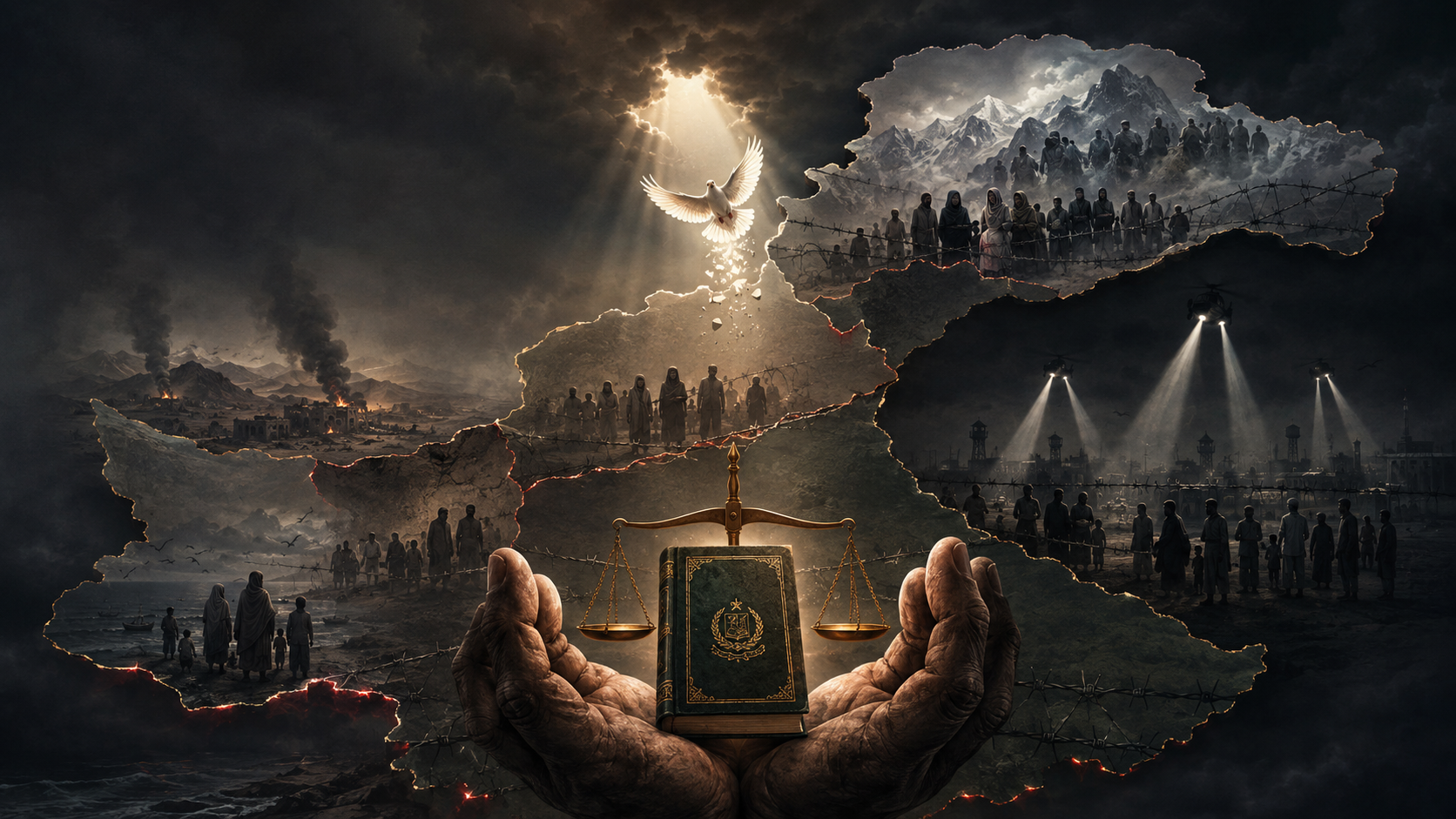
Humanity Is Bleeding Pakistan’s Crisis of Power, Rights and Federation

Humanity Is Bleeding: Pakistan’s Crisis of Power, Rights and Federation

Pakistan is not merely passing through another period of political instability. It is facing a profound crisis of constitutional government, national cohesion and human dignity. From Balochistan to Khyber Pakhtunkhwa, and from Gilgit-Baltistan and Azad Jammu and Kashmir to Sindh and Punjab, citizens increasingly feel that their constitutional rights are conditional—and that the state listens only when people remain silent.

The Human Rights Commission of Pakistan’s latest annual assessment describes a severe contraction of civic space, weakening judicial independence, restrictions on freedom of expression and the growing use of legal and institutional mechanisms against journalists, political workers, activists and lawyers. It also records continuing allegations of enforced disappearances, arbitrary detention, extrajudicial killings and collective punishment. These are not merely partisan accusations; they are warnings from one of Pakistan’s most established independent human-rights organizations. HRCP: State of Human Rights in 2025

A democratic structure without democratic authority

Pakistan still possesses the outward machinery of democracy: a parliament, elections, courts, political parties, commissions and a written constitution. Yet institutions cannot protect democracy when their independence is compromised or when important decisions appear to be made outside the authority of elected representatives.

The term “hybrid government” has consequently become part of Pakistan’s political vocabulary. It describes a system in which a civilian administration formally governs while unelected institutions are widely perceived to exercise decisive influence behind the scenes.

The legitimacy crisis surrounding the February 2024 general election has never been adequately resolved. The United States and European Union raised concerns about restrictions on expression, association and peaceful assembly, the absence of a level playing field and the suspension of mobile services on election day. Pakistan’s government and Election Commission rejected allegations of systematic manipulation, but public distrust cannot be eliminated through official denials alone. It requires transparent investigations, independent courts and verifiable electoral records.

When votes are disputed, opposition leaders are imprisoned, political workers face mass prosecutions, television coverage is controlled and digital speech can lead to criminal charges, democratic government begins to resemble administrative control.

Balochistan: violence cannot resolve political grievances

Balochistan remains the most tragic illustration of the consequences of replacing politics with coercion.

The province has suffered deadly attacks by armed separatist groups, including attacks against civilians and security personnel. Such violence must be condemned without qualification. No political grievance can justify killing passengers, children, labourers or other innocent people.

But terrorism cannot be used as a blanket justification for silencing an entire population. Baloch families have been demanding answers about enforced disappearances for years. Peaceful demonstrators have faced arrests, road blockades, internet shutdowns and anti-terrorism charges. Amnesty International described the 2025 crackdown on Baloch activists as involving arbitrary detention, unlawful force and attacks on peaceful assembly. Amnesty International

The arrest and continued prosecution of peaceful rights advocates send a dangerous message: that constitutional protest offers no meaningful path to justice. When peaceful political space is closed, militant organizations gain an opportunity to present themselves as the only remaining form of resistance.

Balochistan does not need collective punishment. It needs truth about missing persons, lawful investigations, accountable policing, political dialogue, local control over resources and confidence that its citizens are equal members of the federation.

Khyber Pakhtunkhwa: civilians trapped between militancy and militarization

Khyber Pakhtunkhwa has once again become a battlefield between militant organizations and the state. Police officers, soldiers, community elders, children and ordinary residents have all paid a terrible price.

The state has a duty to protect citizens from the Tehreek-e-Taliban Pakistan and other violent groups. However, counterterrorism operations must remain subject to the Constitution and international humanitarian standards. Amnesty International reported that recurrent drone strikes in Khyber Pakhtunkhwa killed at least 17 people, including five children, during the first half of 2025. It called for prompt, independent and transparent investigations into responsibility for civilian deaths. Amnesty International on civilian harm in Khyber Pakhtunkhwa

The people of the former tribal districts have already endured displacement, destroyed livelihoods, militant brutality and repeated military operations. They must not be asked to sacrifice another generation without transparency, compensation, rehabilitation and political participation.

Security cannot be measured only by territory controlled or militants killed. It must also be measured by whether a child can attend school, whether a family can return home and whether civilians can question an operation without being labelled disloyal.

Gilgit-Baltistan, Kashmir and Sindh: grievances must not be allowed to become conflicts

Public anger in Gilgit-Baltistan and Azad Jammu and Kashmir has grown around economic hardship, constitutional uncertainty, political representation, natural resources and the cost of basic necessities. Treating every protest as a security threat risks converting manageable political disputes into lasting alienation.

Sindh also carries deep anxieties concerning enforced disappearances, control over land and water, extraction of resources, demographic pressures and the weakening of provincial autonomy. If unidentified or “hidden” forces are attempting to inflame ethnic divisions, the answer is not greater secrecy. It is transparency, constitutional government and independent investigation.

The state must never allow political engineering, manufactured disorder or selective repression to become instruments for prolonging any government’s tenure. However, claims that particular institutions or foreign powers are deliberately creating unrest require credible, independently verifiable evidence. Such allegations should be investigated rather than repeated as established facts.

What can already be established is that unresolved grievances, institutional interference and excessive force create precisely the environment in which conspiracy, militancy and separatism flourish.

Punjab’s enforced calm

Punjab’s relative calm should not automatically be interpreted as democratic stability. As Pakistan’s most populous and politically decisive province, Punjab has historically been central to the survival of federal governments. The old saying that whoever controls Punjab controls Pakistan continues to carry political meaning.

But peace maintained through arrests, intimidation, media restrictions, political exclusion and fear is not genuine peace. It is enforced silence.

Human Rights Watch reported that Pakistani authorities suppressed dissent during 2025 through restrictions on the media, opposition and civil society. Journalists faced harassment, arrests, disappearances and physical attacks, while hundreds of cases were reportedly registered under the Prevention of Electronic Crimes Act. Human Rights Watch: Pakistan—Events of 2025

Punjab cannot remain politically dominant while being democratically constrained. Nor can the federation remain stable if peace in one province depends on violence or deprivation elsewhere.

International silence and strategic interests

Western governments frequently speak about democracy and human rights, yet their relationships with Pakistan have often been driven by security cooperation, regional strategy, trade and geopolitical convenience.

It would require evidence to claim that Western powers are directing Pakistan’s internal repression. But it is reasonable to question whether their selective criticism—and willingness to continue normal strategic relations—reduces the international cost of authoritarian behaviour.

Foreign governments should apply the same standards to Pakistan that they publicly advocate elsewhere. Security cooperation must not become an excuse for ignoring enforced disappearances, political prisoners, restrictions on the media, military trials of civilians or attacks on peaceful protesters.

Nevertheless, Pakistan’s rulers cannot shift responsibility abroad. The primary duty to protect Pakistan’s people rests with Pakistan’s own government, parliament, judiciary, security institutions and political leadership.

When institutions serve power instead of people

Parliament loses meaning when it merely approves decisions made elsewhere. Courts lose authority when citizens believe justice depends on political alignment. Elections lose credibility when winners appear to be selected after votes are cast. Human-rights institutions lose their purpose when they document violations but cannot protect victims.

Terrorism laws should target terrorists—not peaceful demonstrators, children, journalists or political opponents. Military courts should not replace the ordinary judicial system for civilians. Internet shutdowns should not be used to conceal events or prevent political organization. Enforced disappearance must be treated as a grave crime, whoever commits it and whatever justification is offered.

Pakistan also needs an independent truth-and-accountability process covering enforced disappearances, extrajudicial killings, attacks by militant organizations and civilian casualties during security operations. Victims from every province deserve recognition and remedy without discrimination.

Humanity must come before power

Pakistan cannot be held together indefinitely by force. A federation survives when its people believe that the Constitution protects them equally, their votes carry meaning and their grievances can be heard without fear.

The way forward is neither militancy nor authoritarian control. It is the restoration of constitutional civilian rule, genuinely free elections, judicial independence, freedom of the press, parliamentary oversight of security policy and meaningful dialogue with marginalized regions.

Every murdered civilian, disappeared student, silenced journalist, imprisoned political worker and displaced family represents more than an individual tragedy. Each is evidence of a state moving further away from its constitutional promise.

Pakistan’s greatest threat is not criticism. It is a system that treats criticism as treason, political participation as rebellion and human life as expendable.

Today, humanity is bleeding across Pakistan. Those who benefit from the concentration of power may believe that repression can preserve their rule. History teaches the opposite: force can impose silence for a time, but it cannot manufacture legitimacy, heal a divided federation or extinguish the demand for justice.

No person, party or institution is greater than Pakistan—and no vision of Pakistan is worth defending if humanity must be sacrificed to sustain it.

Dispute of Hydroelectric between AJK and Pakistan

Dispute of Hydroelectric between AJK and Pakistan

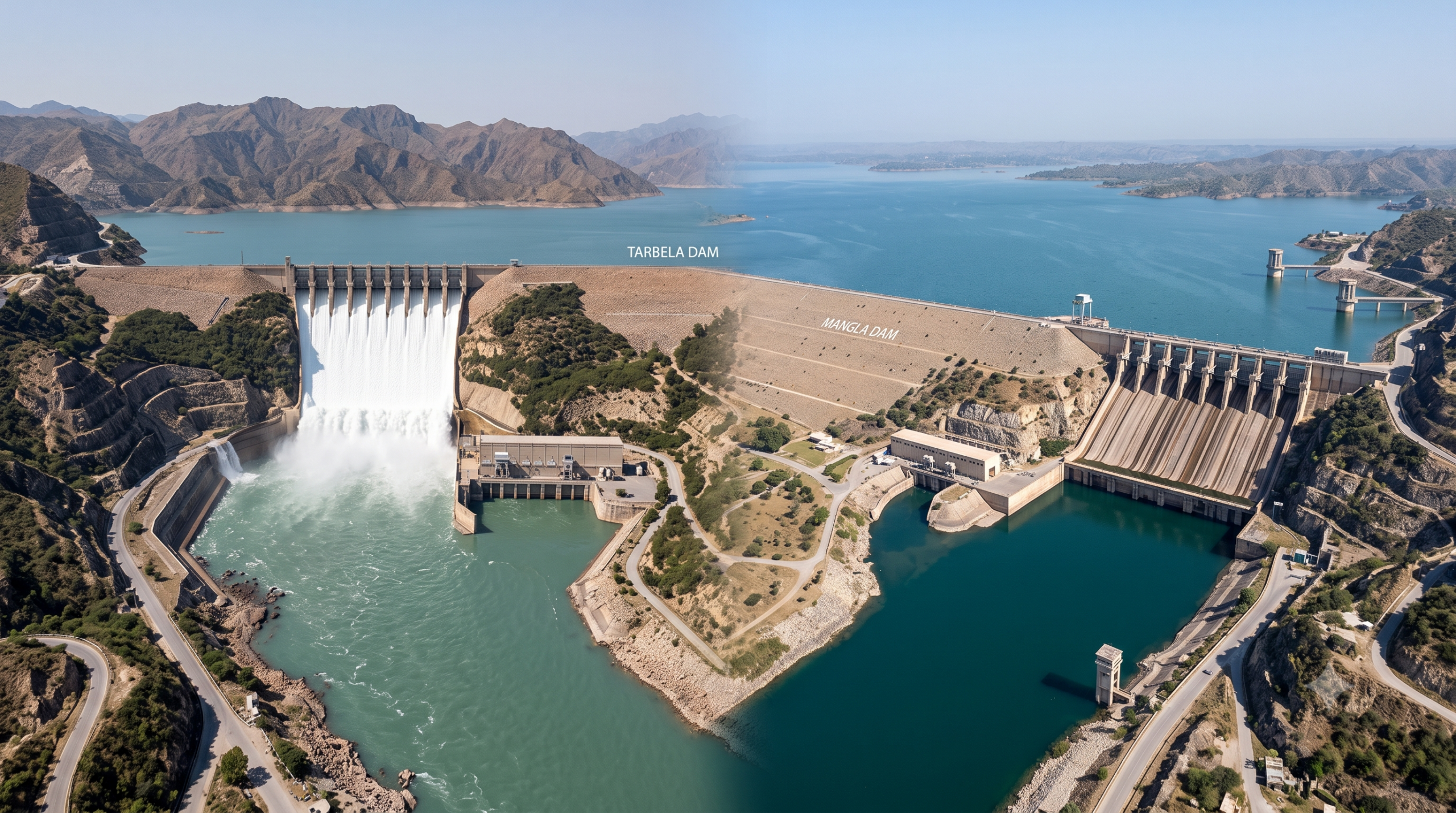
The ongoing civil unrest in Pakistan-administered Azad Jammu and Kashmir (AJK) stems fundamentally from a deep-rooted sense of economic and structural exploitation. At the very center of this grievance stands the Mangla Dam. As the world’s seventh-largest dam, situated in AJK’s Mirpur district, it embodies the stark disconnect between local resource contribution and regional economic deprivation.

The core of the dispute can be broken down into clear historical, financial, and environmental dimensions.

1. The Core Paradox: High Costs vs. Cheap Generation

The fundamental grievance of the Jammu and Kashmir Joint Awami Action Committee (JKJAAC) and the general public rests on a striking mathematical asymmetry regarding energy pricing:

  • The Generation Cost: Hydroelectric power from the Mangla Dam is incredibly cheap to produce. Clean water-driven generation at the source costs approximately Rs. 2 per kilowatt-hour (kWh).
  • The Consumer Cost: Despite living adjacent to the source of this cheap energy, residents of AJK were being charged over Rs. 30 per unit by mid-2023—a price packed with heavy federal taxes, fuel price adjustments (tied to expensive imported coal and thermal plants in mainland Pakistan), and distribution surcharges.

While the federal government issued a temporary emergency subsidy package in mid-2024 dropping local household tariffs down to Rs. 3 for the baseline slab, the movement demands a permanent structural framework rather than temporary fiscal handouts. They argue that as a matter of fundamental resource right, their billing should be tethered to the actual localized cost of generation.

2. The Net Hydel Profit (NHP) and Royalty Disparity

Under Article 161(2) of the Constitution of Pakistan, provinces that generate hydroelectricity—most notably Khyber Pakhtunkhwa (KPK) and Punjab—are legally entitled to a lucrative financial mechanism known as Net Hydel Profit (NHP). This is a cost-plus formula that returns substantial revenue to the generating territory based on bulk electricity supplied to the national grid.

Because AJK holds a ambiguous, semi-autonomous constitutional status and is not officially a province of Pakistan, Islamabad has historically denied it equal NHP status. Instead, AJK is paid a vastly lower, fixed rate called a Water Use Charge (WUC), which sat at a meager Rs. 0.15 per kWh for decades.

Locals view this structural exclusion as institutionalized revenue theft, pointing out that AJK injects roughly 3,500 Megawatts of cheap, green capacity into the Pakistani national grid, yet receives only a fraction of the financial windfall granted to regular provinces.

3. The Generational Trauma of Displacement

The push for cheap electricity is also driven by deep emotional and historical trauma. The construction and subsequent expansion of the Mangla Dam forced massive local sacrifices:

  • The Initial Displacement (1967): The original construction inundated over 118 villages and displaced more than 100,000 native Kashmiris. Entire ancestral lands and the old city of Mirpur were permanently submerged to provide water security and power to Pakistan’s industrial hubs.
  • The Dam Raising Project (2004–present): A massive project to raise the dam’s height by 40 feet to combat siltation submerged an additional 15,780 acres. Decades later, a significant portion of the agreed-upon multi-billion rupee compensation and resettlement package remains gridlocked within the federal Ministry of Finance, triggering formal warnings from the Ministry of Defence regarding internal security risks.

4. Severe Infrastructure Ironies

While the water from the Jhelum River spins turbines that illuminate factories in Punjab and Sindh, the people of AJK face intense daily infrastructure failures. The region experiences prolonged rolling blackouts (load-shedding) lasting up to 10 hours a day, alongside severe local water scarcity in the very districts that border the massive reservoir.

For the protest movement, demanding electricity at production cost is not a request for charity. It is viewed as an inherent right of resource ownership—a logical compensation for the absolute sacrifice of their land, the environmental alteration of their rivers, and the historical displacement of their families.

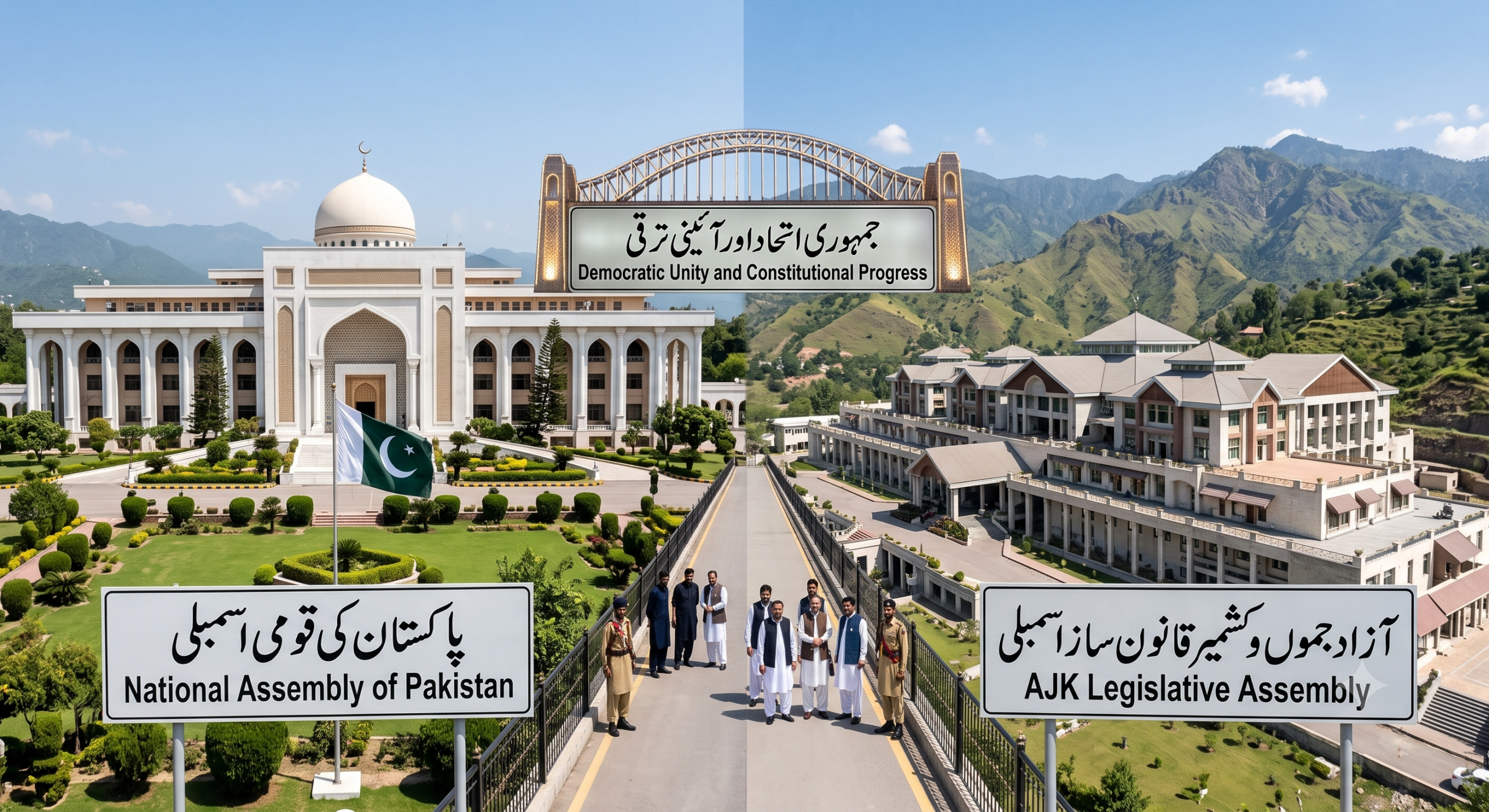
Kash! Pakistan and AJK merge like the photo

Dispute of 12 Refugees seats

Pakistan & Kashmir two brothe: Dispute of 12 Refugees seats, Are We!

Kash! above photo become real!

The dispute over the 12 reserved refugee seats in the Azad Jammu and Kashmir (AJK) Legislative Assembly is a flashpoint of the current political crisis. To understand why these seats are such a deeply guarded, unyielding fixture of the regional government, one has to examine both their mid-century origins and how they are woven into the legal fabric of the state.

1. The Historical Origins: 1947 to 1974

The system of reserved refugee seats traces its roots directly to the partition of the subcontinent and the first Kashmir war.

  • The Waves of Displacement: Between 1947 and 1965, hundreds of thousands of people fled from Indian-administered areas of Jammu and Kashmir into mainland Pakistan (primarily settling across provinces like Punjab). Under regional law, these displaced populations and their descendants retained their status as “State Subjects” natives of Jammu and Kashmir under the historical 1927 definition established by the Dogra dynasty.
  • Evolution of Representation: To give these displaced populations a political voice while they lived outside the geographic borders of AJK, early electoral frameworks were experimented with in 1960 and 1964. By 1970, when a presidential system based on adult franchise was introduced, refugees living in Pakistan were formally granted the right to vote for representatives in the regional assembly.
  • The 1974 Codification: The system was permanently solidified into law via Article 22 of the AJK Interim Constitution Act of 1974. The seats were strictly split down the middle: six seats allocated for refugees originating from the Kashmir Valley, and six seats for those originating from Jammu. Because the voters are scattered across mainland Pakistan, voting for these 12 seats takes place outside AJK’s geographical territory.

2. Why They Are Constitutionally Protected

The reason these seats cannot simply be dissolved by a prime minister or an executive order lies in the unique, dual nature of the AJK Constitution and a recent landmark judicial ruling.

The Doctrine of “Personal Jurisdiction”

While the AJK government only exercises territorial jurisdiction over the physical land of Azad Kashmir, its constitution explicitly maintains personal jurisdiction over all Kashmiris defined as State Subjects. The constitution views the local resident population and the displaced refugee population as legally equal. Therefore, representation is treated as an indivisible, fundamental right of the Kashmiri people, regardless of which side of the Line of Control (LoC) or provincial border they reside on.

The Geopolitical Symbolism

From Pakistan’s perspective on the wider Kashmir conflict, abolishing these seats would be a major diplomatic setback. Keeping the seats intact serves as a continuous, symbolic legal statement to the United Nations and the international community that the territory remains disputed, its population is temporarily displaced, and the final status of the entire 1947 borders of Jammu and Kashmir is yet to be decided.

The 2026 Supreme Court Ruling

In June 2026, amid intense street pressure from the Jammu and Kashmir Joint Awami Action Committee (JKJAAC) to abolish the seats ahead of regional elections, the Supreme Court of AJK issued a decisive 32-page advisory opinion.

The high court ruled that:

  • The 12 refugee seats are firmly entrenched structural features of the state’s polity.
  • They cannot be altered, abridged, or abolished via executive fiat or administrative orders.
  • Any change to this seat allocation requires a formal, two-thirds constitutional amendment under Article 33 passed directly by the Legislative Assembly.

Because mainstream Pakistani political parties heavily rely on these 12 seats to build coalitions and form the regional government in Muzaffarabad, obtaining the legislative majority required to pass such an amendment remains virtually impossible. This creates a deep constitutional deadlock between the legal protections upheld by the courts and the democratic demands of the protesters on the ground.

The Escalating Crisis in Pakistan-Administered Kashmir

From Bread Subsidies to the “Terror” Tag: The Escalating Crisis in Pakistan-Administered Kashmir

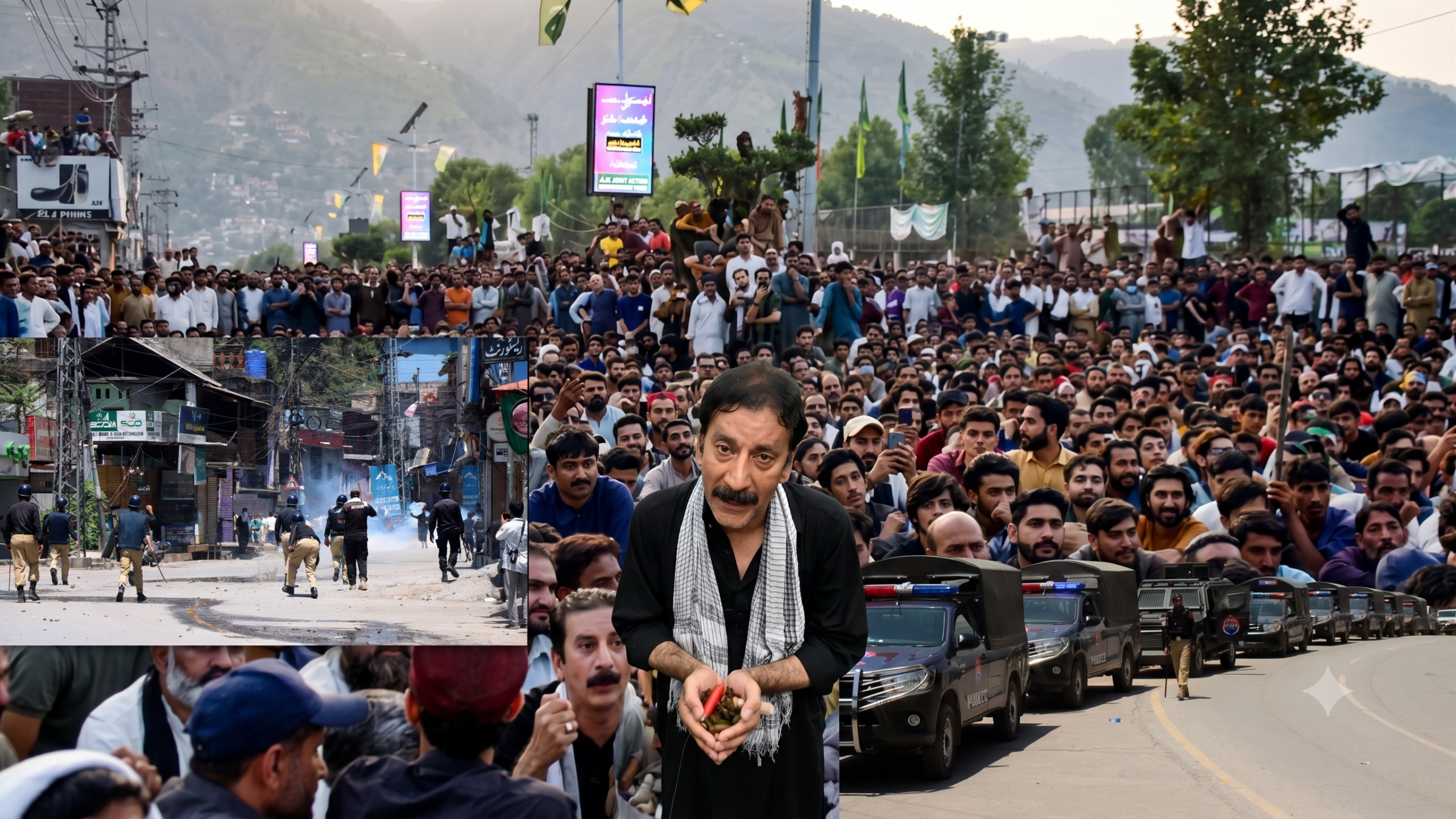
Over the past three weeks, Pakistan-administered Azad Jammu and Kashmir (AJK) has been consumed by a severe wave of civil unrest, resulting in a deadly state crackdown, internet blackouts, mass arbitrary arrests, and a highly controversial counter-terrorism designation aimed at a civilian rights movement.

What began over a year ago as a localized economic grievance regarding the soaring costs of flour and electricity has transformed into a profound political and human rights crisis.

The Trigger: Electoral Seats and Economic Strain

he underlying friction in the region dates back to mid-2023, when the Jammu and Kashmir Joint Awami Action Committee (JKJAAC) a broad-based, grassroots coalition of traders, lawyers, and civil society members began mobilizing mass demonstrations. The initial rallying cries were grounded in severe socioeconomic distress: demands for subsidized wheat flour, the elimination of lavish perks enjoyed by local bureaucrats, and electricity provision at the actual cost of production.

While the regional administration conceded to some economic demands following a massive “long march” toward Muzaffarabad in May 2024, deep-seated political tensions boiled over in early June 2026.

The immediate catalyst for the current phase of unrest is a fierce constitutional battle regarding the upcoming regional elections. The JKJAAC has demanded the abolition of 12 seats in the 45-member Azad Jammu and Kashmir Legislative Assembly that are strictly reserved for refugees who migrated from Indian-administered Kashmir decades ago and currently reside in other provinces of Pakistan.

The protest movement argues that these reserved seats allow non-residents to wield disproportionate influence over the political affairs and governance of AJK. However, on June 7, 2026, the Supreme Court of Azad Jammu and Kashmir ruled that these seats are constitutionally protected and cannot be altered without a formal constitutional amendment.

The judicial validation of the seat allocation immediately re-ignited mass public demonstrations.

The State Backlash: Human Rights Under Siege

In response to the resurgent, largely peaceful democratic demonstrations, the state apparatus deployed a severe security apparatus that human rights watchdogs warn has crossed dangerous red lines.

On June 5, 2026, the regional home department formally designated the JKJAAC as a “proscribed organization” under the Azad Jammu and Kashmir Anti-Terrorism Act. By branding a grassroots civil liberties coalition as a terrorist entity, authorities unlocked vast executive powers to suppress the dissent.

Amnesty International and local human rights groups have strongly condemned this designation, warning that utilizing anti-terror legislation against civil rights advocates marks a dangerous escalation intended to justify the use of lethal force and arbitrary detention.

Key Human Rights Concerns in AJK (June 2026)

  • Abuse of Anti-Terror Laws (JKJAAC proscription)
  • Mass Arbitrary Arrests & Sedition Charges
  • Documented Fatalities (At least 11–20 deaths during recent clashes)
  • Digital Clampdown (Complete mobile internet blackouts)

The human rights fallout over the past three weeks has been severe:

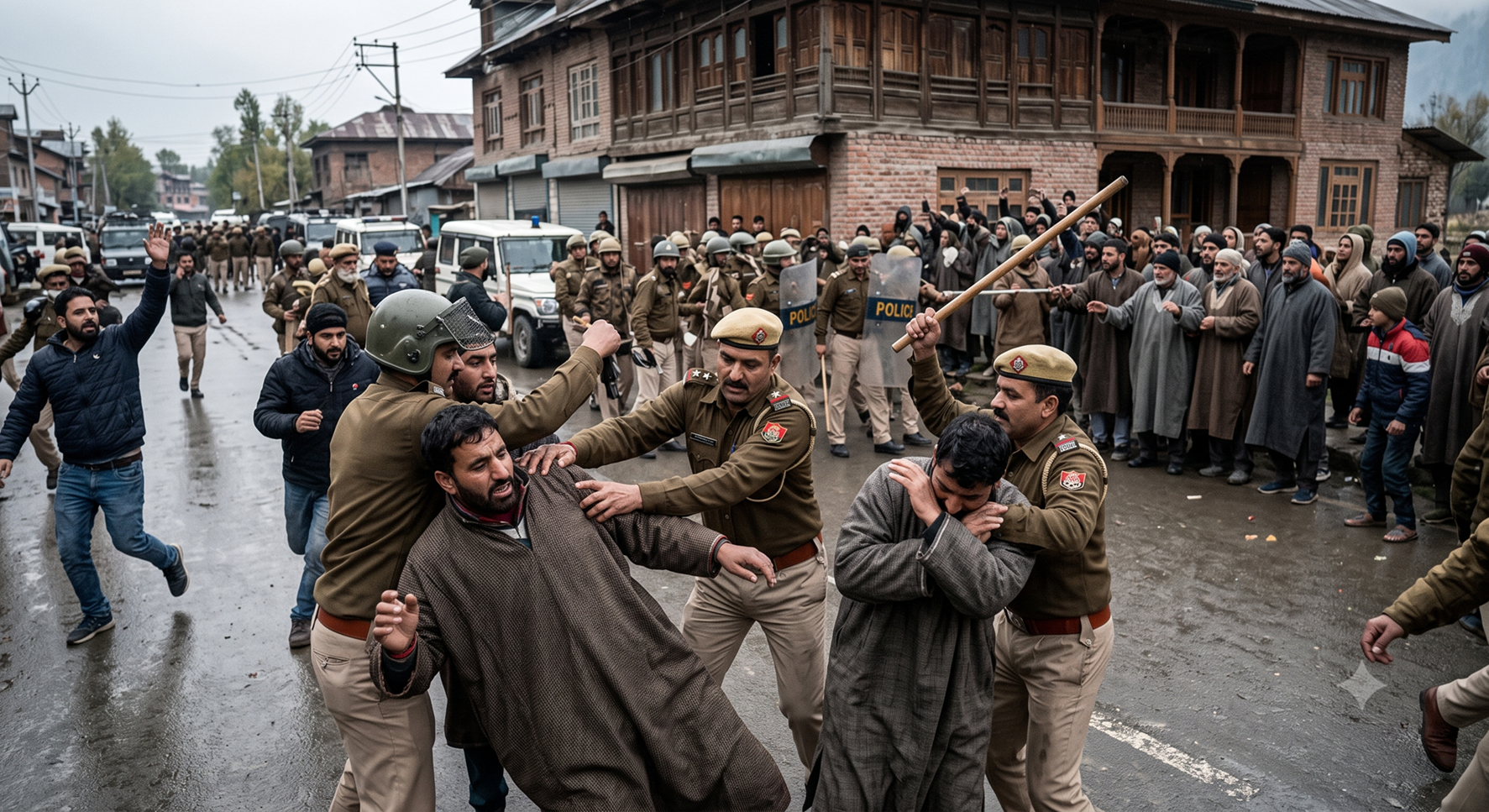
  • Excessive and Lethal Use of Force: Clashes erupted in Rawalakot, Kotli, and Mirpur between demonstrators and heavily deployed federal paramilitary forces. Official estimates confirm that at least 11 individuals—including both civil protesters and security personnel—were killed in the first week of June alone, with some independent human rights trackers pushing the total casualty count closer to 20 dead and over 70 injured.
  • Arbitrary Detentions and Sedition Charges: Dozens of activists and political coordinators have been swept into custody. The crackdown culminated in a high-profile raid resulting in the arrest of prominent JKJAAC leader Shaukat Nawaz Mir on sedition charges, following the state offering a 10 million rupee bounty for his capture.
  • Information Blackouts: To prevent the coordination of rallies and to obstruct the documentation of state violence, authorities instituted severe regional internet and mobile data blackouts. This digital isolation has shielded law enforcement actions from international oversight and heavily disrupted independent local journalism.

The Underlying Crisis of Regional Autonomy

The violence of the past few weeks is a structural symptom of a much deeper, long-standing systemic crisis concerning governance, resource distribution, and regional autonomy.

A central point of local resentment centers around electricity. Residents argue that AJK produces substantial hydroelectric power for the national grid via major installations like the Mangla Dam, yet locals endure up to 10 hours of daily rolling blackouts while being forced to pay highly taxed, inflated electricity bills.

Furthermore, the overarching political structures—such as the Azad Jammu and Kashmir Council, which is chaired directly by the Prime Minister of Pakistan and populated heavily by unelected federal officials—leave local populations feeling fundamentally disenfranchised.

By treating local economic survival and demands for political accountability as security threats and acts of terrorism, the state has closed off the traditional avenues of democratic negotiation. As the region heads toward a highly contentious election cycle under the shadow of a militarized crackdown, the gulf between the local populace and the state apparatus continues to widen.

Mainly Two Issues:

  1. Dispute of 12 Refugees seats and
  2. Dispute of Hydroelectric between AJK and Pakistan

Read about these two issues in next article. And also watch two videos shared just before this article on main Stream