


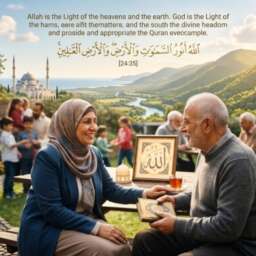




In the light of Quranic education, humanity (Al-Insaaniyyah) is viewed as a noble, purposeful, and interconnected creation. The Quran outlines a comprehensive framework for the status, role, and ethical responsibilities of human beings.
Here is a breakdown of humanity according to Quranic teachings:
1. Divinely Honored and Dignified
The Quran explicitly states that every human being possesses inherent dignity, regardless of race, gender, wealth, or social status.
- The Verse: “And We have certainly honored the children of Adam…” (Quran 17:70).
- The Meaning: Dignity is a birthright given by God, not a privilege granted by society.
2. Trustees and Stewards of the Earth
Humanity is not left on Earth without a purpose. Humans are designated as Khalifah (vicegerents or trustees) to build, preserve, and care for the world.
- The Verse: “Indeed, I will make upon the earth a successive authority [khalifah].” (Quran 2:30).
- The Meaning: Humans carry the moral responsibility to practice justice, protect nature, and foster peace.
3. Born with a Pure Innate Nature
Quranic education teaches that humans are born with Fitrah—an innate, pure disposition aligned with goodness, truth, and monotheism.
- The Verse: “The natural disposition [fitrah] of Allah upon which He has created [all] people…” (Quran 30:30).
- The Meaning: Evil or corruption is not an inherent human condition; it is a learned deviation from this natural purity.
4. Part of a Single, Diverse Family
The Quran emphasizes universal brotherhood. Diversity in language, color, and nationality is designed for mutual understanding, not for division or superiority.
- The Verse: “O mankind, indeed We have created you from male and female and made you peoples and tribes that you may know one another…” (Quran 49:13).
- The Meaning: True superiority is judged solely by righteousness (Taqwa) and moral character, not by external traits.
5. Accountable and Bound by Justice
Humanity is endowed with free will and intellect (Aql). Because humans can choose between right and wrong, they are fully accountable for their actions.
- The Verse: “So whoever does an atom’s weight of good will see it, and whoever does an atom’s weight of evil will see it.” (Quran 99:7-8).
- The Meaning: Quranic education places a heavy emphasis on absolute justice, compassion, and treating all living things with mercy.
The concept of social justice and human rights in Islam.
The discourse surrounding human rights and social justice is often framed as a modern Western achievement, crystallizing in milestones like the Magna Carta or the 1948 Universal Declaration of Human Rights (UDHR). However, within the Islamic tradition, these principles were codified in the 7th century CE, rooted not in a human socio-political struggle, but in divine revelation (Wahi) (Ehaf, 1998; Saeed, 2013).
In Islam, social justice (‘Adl) and human rights (Huquq al-‘Ibad) are structurally interdependent concepts derived from the twin pillars of Islamic epistemology: the Holy Qur’an and the Sunnah (the prophetic tradition). Rather than treating rights as standalone entitlements claimed against the state, the Islamic paradigm approaches human rights through a sophisticated, communitarian lens of mutual obligations and individual duties (Ghauri, 2010; Morgan-Foster, 2002).
The Theocentric Foundation of Human Dignity
The foundational baseline for human rights in Islam is the concept of Karamah—the inherent dignity bestowed by God upon all human beings, irrespective of race, social class, gender, or creed (Ghauri, 2010; Saeed, 2013). As expressed in the Qur’an:
“And We have certainly honored the children of Adam…” (Surah Al-Isra, 17:70)
Because God is the sole creator and absolute sovereign (Tawhid), rights are granted as a divine trust (Amanah). Consequently, no worldly ruler, government, or legislative body has the authority to abrogate or curtail these rights arbitrarily (A’la Maududi, 1976; Robina et al., 2020). If an authority systematically violates these rights, Islamic law explicitly commands the defense of the oppressed and the rectification of injustice (al-Sheha, 2000).
Core Components of Islamic Social Justice
Social justice in Islam is not merely an ethical ideal; it is a legal imperative enforced through institutional frameworks.
1. Absolute Equality and the Eradication of Elitism
Islam fundamentally rejects tribal, racial, and socio-economic aristocracy. This was most explicitly articulated during the Prophet Muhammad’s Last Sermon (Khutbat al-Wada) in 10 AH / 632 CE, which serves as the foundational charter of human rights in Islam (Robina et al., 2020; Saeed, 2013). The Prophet declared that an Arab holds no superiority over a non-Arab, nor a white person over a black person, except through piety (Taqwa) and righteous actions (al-Sheha, 2000; Ghauri, 2010).
2. Legal and Judicial Justice (‘Adl)
The concept of ‘Adl requires absolute impartiality under the law. The Qur’an instructs believers to stand firmly for justice, even if it goes against themselves, their parents, or their kin (Surah An-Nisa, 4:135). Furthermore, personal animosity must never compromise judicial integrity:
“Do not let your hatred of a people incite you to aggression [or injustice].” (Surah Al-Ma’idah, 5:2; A’la Maududi, 1976)
3. Economic Equity and Distributive Justice
Islamic social justice heavily emphasizes economic rights, introducing structured mechanisms to prevent the hazardous concentration of wealth among the elite. Chief among these is Zakat (mandatory alms), which functions not as voluntary charity, but as a formal economic right (Haq) belonging to the poor and disenfranchised, drawn directly from the surplus assets of the wealthy (A’la Maududi, 1976; al-Sheha, 2000).
Rights vs. Duties: The Intertwined Paradigm
A major point of divergence between Western liberal human rights theories and the Islamic framework lies in the relationship between rights and duties.
| Feature | Western Secular Paradigm | Islamic Legal Paradigm |
| Primary Source | Human reason, social contracts, empirical struggle | Divine revelation (Qur’an and Sunnah) |
| Core Orientation | Individual rights-first; duties are often secondary or implicit | Duty-centric; an individual’s duty forms another’s right |
| Enforceability | Secular legal institutions and state apparatus | Legal accountability paired with accountability in the Hereafter |
In the conventional Western framework, rights are explicit, while corresponding duties are frequently poorly theorized or implicit (Morgan-Foster, 2002). Conversely, Islamic law constructs a reciprocal network of responsibilities: the responsibility of one individual is structurally the right of their fellow human being (Ghauri, 2010).
For example, the right to life and safety is guaranteed because taking an innocent life is legally and spiritually equated to killing all of humanity (Surah Al-Ma’idah, 5:32; A’la Maududi, 1976). Similarly, the right to a basic standard of living, religious freedom, and the protection of personal honor are operationalized through strict religious duties imposed on the community and the state (A’la Maududi, 1976; Ehaf, 1998). Because these rights are bound to individual accountability before God, compliance is driven by an internal spiritual conscience alongside external legal enforcement (Ghauri, 2010; Saeed, 2013).
Conclusion
The Islamic conception of social justice and human rights offers a comprehensive blueprint that harmonizes individual freedom with collective societal well-being. By anchoring human dignity in a theocentric framework, Islam elevates human rights from shifting political compromises to permanent, inviolable realities. While modern practices in various regions may sometimes diverge from these classical legal ideals due to political regressions or cultural patriarchal overlays (Moosa, 1998), the foundational texts of Islam continue to provide a sophisticated, duty-grounded ethos capable of addressing modern global challenges in human rights and sustainable development.
References
- A’la Maududi, S. A. (1976). Human Rights in Islam. Muslim Library.
- Ehaf, A. R. (1998). Islam and Human Rights. Journal of Islamic Studies, 12(2), 101–118.
- Ghauri, M. T. (2010). An Analytical Study of Islamic Concept of Human Rights. The Dialogue, 5(4), 314–328.
- Moosa, N. (1998). Human Rights in Islam. South African Journal on Human Rights, 14(4), 508–524. https://doi.org/10.1080/02587203.1998.11834991
- Morgan-Foster, J. (2002). Third Generation Rights: What Islamic Law Can Teach the International Human Rights Movement. Yale Human Rights and Development Law Journal, 5(1), 65–116.
- Cited by: 105
- Robina, M., Shah, A. A., & Abbas, Z. (2020). Human Rights in Islamic Sustainable Development. Current Research Journal of Social Sciences and Humanities, 2(2), 123–131. https://doi.org/10.12944/crjssh.2.2.08
- Cited by: 5
- Saeed, R. A. (2013). Human rights in Islam and the West—(The Last Sermon of the Prophet and UDHR). Jihat-ul-Islam, 6(2), 1–22.
- Cited by: 10
- al-Sheha, A. R. (2000). Human Rights in Islam And Common Misconceptions. University of Minnesota Human Rights Library.



Get involved!
Comments