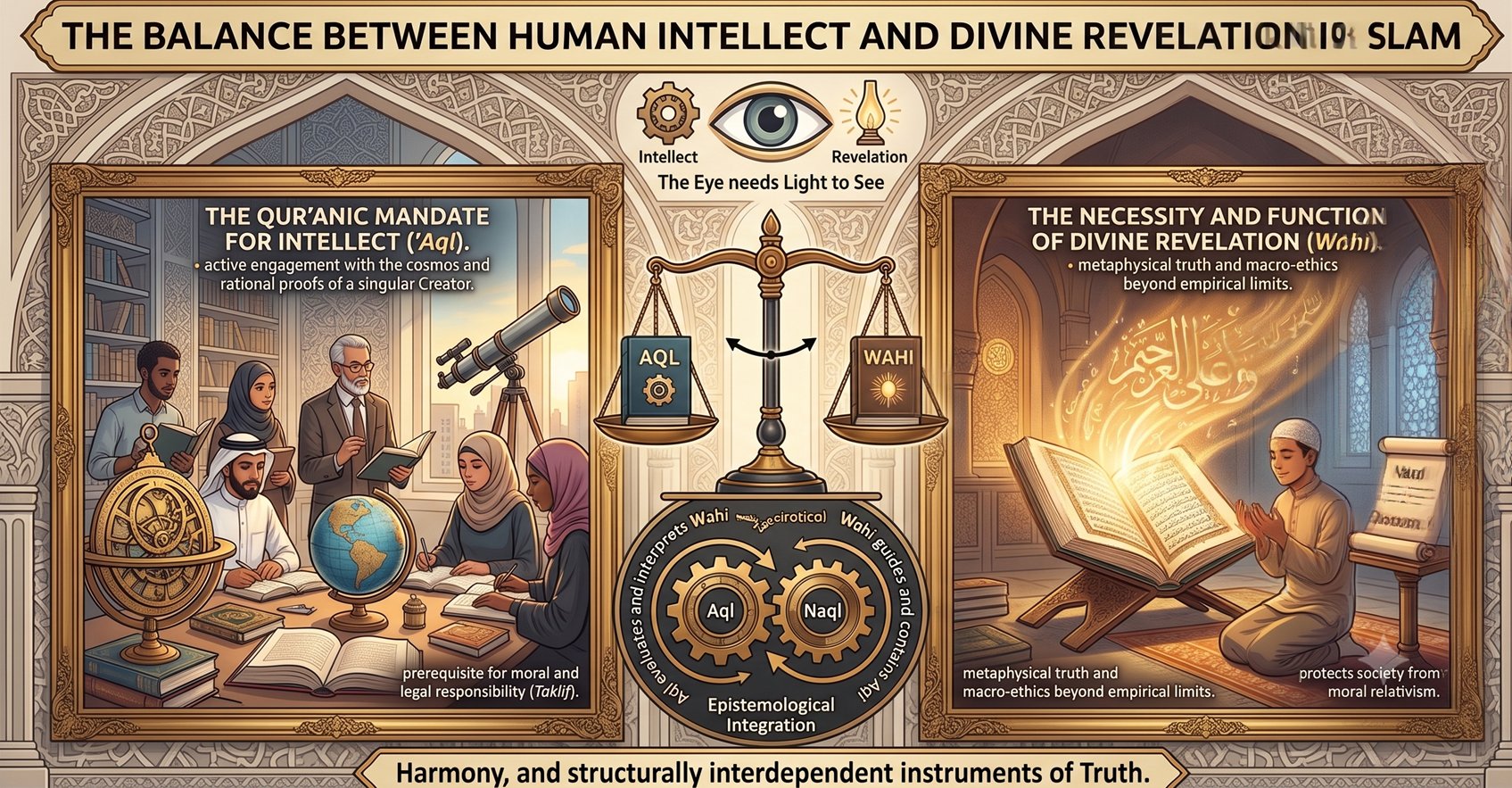
La relation entre l'intellect humain () et la révélation divine () est l'un des discours les plus dynamiques et durables de l'épistémologie islamique. Contrairement aux traditions philosophiques qui considèrent la raison et la révélation comme intrinsèquement adverses — où l'une doit être compromise pour accommoder l'autre — le paradigme islamique classique les postule comme des instruments de vérité complémentaires, harmonieux et structurellement interdépendants (Al-Attas, 1993 ; Ibn Rushd, 1179).
Dans l'Islam, l'intellect et la révélation sont métaphoriquement décrits comme l'œil et la lumière. L'intellect est l'œil, possédant la capacité interne de voir, tandis que la révélation est la lumière externe. Sans lumière, l'œil le plus sain reste dans l'obscurité ; sans l'œil, la lumière ne peut être perçue ou utilisée.
Le mandat coranique pour l'intellect (")
Le Saint Coran ne tolère pas simplement l'intellect humain ; il exige son engagement actif. Le mot racine pour intellect, ‘aqala (raisonner, comprendre ou intellect), apparaît 49 fois dans le Coran, réprimandant constamment ceux qui ne parviennent pas à exercer leurs facultés rationnelles (Saeed, 2006).
Le texte fait fréquemment appel à l'observation humaine, exhortant les individus à regarder le cosmos, les systèmes biologiques et les cycles historiques comme des preuves rationnelles d'un Créateur unique ().
« En vérité, dans la création des cieux et de la terre, et dans l'alternance de la nuit et du jour, il y a des signes pour ceux qui sont doués d'intelligence. » (Sourate Ali 'Imran, 3:190)
Le droit islamique (Shari’ah) positionne la santé mentale rationnelle comme un prérequis strict pour la responsabilité morale et légale (Taklif). Un individu qui manque de capacité rationnelle en raison d'une maladie mentale, d'une immaturité ou d'une déficience est légalement exempté de responsabilité, soulignant que la révélation s'adresse exclusivement à l'intellect (Al-Ghazali, 1109).
La nécessité et la fonction de la révélation divine (")
Bien que l'intellect soit très élevé, l'épistémologie islamique reconnaît ses limites inhérentes et structurelles. La raison humaine est limitée par l'observation empirique, les contraintes temporelles et spatiales, et les biais culturels subjectifs (Al-Attas, 1993). Elle peut déduire qu'un Créateur Suprême existe, mais elle ne peut pas déterminer indépendamment :
- Les Attributs Divins : Qui est Dieu au-delà de la nécessité logique de base.
- Le Royaume Métaphysique (Al-Ghayb) : Les réalités de l'âme, de l'au-delà et les vérités métaphysiques ultimes.
- Axiomes Moraux Objectifs : Des normes parfaites de justice absolue, de culte rituel et de cadres éthiques qui restent à l'abri des intérêts humains changeants.
C'est là que le Wahi devient nécessaire. La révélation fournit la base définitive et immuable de la vérité métaphysique et de la macro-éthique. Elle protège la société humaine de l'instabilité du relativisme moral, garantissant que les droits humains fondamentaux et les obligations spirituelles restent absolus, plutôt que soumis au consensus changeant des négociations socio-politiques humaines (Ibn Taymiyyah, 1320).
Intégration épistémologique : Aql et Naql
L'âge d'or de la recherche islamique a produit une synthèse très sophistiquée entre Aql (Raison) et Naql (Révélation transmise). Des penseurs comme Ibn Rushd (Averroès) et plus tard Ibn Taymiyyah ont consacré des œuvres monumentales à prouver qu'un intellect sain et incorrompu ne peut jamais contredire un texte authentique et explicitement transmis.
Le cadre analytique :
- Rôle de l'intellect avant la Révélation : L'intellect est responsable de l'analyse et de la vérification des affirmations de vérité d'un prophète. Il évalue les preuves historiques, les miracles linguistiques et la cohérence logique pour conclure qu'une révélation provient véritablement de Dieu (Al-Ghazali, 1109).
- Rôle de l'intellect après la Révélation : Une fois que l'intellect reconnaît le texte comme divin, sa fonction principale passe de la validation à l'interprétation (Ijtihad). L'intellect est déployé pour extraire des décisions juridiques, analogiser de nouveaux scénarios (Qiyas) et opérationnaliser les objectifs universels de la loi (Maqasid al-Shari’ah) pour relever les défis modernes (Hallaq, 2009).
- Les garde-fous : Si l'intellect parvient à une conclusion qui s'oppose directement à un texte définitif et explicite (Nass), les savants classiques soutiennent que soit la déduction rationnelle est erronée en raison de données incomplètes, soit l'interprétation textuelle est mal comprise. L'intellect est censé céder à la sagesse divine dans les matières qui transcendent la capacité empirique humaine (Ibn Taymiyyah, 1320).
Conclusion
Dans le paradigme islamique, la tension entre le rationalisme séculier et le fidéisme aveugle (le rejet de la raison au profit de la foi) est entièrement contournée. La révélation n'enchaîne pas l'esprit ; elle fournit le système de coordonnées qui empêche l'esprit de sombrer dans le nihilisme existentiel ou le chaos moral. En équilibrant Aql et Wahi, l'Islam crée un modèle civilisationnel où la poursuite scientifique et rationnelle est considérée comme une forme d'adoration, et l'adhésion religieuse est traitée comme un acte profondément rationnel.
Références
- Al-Attas, S. M. N. (1993). Islam and Secularism. International Institute of Islamic Thought and Civilization (ISTAC).
- Al-Ghazali, Abu Hamid (1109). Al-Mustasfa min ‘Ilm al-Usul [La boîte à outils clarifiée de la théorie juridique].
- Hallaq, W. B. (2009). An Introduction to Islamic Law. Cambridge University Press.
- Ibn Rushd (Averroès) (1179). Fasl al-Maqal fi ma bayn al-Shari’ah wa al-Hikmah min al-Ittisal [Le traité décisif sur le lien entre la loi islamique et la sagesse].
- Ibn Taymiyyah, Ahmad (1320). Dar’ Ta’arud al-‘Aql wa al-Naql [Le rejet du conflit entre la raison et la révélation].
- Saeed, A. (2006). Interpreting the Qur’an: Towards a Contemporary Approach. Routledge.