The balance between human intellect and divine revelation in Islam

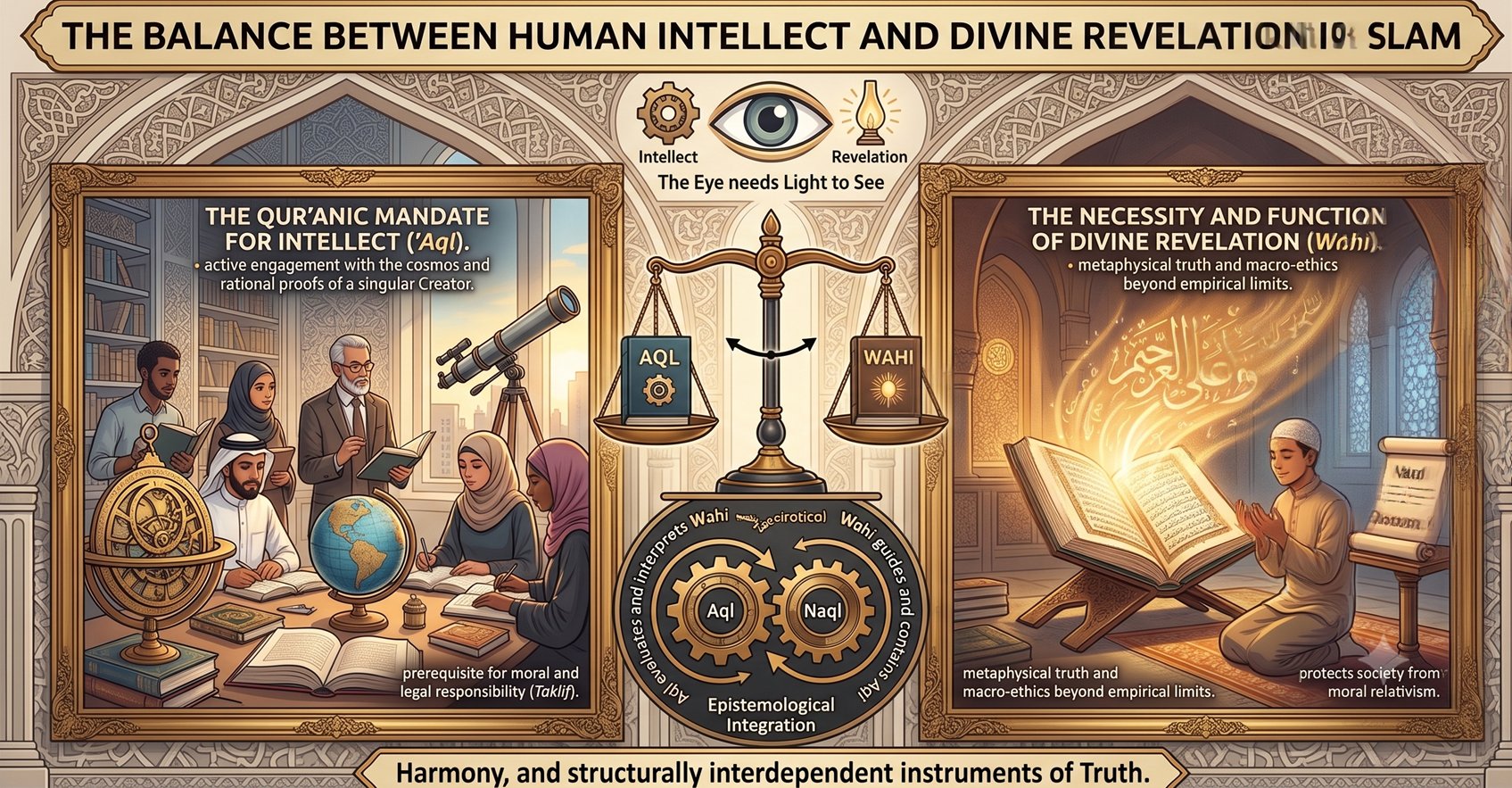
The relationship between human intellect () and divine revelation () is one of the most dynamic and enduring discourses in Islamic epistemology. Unlike philosophical traditions that view reason and revelation as inherently adversarial—where one must be compromised to accommodate the other—the classical Islamic paradigm posits them as complementary, harmonious, and structurally interdependent instruments of truth (Al-Attas, 1993; Ibn Rushd, 1179).

In Islam, intellect and revelation are metaphorically described as the eye and light. The intellect is the eye, possessing the internal capacity to see, while revelation is the external light. Without light, the healthiest eye remains in darkness; without the eye, light cannot be perceived or utilized.

The Qur’anic Mandate for Intellect ()

The Holy Qur’an does not merely tolerate human intellect; it demands its active engagement. The root word for intellect, ‘aqala (to reason, intellect, or understand), occurs 49 times in the Qur’an, consistently rebuking those who fail to exercise their rational faculties (Saeed, 2006).

The text frequently appeals to human observation, urging individuals to look at the cosmos, biological systems, and historical cycles as rational proofs of a singular Creator ().

“Indeed, in the creation of the heavens and the earth and the alternation of the night and the day are signs for those of understanding.” (Surah Ali ‘Imran, 3:190)

Islamic law (Shari’ah) positions rational sanity as a strict prerequisite for moral and legal responsibility (Taklif). An individual who lacks rational capacity due to mental illness, immaturity, or impairment is legally exempt from accountability, highlighting that revelation addresses itself exclusively to the intellect (Al-Ghazali, 1109).

The Necessity and Function of Divine Revelation ()

While the intellect is highly elevated, Islamic epistemology recognizes its inherent, structural limitations. Human reason is bound by empirical observation, temporal and spatial constraints, and subjective cultural biases (Al-Attas, 1993). It can deduce that a Supreme Creator exists, but it cannot independently determine:

  1. The Divine Attributes: Who God is beyond basic logical necessity.
  2. The Metaphysical Realm (Al-Ghayb): The realities of the soul, the afterlife, and ultimate metaphysical truths.
  3. Objective Moral Axioms: Perfect standards of absolute justice, ritual worship, and ethical frameworks that remain immune to shifting human self-interest.

This is where Wahi becomes necessary. Revelation provides the definitive, unalterable baseline of metaphysical truth and macro-ethics. It protects human society from the instability of moral relativism, ensuring that foundational human rights and spiritual obligations remain absolute, rather than subject to the shifting consensus of human socio-political bargaining (Ibn Taymiyyah, 1320).

Epistemological Integration: Aql and Naql

The golden age of Islamic scholarship produced a highly sophisticated synthesis between Aql (Reason) and Naql (Transmitted Revelation). Thinkers like Ibn Rushd (Averroes) and later Ibn Taymiyyah dedicated monumental works to proving that sound, uncorrupted intellect can never contradict authentic, explicitly transmitted text.

The Analytical Framework:

  • Intellect’s Role Before Revelation: The intellect is responsible for analyzing and verifying the truth-claims of a prophet. It evaluates historical evidence, linguistic miracles, and logical consistency to conclude that a revelation is genuinely from God (Al-Ghazali, 1109).
  • Intellect’s Role After Revelation: Once the intellect recognizes the text as divine, its primary function shifts from validation to interpretation (Ijtihad). The intellect is deployed to extract legal rulings, analogize new scenarios (Qiyas), and operationalize universal objectives of the law (Maqasid al-Shari’ah) to meet modern challenges (Hallaq, 2009).
  • The Guardrails: If the intellect arrives at a conclusion that directly opposes a definitive, explicit textual text (Nass), classical scholars argue that either the rational deduction is flawed due to incomplete data, or the textual interpretation is misunderstood. The intellect is expected to yield to divine wisdom in matters that transcend human empirical capacity (Ibn Taymiyyah, 1320).

Conclusion

In the Islamic paradigm, the tension between secular rationalism and blind fideism (the rejection of reason in favor of faith) is bypassed entirely. Revelation does not chain the mind; it provides the coordinate system that prevents the mind from wandering into existential nihilism or moral chaos. By balancing Aql and Wahi, Islam creates a civilizational model where scientific and rational pursuit is viewed as a form of worship, and religious adherence is treated as a deeply rational act.

References

  • Al-Attas, S. M. N. (1993). Islam and Secularism. International Institute of Islamic Thought and Civilization (ISTAC).
  • Al-Ghazali, Abu Hamid (1109). Al-Mustasfa min ‘Ilm al-Usul [The Clarified Toolkit of Legal Theory].
  • Hallaq, W. B. (2009). An Introduction to Islamic Law. Cambridge University Press.
  • Ibn Rushd (Averroes) (1179). Fasl al-Maqal fi ma bayn al-Shari’ah wa al-Hikmah min al-Ittisal [The Decisive Treatise on the Connection Between Islamic Law and Wisdom].
  • Ibn Taymiyyah, Ahmad (1320). Dar’ Ta’arud al-‘Aql wa al-Naql [The Rejection of Conflict Between Reason and Revelation].
  • Saeed, A. (2006). Interpreting the Qur’an: Towards a Contemporary Approach. Routledge.
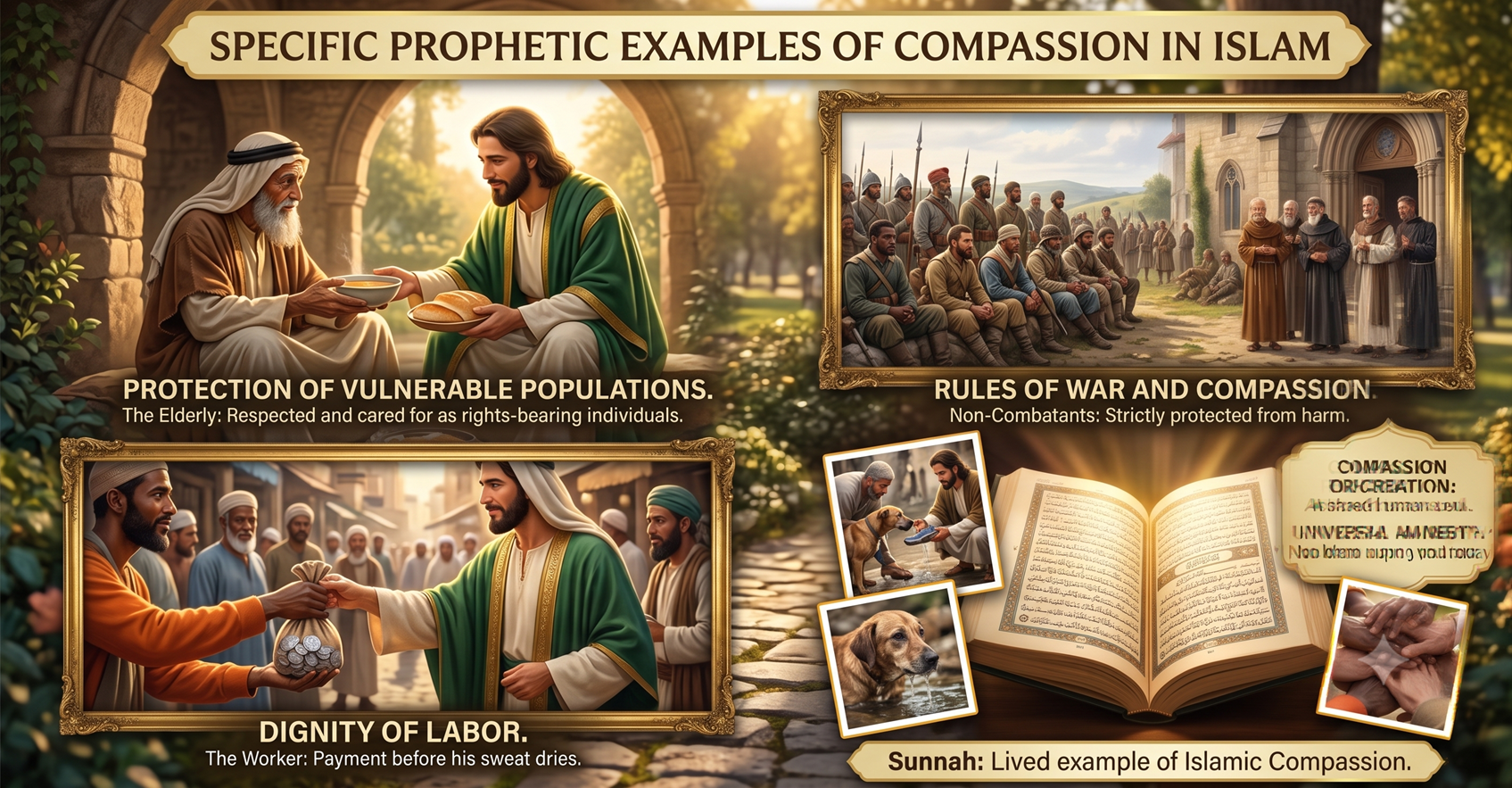
 

Specific prophetic examples of how humanity was treated with compassion in islam

The theological framework of human rights and social justice in Islam was translated into reality through the lived example (Sunnah) of the Prophet Muhammad. In the Islamic tradition, his actions are not viewed merely as historical anecdotes, but as binding legal and ethical precedents.

The Prophet’s treatment of humanity was characterized by a systemic compassion that transcended tribal, religious, gender, and social hierarchies—directly challenging the brutal socio-political norms of 7th-century Arabia.

  1. Protection of Non-Combatants and Rules of Engagement

Long before the codification of the modern Geneva Conventions, the Prophet Muhammad established strict, legally binding regulations governing warfare to protect human life and dignity. He directly forbade the targeting of vulnerable populations and infrastructure.

  • The Injunction: In multiple narrations compiled in Sahih Muslim, when dispatching an army, the Prophet would explicitly command: “Do not kill an old man, a child, or a woman. Do not steal from the spoils of war… and do good, for Allah loves those who do good.”
  • Protection of Infrastructure: He banned the destruction of orchards, the cutting down of fruit-bearing trees, and the slaughter of livestock except for sustenance.
  • Religious Freedom in War: Monks and priests worshipping in their monasteries were granted absolute immunity. Military commanders were strictly ordered to leave them and their places of worship unmolested (Al-Zuhayli, 2005).
  1. Diplomatic Inviolability and Rights of Minorities

The Prophet established legal treaties that guaranteed the protection, religious freedom, and civil rights of non-Muslim communities living within or interacting with the Islamic state.

  • The Covenant with the Christians of Najran (632 CE): This historic document guaranteed the protection of Christian churches, property, and lives. The Prophet declared: “No bishop shall be removed from his bishopric, nor any monk from his monastery… and no right of theirs shall be altered.”
  • The Status of Diplomats: When the envoys of Musaylimah (a hostile political rival) came to Medina and spoke aggressively, the Prophet noted that standard law protected them, stating: “By Allah, were it not that ambassadors are not to be killed, I would have struck your necks” (Sunan Abi Dawud). This established the strict principle of diplomatic immunity in Islamic law.
  1. Human Inviolability Regardless of Creed

The Prophet’s compassion was rooted in the shared lineage of humanity (Karamah), separate from an individual’s theological choices.

  • Standing for a Jewish Funeral: A famous incident recorded in both Sahih al-Bukhari and Sahih Muslim narrates that a funeral procession passed by the Prophet, and he stood up out of respect. His companions, surprised, remarked, “O Messenger of Allah, it is the funeral of a Jew.” The Prophet responded with a foundational universal maxim:

“Is it not a human soul?”

  • The Forgiveness at the Conquest of Mecca (630 CE): After two decades of severe persecution, torture, and forced exile inflicted upon the early Muslim community by the Quraysh, the Prophet marched into Mecca at the head of a decisive military force. Instead of seeking retribution or mass executions—the standard practice of ancient warfare—he granted a universal amnesty, famously echoing the words of the Prophet Joseph to his brothers: “No blame will there be upon you today. Go, for you are free” (Sunan al-Kubra).
  1. Institutionalizing the Rights of the Vulnerable

The Prophet radically altered the legal status of marginalized groups, including orphans, laborers, and the enslaved, moving them from properties to rights-bearing individuals.

  • Dignity of Labor: The Prophet elevated the status of workers by framing their compensation as an immediate ethical right. He instructed: “Give the worker his wages before his sweat dries” (Sunan Ibn Majah).
  • Abolition of Abuse: He strictly forbade physical violence against domestic workers and the enslaved. In one instance, upon seeing a companion beating a slave, the Prophet warned him that God had more power over him than he had over the slave. The companion immediately freed the slave out of remorse, to which the Prophet replied that if he hadn’t done so, he would have faced severe spiritual consequences (Sahih Muslim).
  • Protection of Orphans: In a tribal society where orphans routinely had their wealth plundered, the Prophet positioned the care of orphans as a peak virtue, stating: “I and the one who looks after an orphan will be like this in Paradise,” holding his index and middle fingers close together (Sahih al-Bukhari).
  1. Compassion Toward the Animal Kingdom

The prophetic precedent expanded the umbrella of compassion beyond humanity to encompass ecology and animal welfare, treating animals as sentient beings with rights against cruelty.

  • The Thirsty Dog: The Prophet taught that human salvation could be tied to the treatment of animals, sharing the account of a man who descended into a well, filled his shoe with water, and quenched the thirst of a dying dog. The Prophet stated, “Allah thanked him and forgave his sins.” When asked if there was a reward for serving animals, he answered, “There is a reward for serving every living being” (Sahih al-Bukhari).
  • Surgical and Slaughter Ethics: Even when taking an animal’s life for food, the Prophet demanded mercy, ordering: “When you slaughter, slaughter well. Let each of you sharpen his blade and give relief to the animal” (Sahih Muslim). He strictly forbade sharpening a blade in front of an animal or slaughtering one in the sight of another.

Conclusion

These historical precedents demonstrate that compassion in the prophetic tradition was not an occasional act of personal charity; it was a structured philosophy. By enforcing these behaviors as religious obligations and legal boundaries, the Prophet Muhammad created a societal ethos where human life, dignity, and freedom were guarded by the state and anchored in divine accountability.

References

  • Al-Zuhayli, W. (2005). Islam and International Law. International Review of the Red Cross, 87(858), 269–283.
  • Al-Bukhari, M. (d. 870 CE). Sahih al-Bukhari.
  • Al-Sijistani, Abu Dawud (d. 889 CE). Sunan Abi Dawud.
  • Ibn Hajjaj, Muslim (d. 875 CE). Sahih Muslim.
  • Ibn Majah, M. (d. 887 CE). Sunan Ibn Majah.

What is humanity and Human Rights as per Quranic Education

In the light of Quranic education, humanity (Al-Insaaniyyah) is viewed as a noble, purposeful, and interconnected creation. The Quran outlines a comprehensive framework for the status, role, and ethical responsibilities of human beings.

Here is a breakdown of humanity according to Quranic teachings:

1. Divinely Honored and Dignified

The Quran explicitly states that every human being possesses inherent dignity, regardless of race, gender, wealth, or social status.

  • The Verse: “And We have certainly honored the children of Adam…” (Quran 17:70).
  • The Meaning: Dignity is a birthright given by God, not a privilege granted by society.

2. Trustees and Stewards of the Earth

Humanity is not left on Earth without a purpose. Humans are designated as Khalifah (vicegerents or trustees) to build, preserve, and care for the world.

  • The Verse: “Indeed, I will make upon the earth a successive authority [khalifah].” (Quran 2:30).
  • The Meaning: Humans carry the moral responsibility to practice justice, protect nature, and foster peace.

3. Born with a Pure Innate Nature

Quranic education teaches that humans are born with Fitrah—an innate, pure disposition aligned with goodness, truth, and monotheism.

  • The Verse: “The natural disposition [fitrah] of Allah upon which He has created [all] people…” (Quran 30:30).
  • The Meaning: Evil or corruption is not an inherent human condition; it is a learned deviation from this natural purity.

4. Part of a Single, Diverse Family

The Quran emphasizes universal brotherhood. Diversity in language, color, and nationality is designed for mutual understanding, not for division or superiority.

  • The Verse: “O mankind, indeed We have created you from male and female and made you peoples and tribes that you may know one another…” (Quran 49:13).
  • The Meaning: True superiority is judged solely by righteousness (Taqwa) and moral character, not by external traits.

5. Accountable and Bound by Justice

Humanity is endowed with free will and intellect (Aql). Because humans can choose between right and wrong, they are fully accountable for their actions.

  • The Verse: “So whoever does an atom’s weight of good will see it, and whoever does an atom’s weight of evil will see it.” (Quran 99:7-8).
  • The Meaning: Quranic education places a heavy emphasis on absolute justice, compassion, and treating all living things with mercy.

The concept of social justice and human rights in Islam.

The discourse surrounding human rights and social justice is often framed as a modern Western achievement, crystallizing in milestones like the Magna Carta or the 1948 Universal Declaration of Human Rights (UDHR). However, within the Islamic tradition, these principles were codified in the 7th century CE, rooted not in a human socio-political struggle, but in divine revelation (Wahi) (Ehaf, 1998; Saeed, 2013).

In Islam, social justice (‘Adl) and human rights (Huquq al-‘Ibad) are structurally interdependent concepts derived from the twin pillars of Islamic epistemology: the Holy Qur’an and the Sunnah (the prophetic tradition). Rather than treating rights as standalone entitlements claimed against the state, the Islamic paradigm approaches human rights through a sophisticated, communitarian lens of mutual obligations and individual duties (Ghauri, 2010; Morgan-Foster, 2002).

The Theocentric Foundation of Human Dignity

The foundational baseline for human rights in Islam is the concept of Karamah—the inherent dignity bestowed by God upon all human beings, irrespective of race, social class, gender, or creed (Ghauri, 2010; Saeed, 2013). As expressed in the Qur’an:

“And We have certainly honored the children of Adam…” (Surah Al-Isra, 17:70)

Because God is the sole creator and absolute sovereign (Tawhid), rights are granted as a divine trust (Amanah). Consequently, no worldly ruler, government, or legislative body has the authority to abrogate or curtail these rights arbitrarily (A’la Maududi, 1976; Robina et al., 2020). If an authority systematically violates these rights, Islamic law explicitly commands the defense of the oppressed and the rectification of injustice (al-Sheha, 2000).

Core Components of Islamic Social Justice

Social justice in Islam is not merely an ethical ideal; it is a legal imperative enforced through institutional frameworks.

1. Absolute Equality and the Eradication of Elitism

Islam fundamentally rejects tribal, racial, and socio-economic aristocracy. This was most explicitly articulated during the Prophet Muhammad’s Last Sermon (Khutbat al-Wada) in 10 AH / 632 CE, which serves as the foundational charter of human rights in Islam (Robina et al., 2020; Saeed, 2013). The Prophet declared that an Arab holds no superiority over a non-Arab, nor a white person over a black person, except through piety (Taqwa) and righteous actions (al-Sheha, 2000; Ghauri, 2010).

2. Legal and Judicial Justice (‘Adl)

The concept of ‘Adl requires absolute impartiality under the law. The Qur’an instructs believers to stand firmly for justice, even if it goes against themselves, their parents, or their kin (Surah An-Nisa, 4:135). Furthermore, personal animosity must never compromise judicial integrity:

“Do not let your hatred of a people incite you to aggression [or injustice].” (Surah Al-Ma’idah, 5:2; A’la Maududi, 1976)

3. Economic Equity and Distributive Justice

Islamic social justice heavily emphasizes economic rights, introducing structured mechanisms to prevent the hazardous concentration of wealth among the elite. Chief among these is Zakat (mandatory alms), which functions not as voluntary charity, but as a formal economic right (Haq) belonging to the poor and disenfranchised, drawn directly from the surplus assets of the wealthy (A’la Maududi, 1976; al-Sheha, 2000).

Rights vs. Duties: The Intertwined Paradigm

A major point of divergence between Western liberal human rights theories and the Islamic framework lies in the relationship between rights and duties.

FeatureWestern Secular ParadigmIslamic Legal Paradigm
Primary SourceHuman reason, social contracts, empirical struggleDivine revelation (Qur’an and Sunnah)
Core OrientationIndividual rights-first; duties are often secondary or implicitDuty-centric; an individual’s duty forms another’s right
EnforceabilitySecular legal institutions and state apparatusLegal accountability paired with accountability in the Hereafter
   

In the conventional Western framework, rights are explicit, while corresponding duties are frequently poorly theorized or implicit (Morgan-Foster, 2002). Conversely, Islamic law constructs a reciprocal network of responsibilities: the responsibility of one individual is structurally the right of their fellow human being (Ghauri, 2010).

For example, the right to life and safety is guaranteed because taking an innocent life is legally and spiritually equated to killing all of humanity (Surah Al-Ma’idah, 5:32; A’la Maududi, 1976). Similarly, the right to a basic standard of living, religious freedom, and the protection of personal honor are operationalized through strict religious duties imposed on the community and the state (A’la Maududi, 1976; Ehaf, 1998). Because these rights are bound to individual accountability before God, compliance is driven by an internal spiritual conscience alongside external legal enforcement (Ghauri, 2010; Saeed, 2013).

Conclusion

The Islamic conception of social justice and human rights offers a comprehensive blueprint that harmonizes individual freedom with collective societal well-being. By anchoring human dignity in a theocentric framework, Islam elevates human rights from shifting political compromises to permanent, inviolable realities. While modern practices in various regions may sometimes diverge from these classical legal ideals due to political regressions or cultural patriarchal overlays (Moosa, 1998), the foundational texts of Islam continue to provide a sophisticated, duty-grounded ethos capable of addressing modern global challenges in human rights and sustainable development.

References

  • A’la Maududi, S. A. (1976). Human Rights in Islam. Muslim Library.
  • Ehaf, A. R. (1998). Islam and Human Rights. Journal of Islamic Studies, 12(2), 101–118.
  • Ghauri, M. T. (2010). An Analytical Study of Islamic Concept of Human Rights. The Dialogue, 5(4), 314–328.
  • Moosa, N. (1998). Human Rights in Islam. South African Journal on Human Rights, 14(4), 508–524. https://doi.org/10.1080/02587203.1998.11834991
  • Morgan-Foster, J. (2002). Third Generation Rights: What Islamic Law Can Teach the International Human Rights Movement. Yale Human Rights and Development Law Journal, 5(1), 65–116.
  • Cited by: 105
  • Robina, M., Shah, A. A., & Abbas, Z. (2020). Human Rights in Islamic Sustainable Development. Current Research Journal of Social Sciences and Humanities, 2(2), 123–131. https://doi.org/10.12944/crjssh.2.2.08
  • Cited by: 5
  • Saeed, R. A. (2013). Human rights in Islam and the West—(The Last Sermon of the Prophet and UDHR). Jihat-ul-Islam, 6(2), 1–22.
  • Cited by: 10
  • al-Sheha, A. R. (2000). Human Rights in Islam And Common Misconceptions. University of Minnesota Human Rights Library.