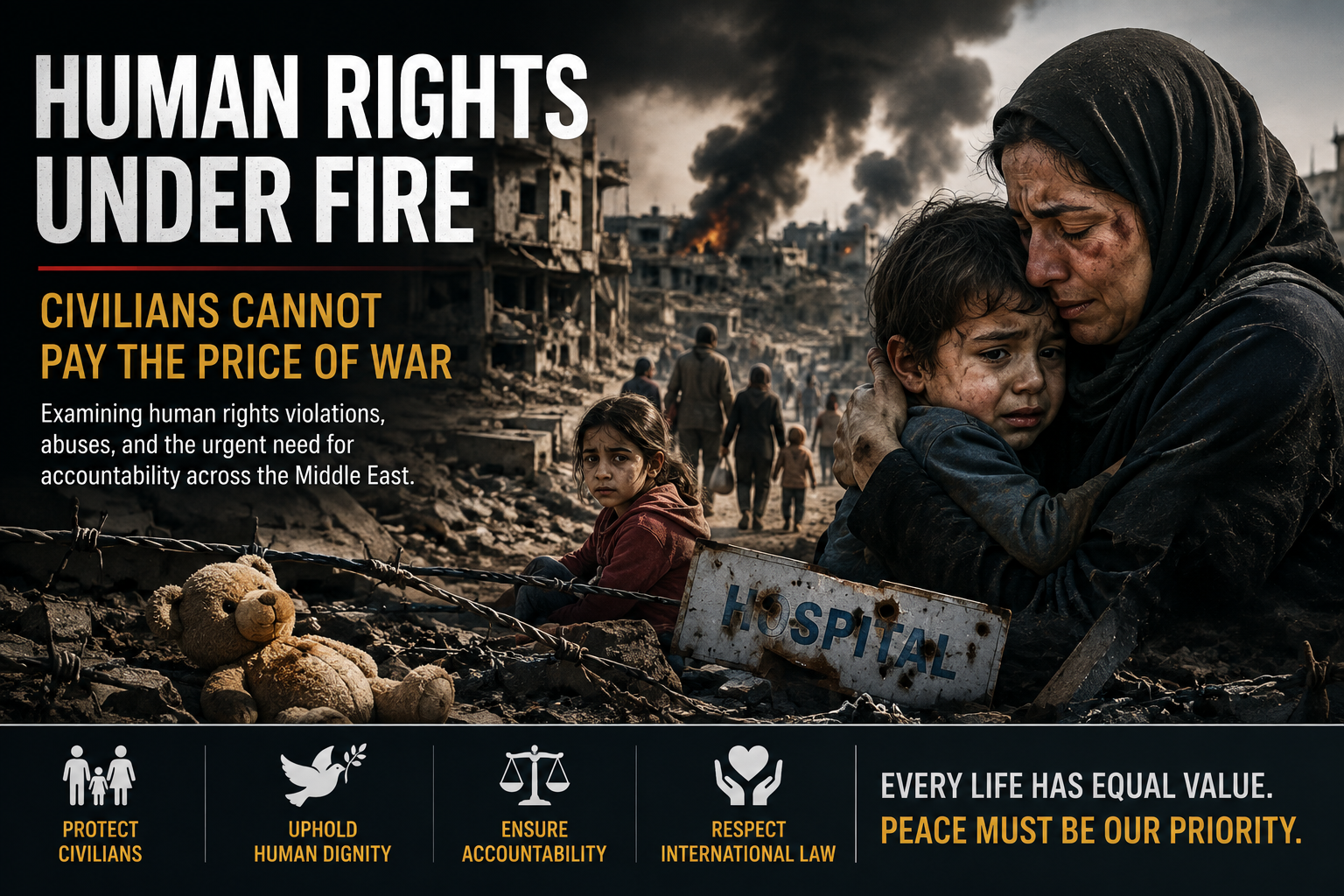
Human Rights Under Fire Civilians Continue to Pay the Highest Price in the Middle East Conflict

Human Rights Under Fire: Civilians Continue to Pay the Highest Price in the Middle East Conflict

For decades, the Middle East has endured cycles of armed conflict, political instability, and humanitarian crises. Yet the recent escalation across Gaza, Israel, Lebanon, the West Bank, Iran, Syria, Yemen, and neighboring regions has once again demonstrated a painful reality: civilians, not governments or armed groups, bear the greatest burden of war.

Beyond military operations and geopolitical rivalries lies a growing human rights emergency. Families have been displaced, hospitals have been damaged, schools have been destroyed, journalists and humanitarian workers have been killed, and millions of civilians continue to face insecurity, hunger, and uncertainty. International organizations have repeatedly warned that respect for international humanitarian law is deteriorating across multiple conflicts.

Civilians Must Never Be Targets

International humanitarian law, including the Geneva Conventions, requires all parties to armed conflict to distinguish between military objectives and civilians.

Reports from the United Nations, the Office of the High Commissioner for Human Rights (OHCHR), Amnesty International, and Human Rights Watch have documented allegations of unlawful attacks on civilian areas, disproportionate use of force, attacks on civilian infrastructure, and failures to adequately protect non-combatants in several conflicts across the region. Many of these incidents have prompted calls for independent investigations into possible war crimes. (United Nations)

Regardless of who commits these violations, attacks intentionally directed at civilians or carried out without sufficient precautions are prohibited under international law.

Gaza and Israel: Civilians Trapped Between War

The conflict between Israel and Hamas has produced one of the region’s gravest humanitarian crises.

United Nations investigators have reported that Palestinian civilians are caught between military operations by Israeli forces and abuses by Hamas and other Palestinian armed groups. The Commission concluded that civilians have suffered severe violations committed by multiple parties to the conflict. (United Nations)

Human rights organizations have also documented allegations involving indiscriminate attacks, hostage-taking, arbitrary detention, attacks affecting medical facilities, and restrictions on humanitarian assistance. These allegations concern different actors and require independent investigation and accountability where violations are established. (United Nations)

Lebanon: Civilian Communities Continue to Suffer

Recent fighting in southern Lebanon has left thousands displaced and caused extensive destruction to civilian infrastructure.

Amnesty International has stated that several Israeli air strikes that killed civilians, including children, should be investigated as possible war crimes. The organization has also criticized provisions in a recent political framework agreement that it argues could undermine victims’ access to justice. (Amnesty International)

At the same time, Hezbollah’s rocket attacks directed toward Israeli communities have also drawn condemnation for endangering civilians and violating the laws of armed conflict. (Le Monde.fr)

Iran and the Wider Region

The regional conflict has increasingly extended beyond traditional front lines.

Amnesty International has reported that Iranian drone strikes on civilian infrastructure in Gulf states may constitute war crimes if confirmed through independent investigations. The organization has also documented concerns about domestic repression, restrictions on freedom of expression, and arrests linked to the conflict. (Amnesty International)

Meanwhile, civilians inside Iran have experienced air strikes, infrastructure damage, water shortages, internet disruptions, and growing humanitarian hardship alongside increased internal repression, according to recent reporting and human rights observers. (The Guardian)

The Human Cost Beyond the Battlefield

Human rights violations during armed conflict extend far beyond direct violence.

Across the region, humanitarian organizations have reported concerns including:

  • Forced displacement of civilian populations
  • Destruction of homes and civilian infrastructure
  • Damage to hospitals, schools, and places of worship
  • Restrictions on humanitarian aid
  • Arbitrary detention
  • Abuse of detainees
  • Attacks affecting journalists and medical personnel
  • Psychological trauma among children
  • Family separation and prolonged displacement

These consequences often persist for generations, leaving societies struggling with trauma, poverty, interrupted education, and weakened public institutions.

Accountability Cannot Be Selective

One of the most important principles of international human rights law is that accountability must apply equally to everyone.

Whether violations are committed by state armed forces, non-state armed groups, militias, or foreign actors, the law requires impartial investigations and, where appropriate, prosecution of those responsible.

Justice cannot depend on nationality, religion, ethnicity, or political alliances. Selective accountability weakens international law and undermines the rights of victims everywhere.

The Role of the International Community

Governments and international institutions face increasing pressure to move beyond statements of concern.

Human rights organizations continue to call for:

  • Immediate protection of civilians
  • Compliance with international humanitarian law
  • Safe and unhindered humanitarian access
  • Independent investigations into alleged war crimes
  • Protection of journalists and medical personnel
  • Release of unlawfully detained civilians
  • Accountability for serious violations regardless of the perpetrator
  • Renewed diplomatic efforts toward sustainable peace

Human Rights Must Never Become Casualties of War

Wars eventually end. The suffering of civilians often does not.

Every civilian life has equal value regardless of nationality, religion, or political identity. Human rights are universalโ€”not conditional. Protecting those rights during conflict is not simply a legal obligation but a moral one.

As violence continues across parts of the Middle East, lasting peace will require more than ceasefires and political agreements. It will require justice for victims, accountability for perpetrators, and a renewed commitment by all parties to uphold the fundamental dignity and rights of every human being.


Lakho.com believes that human rights are universal. We condemn unlawful attacks on civilians, hostage-taking, torture, arbitrary detention, indiscriminate attacks, and other violations of international humanitarian law by any party to a conflict. Protecting human dignity must remain the foundation of every effort toward peace.
The balance between human intellect and divine revelation in Islam

The relationship between human intellect () and divine revelation () is one of the most dynamic and enduring discourses in Islamic epistemology. Unlike philosophical traditions that view reason and revelation as inherently adversarialโ€”where one must be compromised to accommodate the otherโ€”the classical Islamic paradigm posits them as complementary, harmonious, and structurally interdependent instruments of truth (Al-Attas, 1993; Ibn Rushd, 1179).

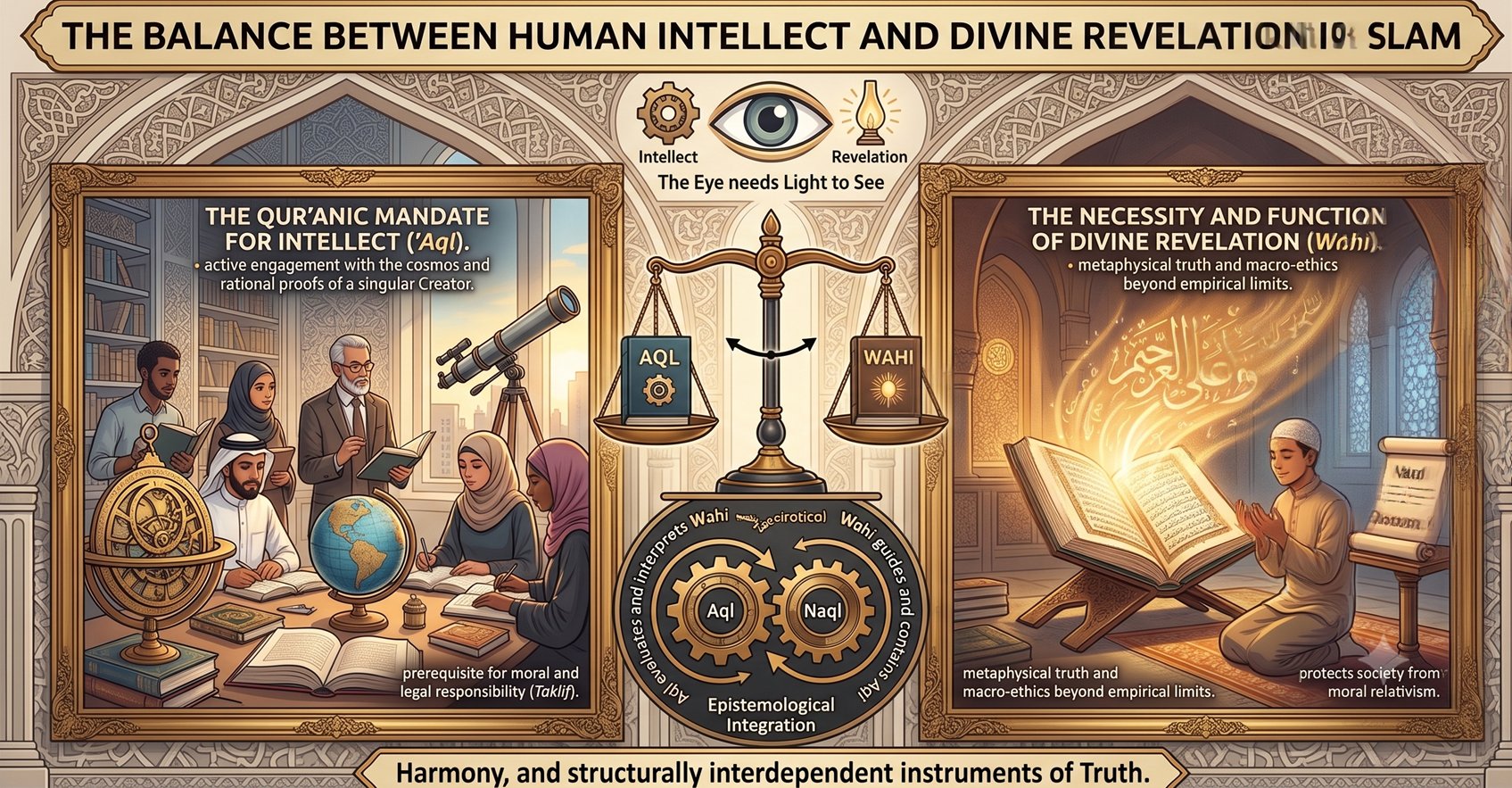
In Islam, intellect and revelation are metaphorically described as the eye and light. The intellect is the eye, possessing the internal capacity to see, while revelation is the external light. Without light, the healthiest eye remains in darkness; without the eye, light cannot be perceived or utilized.

The Qur’anic Mandate for Intellect ()

The Holy Qur’an does not merely tolerate human intellect; it demands its active engagement. The root word for intellect, ‘aqala (to reason, intellect, or understand), occurs 49 times in the Qur’an, consistently rebuking those who fail to exercise their rational faculties (Saeed, 2006).

The text frequently appeals to human observation, urging individuals to look at the cosmos, biological systems, and historical cycles as rational proofs of a singular Creator ().

“Indeed, in the creation of the heavens and the earth and the alternation of the night and the day are signs for those of understanding.” (Surah Ali ‘Imran, 3:190)

Islamic law (Shari’ah) positions rational sanity as a strict prerequisite for moral and legal responsibility (Taklif). An individual who lacks rational capacity due to mental illness, immaturity, or impairment is legally exempt from accountability, highlighting that revelation addresses itself exclusively to the intellect (Al-Ghazali, 1109).

The Necessity and Function of Divine Revelation ()

While the intellect is highly elevated, Islamic epistemology recognizes its inherent, structural limitations. Human reason is bound by empirical observation, temporal and spatial constraints, and subjective cultural biases (Al-Attas, 1993). It can deduce that a Supreme Creator exists, but it cannot independently determine:

  1. The Divine Attributes: Who God is beyond basic logical necessity.
  2. The Metaphysical Realm (Al-Ghayb): The realities of the soul, the afterlife, and ultimate metaphysical truths.
  3. Objective Moral Axioms: Perfect standards of absolute justice, ritual worship, and ethical frameworks that remain immune to shifting human self-interest.

This is where Wahi becomes necessary. Revelation provides the definitive, unalterable baseline of metaphysical truth and macro-ethics. It protects human society from the instability of moral relativism, ensuring that foundational human rights and spiritual obligations remain absolute, rather than subject to the shifting consensus of human socio-political bargaining (Ibn Taymiyyah, 1320).

Epistemological Integration: Aql and Naql

The golden age of Islamic scholarship produced a highly sophisticated synthesis between Aql (Reason) and Naql (Transmitted Revelation). Thinkers like Ibn Rushd (Averroes) and later Ibn Taymiyyah dedicated monumental works to proving that sound, uncorrupted intellect can never contradict authentic, explicitly transmitted text.

The Analytical Framework:

  • Intellect’s Role Before Revelation: The intellect is responsible for analyzing and verifying the truth-claims of a prophet. It evaluates historical evidence, linguistic miracles, and logical consistency to conclude that a revelation is genuinely from God (Al-Ghazali, 1109).
  • Intellect’s Role After Revelation: Once the intellect recognizes the text as divine, its primary function shifts from validation to interpretation (Ijtihad). The intellect is deployed to extract legal rulings, analogize new scenarios (Qiyas), and operationalize universal objectives of the law (Maqasid al-Shari’ah) to meet modern challenges (Hallaq, 2009).
  • The Guardrails: If the intellect arrives at a conclusion that directly opposes a definitive, explicit textual text (Nass), classical scholars argue that either the rational deduction is flawed due to incomplete data, or the textual interpretation is misunderstood. The intellect is expected to yield to divine wisdom in matters that transcend human empirical capacity (Ibn Taymiyyah, 1320).

Conclusion

In the Islamic paradigm, the tension between secular rationalism and blind fideism (the rejection of reason in favor of faith) is bypassed entirely. Revelation does not chain the mind; it provides the coordinate system that prevents the mind from wandering into existential nihilism or moral chaos. By balancing Aql and Wahi, Islam creates a civilizational model where scientific and rational pursuit is viewed as a form of worship, and religious adherence is treated as a deeply rational act.

References

  • Al-Attas, S. M. N. (1993). Islam and Secularism. International Institute of Islamic Thought and Civilization (ISTAC).
  • Al-Ghazali, Abu Hamid (1109). Al-Mustasfa min ‘Ilm al-Usul [The Clarified Toolkit of Legal Theory].
  • Hallaq, W. B. (2009). An Introduction to Islamic Law. Cambridge University Press.
  • Ibn Rushd (Averroes) (1179). Fasl al-Maqal fi ma bayn al-Shari’ah wa al-Hikmah min al-Ittisal [The Decisive Treatise on the Connection Between Islamic Law and Wisdom].
  • Ibn Taymiyyah, Ahmad (1320). Dar’ Ta’arud al-‘Aql wa al-Naql [The Rejection of Conflict Between Reason and Revelation].
  • Saeed, A. (2006). Interpreting the Qur’an: Towards a Contemporary Approach. Routledge.


Specific prophetic examples of how humanity was treated with compassion in islam

The theological framework of human rights and social justice in Islam was translated into reality through the lived example (Sunnah) of the Prophet Muhammad. In the Islamic tradition, his actions are not viewed merely as historical anecdotes, but as binding legal and ethical precedents.

The Prophet’s treatment of humanity was characterized by a systemic compassion that transcended tribal, religious, gender, and social hierarchiesโ€”directly challenging the brutal socio-political norms of 7th-century Arabia.

  1. Protection of Non-Combatants and Rules of Engagement

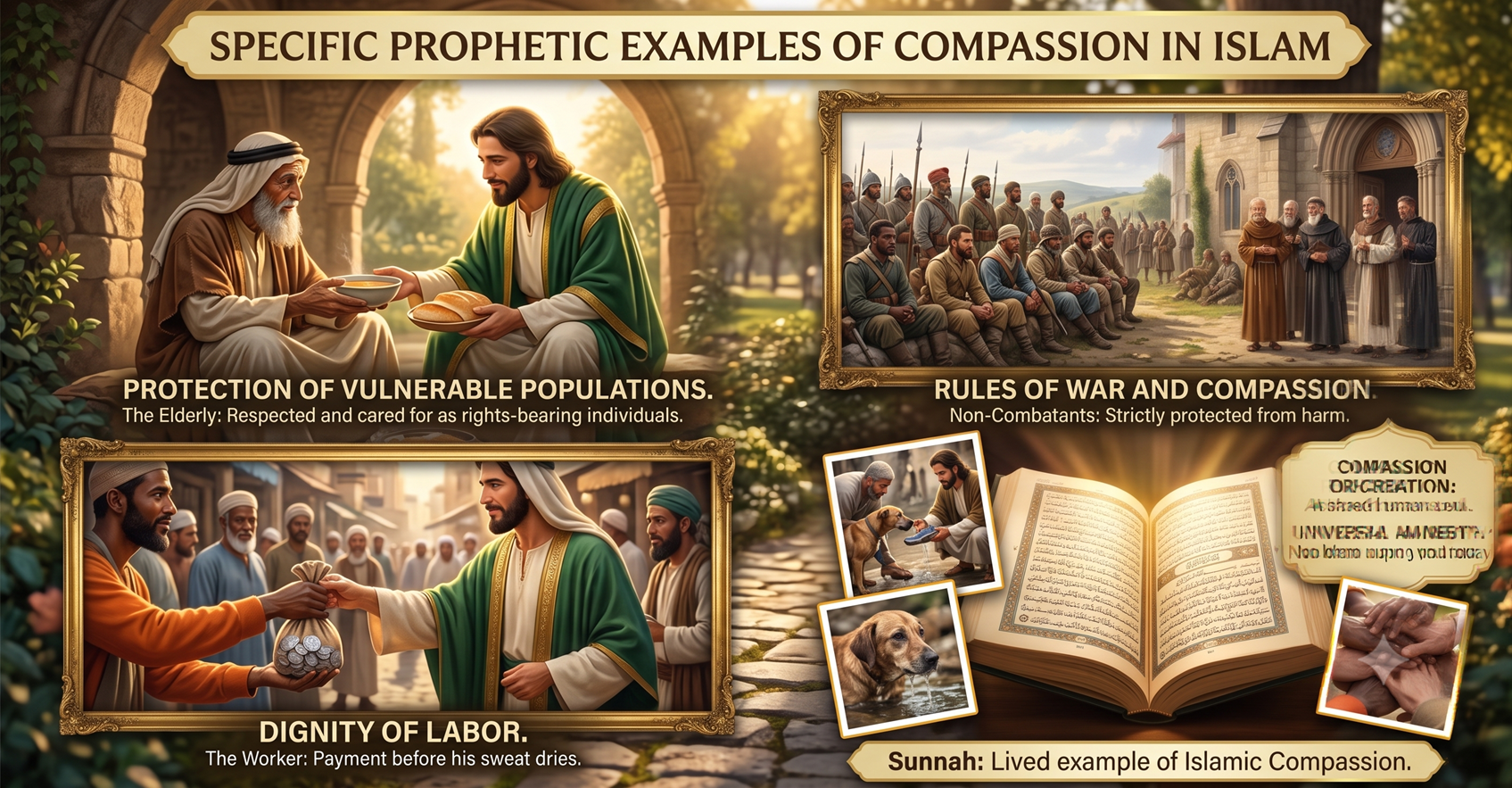
Long before the codification of the modern Geneva Conventions, the Prophet Muhammad established strict, legally binding regulations governing warfare to protect human life and dignity. He directly forbade the targeting of vulnerable populations and infrastructure.

  • The Injunction: In multiple narrations compiled in Sahih Muslim, when dispatching an army, the Prophet would explicitly command: “Do not kill an old man, a child, or a woman. Do not steal from the spoils of war… and do good, for Allah loves those who do good.”
  • Protection of Infrastructure: He banned the destruction of orchards, the cutting down of fruit-bearing trees, and the slaughter of livestock except for sustenance.
  • Religious Freedom in War: Monks and priests worshipping in their monasteries were granted absolute immunity. Military commanders were strictly ordered to leave them and their places of worship unmolested (Al-Zuhayli, 2005).
  1. Diplomatic Inviolability and Rights of Minorities

The Prophet established legal treaties that guaranteed the protection, religious freedom, and civil rights of non-Muslim communities living within or interacting with the Islamic state.

  • The Covenant with the Christians of Najran (632 CE): This historic document guaranteed the protection of Christian churches, property, and lives. The Prophet declared: “No bishop shall be removed from his bishopric, nor any monk from his monastery… and no right of theirs shall be altered.”
  • The Status of Diplomats: When the envoys of Musaylimah (a hostile political rival) came to Medina and spoke aggressively, the Prophet noted that standard law protected them, stating: “By Allah, were it not that ambassadors are not to be killed, I would have struck your necks” (Sunan Abi Dawud). This established the strict principle of diplomatic immunity in Islamic law.
  1. Human Inviolability Regardless of Creed

The Prophetโ€™s compassion was rooted in the shared lineage of humanity (Karamah), separate from an individual’s theological choices.

  • Standing for a Jewish Funeral: A famous incident recorded in both Sahih al-Bukhari and Sahih Muslim narrates that a funeral procession passed by the Prophet, and he stood up out of respect. His companions, surprised, remarked, “O Messenger of Allah, it is the funeral of a Jew.” The Prophet responded with a foundational universal maxim:

“Is it not a human soul?”

  • The Forgiveness at the Conquest of Mecca (630 CE): After two decades of severe persecution, torture, and forced exile inflicted upon the early Muslim community by the Quraysh, the Prophet marched into Mecca at the head of a decisive military force. Instead of seeking retribution or mass executionsโ€”the standard practice of ancient warfareโ€”he granted a universal amnesty, famously echoing the words of the Prophet Joseph to his brothers: “No blame will there be upon you today. Go, for you are free” (Sunan al-Kubra).
  1. Institutionalizing the Rights of the Vulnerable

The Prophet radically altered the legal status of marginalized groups, including orphans, laborers, and the enslaved, moving them from properties to rights-bearing individuals.

  • Dignity of Labor: The Prophet elevated the status of workers by framing their compensation as an immediate ethical right. He instructed: “Give the worker his wages before his sweat dries” (Sunan Ibn Majah).
  • Abolition of Abuse: He strictly forbade physical violence against domestic workers and the enslaved. In one instance, upon seeing a companion beating a slave, the Prophet warned him that God had more power over him than he had over the slave. The companion immediately freed the slave out of remorse, to which the Prophet replied that if he hadnโ€™t done so, he would have faced severe spiritual consequences (Sahih Muslim).
  • Protection of Orphans: In a tribal society where orphans routinely had their wealth plundered, the Prophet positioned the care of orphans as a peak virtue, stating: “I and the one who looks after an orphan will be like this in Paradise,” holding his index and middle fingers close together (Sahih al-Bukhari).
  1. Compassion Toward the Animal Kingdom

The prophetic precedent expanded the umbrella of compassion beyond humanity to encompass ecology and animal welfare, treating animals as sentient beings with rights against cruelty.

  • The Thirsty Dog: The Prophet taught that human salvation could be tied to the treatment of animals, sharing the account of a man who descended into a well, filled his shoe with water, and quenched the thirst of a dying dog. The Prophet stated, “Allah thanked him and forgave his sins.” When asked if there was a reward for serving animals, he answered, “There is a reward for serving every living being” (Sahih al-Bukhari).
  • Surgical and Slaughter Ethics: Even when taking an animal’s life for food, the Prophet demanded mercy, ordering: “When you slaughter, slaughter well. Let each of you sharpen his blade and give relief to the animal” (Sahih Muslim). He strictly forbade sharpening a blade in front of an animal or slaughtering one in the sight of another.

Conclusion

These historical precedents demonstrate that compassion in the prophetic tradition was not an occasional act of personal charity; it was a structured philosophy. By enforcing these behaviors as religious obligations and legal boundaries, the Prophet Muhammad created a societal ethos where human life, dignity, and freedom were guarded by the state and anchored in divine accountability.

References

  • Al-Zuhayli, W. (2005). Islam and International Law. International Review of the Red Cross, 87(858), 269โ€“283.
  • Al-Bukhari, M. (d. 870 CE). Sahih al-Bukhari.
  • Al-Sijistani, Abu Dawud (d. 889 CE). Sunan Abi Dawud.
  • Ibn Hajjaj, Muslim (d. 875 CE). Sahih Muslim.
  • Ibn Majah, M. (d. 887 CE). Sunan Ibn Majah.