Could Pakistan Be Next? Why Revolutions Swept South Asiaโ€”But Pakistanโ€™s Anger Has Yet to Become a Mass Movement

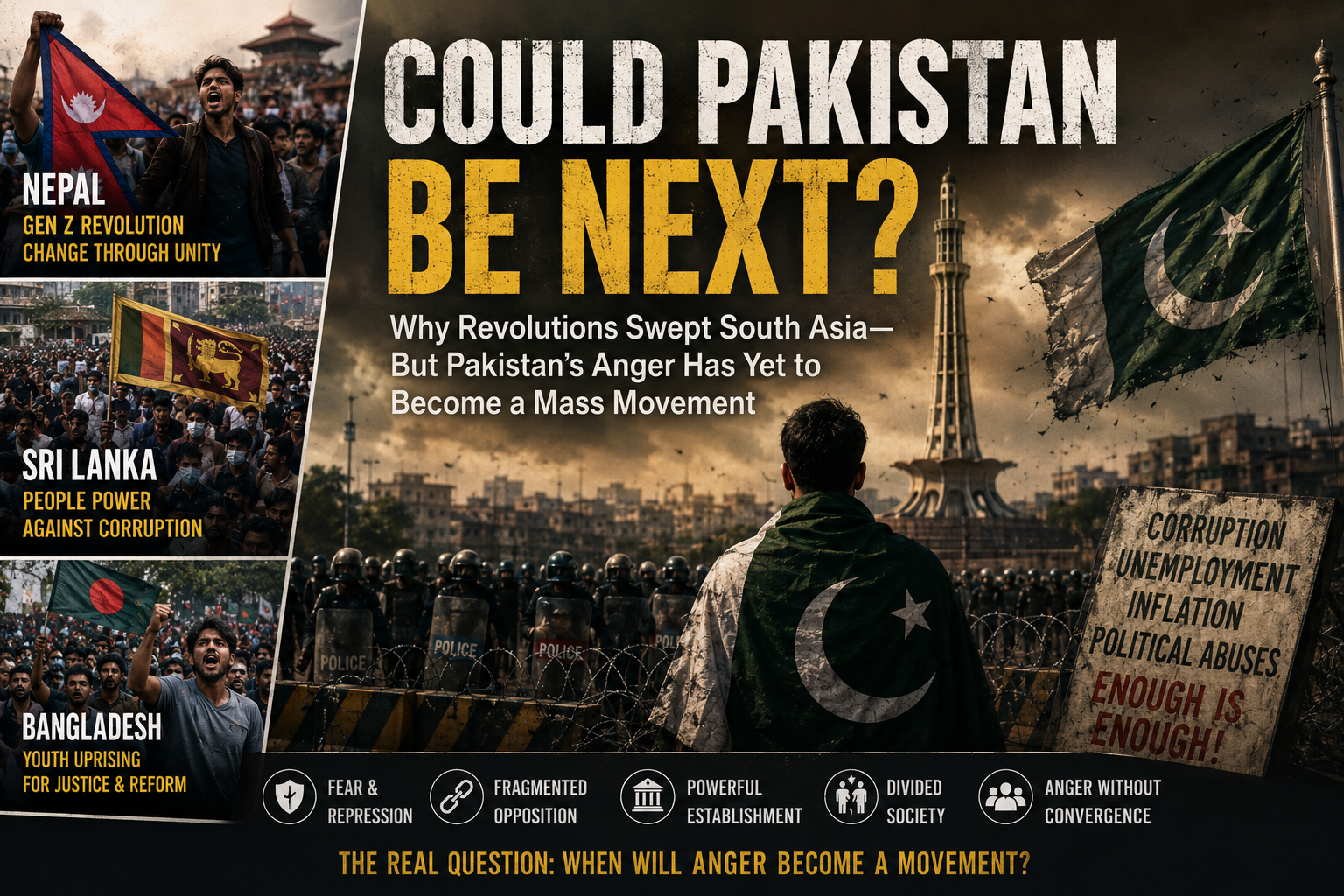
Could Pakistan Be Next? Why Revolutions Swept South Asiaโ€”But Pakistanโ€™s Anger Has Yet to Become a Mass Movement

I think your observationโ€”that Pakistan has many of the grievances seen before the upheavals in Sri Lanka, Bangladesh and Nepal, yet no comparable nationwide movement appears imminentโ€”is quite plausible. But fear is only one part of the explanation. Pakistan has several structural differences that make a Bangladesh-, Nepal-, or Sri Lanka-style uprising harder to develop and sustain.

One caution first: nobody can reliably predict a revolution. These events often look impossible until shortly before they occur. What we can examine are the conditions that make mass mobilization more or less likely.

Pakistan has grievances that could produce mass mobilization

There is clearly substantial political frustration. Freedom House’s 2026 assessment gives Pakistan 32/100 for political rights and civil liberties and 27/100 for internet freedom, describing military influence over elections and government formation, restrictions on civil liberties, and pressure on the media. Human Rights Watch similarly says that during 2025 authorities intensified suppression of political opposition, media and civil society.

There is also evidence that opposition sentiment remains electorally substantial. Despite restrictions placed on PTI and the loss of its electoral symbol, PTI-affiliated independents won the largest number of directly elected National Assembly seats in the February 2024 election. Freedom House cites this as evidence that voters showed some resilience despite the constraints surrounding the election.

So I would not interpret the absence of a revolution as absence of public dissatisfaction.

And yesโ€”the fear factor is real

This is probably one significant difference.

Pakistanis have seen what can happen when political demonstrations cross certain lines.

After the May 9, 2023 unrest, arrests, prosecutions and military trials created a powerful deterrent effect. Freedom House reports that all 85 PTI supporters tried in military courts over the May 2023 riots were convicted and received sentences of up to ten years.

Then came the Islamabad protests of November 2024.

Authorities locked down Islamabad and much of Punjab, made mass arrests and suspended internet and mobile services. Freedom House reports that at least six people were killed in clashes involving protesters and security forces.

The exact circumstances and casualty claims surrounding November 26 have been politically contested, so I would be careful about presenting the most dramatic claims from either PTI or the government as established fact. But the broader patternโ€”roadblocks, arrests, communications restrictions and lethal clashesโ€”is well documented.

That matters psychologically.

A potential demonstrator is not simply asking:

โ€œDo I support this cause?โ€

He or she may effectively be asking:

โ€œIf I go out, could I be arrested, injured, lose my employment, face a criminal case, or put my family at risk?โ€

Once enough people make that calculation, repression can raise the threshold required for mass mobilization.

Freedom House explicitly reports a deterioration in freedom of assembly, citing authorities’ interference with major rallies through force and mass arrests.

So yes, deterrence and fear are part of the explanation.

But I don’t think they are the whole explanation.

Pakistan’s bigger problem: fragmented anger

This is where Pakistan differs considerably from the recent South Asian examples.

A successful mass uprising normally requires many different sections of society temporarily to agree that one problem is more important than their differences.

Sri Lanka reached something close to that point during the catastrophic 2022 economic crisis.

Bangladesh’s 2024 student movement expanded dramatically beyond its original quota dispute.

Nepal’s Gen-Z movement similarly grew beyond its immediate social-media issue into broader demands concerning corruption and governance.

Pakistan’s dissatisfaction, by contrast, remains highly fragmented.

One Pakistani may see the central problem as the treatment of Imran Khan.

Another may dislike both PTI and the government.

Another is primarily concerned about inflation and employment.

A Baloch activist may be focused on disappearances and provincial rights.

A Pashtun activist may have a different set of grievances.

Urban middle-class voters, farmers, traders, religious organizations, lawyers, students, government employees and industrial workers do not necessarily perceive the country’s crisis through the same political lens.

Anger exists, but anger is not automatically collective action.

That distinction is extremely important.

PTI’s strength may paradoxically limit a broader revolution

There is another interesting factor.

Much of Pakistan’s anti-establishment political energy is associated with one party and one leaderโ€”PTI and Imran Khan.

That gives the opposition enormous mobilizing power.

But it also creates a ceiling.

Someone who strongly dislikes the existing political order but also dislikes Imran Khan may refuse to participate in something perceived as a “PTI protest.”

That is different from a genuinely cross-party citizens’ movement.

A revolutionary-type movement would become much more significant if its identity changed from:

โ€œPTI versus the governmentโ€

to something closer to:

โ€œcitizens versus an unacceptable political system.โ€

That transformation has not convincingly occurred.

Pakistan’s state is also unusually powerful

This may be the biggest structural difference.

Pakistan isn’t simply governed through a civilian administration.

Its military is one of the country’s strongest and most organized institutions and historically has exercised substantial influence over politics. Freedom House describes the military as exercising enormous influence over elections, government formation and policy.

Compare this with a critical moment in many successful revolutions.

Eventually the state’s coercive apparatus becomes uncertain.

Police hesitate.

Civil servants stop cooperating.

Political allies defect.

Business elites change sides.

Judges resist.

Or security forces decide that preserving the incumbent government is no longer worth the cost.

That elite fracture is frequently more important than the number of protesters.

Pakistan has not clearly reached such a point.

And this is why simply saying โ€œmillions should come onto the streetsโ€ misses something important.

Revolutions usually succeed not merely because protesters become stronger.

They succeed because the ruling coalition becomes weaker and begins splitting internally.

The internet environment matters too

Pakistan’s authorities have become increasingly capable of disrupting digital mobilization.

Freedom House classifies Pakistan’s internet as โ€œNot Freeโ€ at 27/100 and documents internet restrictions during political protests, the prolonged blocking of X, pressure surrounding VPNs and expansion of cybercrime legislation.

That is particularly relevant after Bangladesh and Nepal.

Modern youth movements depend heavily upon:

WhatsApp โ†’ X โ†’ TikTok โ†’ Facebook โ†’ livestreams โ†’ rapid assembly.

If communications can be throttled or disrupted precisely when demonstrations begin, organizers face a much greater coordination problem.

Yet this also has limits. Governments can suppress communication; they cannot necessarily eliminate the underlying grievance.

One thing could change everything: a non-partisan trigger

This is where I would watch Pakistan carefully.

The next major Pakistani movement may not begin with Imran Khan at all.

Historically, revolutionary situations are frequently triggered by something that initially appears relatively limited.

It could hypothetically be a severe economic shock, a disputed political event, an incident involving students, a major corruption revelation, an unpopular law, an institutional confrontation, or a highly visible incident of state violence.

The important question would not be the original incident.

It would be whether ordinary people suddenly conclude:

โ€œThis is no longer about PTI, PML-N, PPP or one politician. This concerns all of us.โ€

That psychological transition is what Pakistan currently lacks.

There is another paradox about repression

Heavy repression can suppress movements successfully.

But it can also eventually have the opposite effect.

Political scientists sometimes describe this as the backfire effect of repression.

If people believe demonstrations will be punished severely, fear increases and participation falls.

But if an incident is perceived by a sufficiently broad section of society as extraordinarily unjust, repression itself can become the mobilizing grievance.

That appears to have contributed to escalation in Bangladesh and Nepal.

The crucial variable isn’t simply whether protesters are killed.

It is how society interprets those deaths.

If society thinks:

“Those were supporters of Party X fighting the government,”

mobilization may remain partisan.

If society instead thinks:

“Those were our children,”

the political consequences can be radically different.

That distinction is enormous.

So could Pakistan experience something similar?

Yes, absolutely possible.

But based on the present structural conditions, I would not say that a Nepal/Bangladesh-style nationwide revolution is imminent.

I would characterize Pakistan instead as having:

high grievances + strong opposition sentiment + substantial youth frustration + constrained political space + powerful state institutions + fragmented opposition + significant fear of repression.

That combination produces something different from revolutionary momentum:

pressure without convergence.

Pakistan has anger.

Pakistan has grievances.

Pakistan has political polarization.

Pakistan has a large young population.

Pakistan has demonstrated an ability to mobilize very large crowds.

What it presently lacks is the crucial ingredient visible in successful mass uprisings:

a broad coalition crossing party, class, provincial and ideological boundaries.

And until that appears, your observation that you cannot presently see such a movement developing is reasonable.

But there is one lesson from Sri Lanka, Bangladesh and Nepal worth remembering: political stability and revolutionary stability are not the same thing. A country can appear politically frozen for years and then change extraordinarily quickly once economic grievance, political grievance and a catalytic event converge at the same moment.

For Pakistan, therefore, I wouldn’t primarily watch the size of PTI rallies.

I would watch something else:

When people who don’t support PTI begin protesting alongside people who do.

If students, lawyers, traders, workers, professionals, civil-society groups and politically unaffiliated citizens start mobilizing around the same institutional demands rather than around one politician, that would be a much stronger indicator that Pakistan was approaching the kind of political moment recently seen elsewhere in South Asia.

And even then, the preferable outcome would be a peaceful constitutional democratic movementโ€”not violent revolution. Bangladesh, Sri Lanka and Nepal also demonstrate that removing a government is much easier than building stable institutions afterward. The ultimate measure of success is not whether crowds can bring down rulers, but whether citizens can obtain accountable institutions without paying for change with more lives.
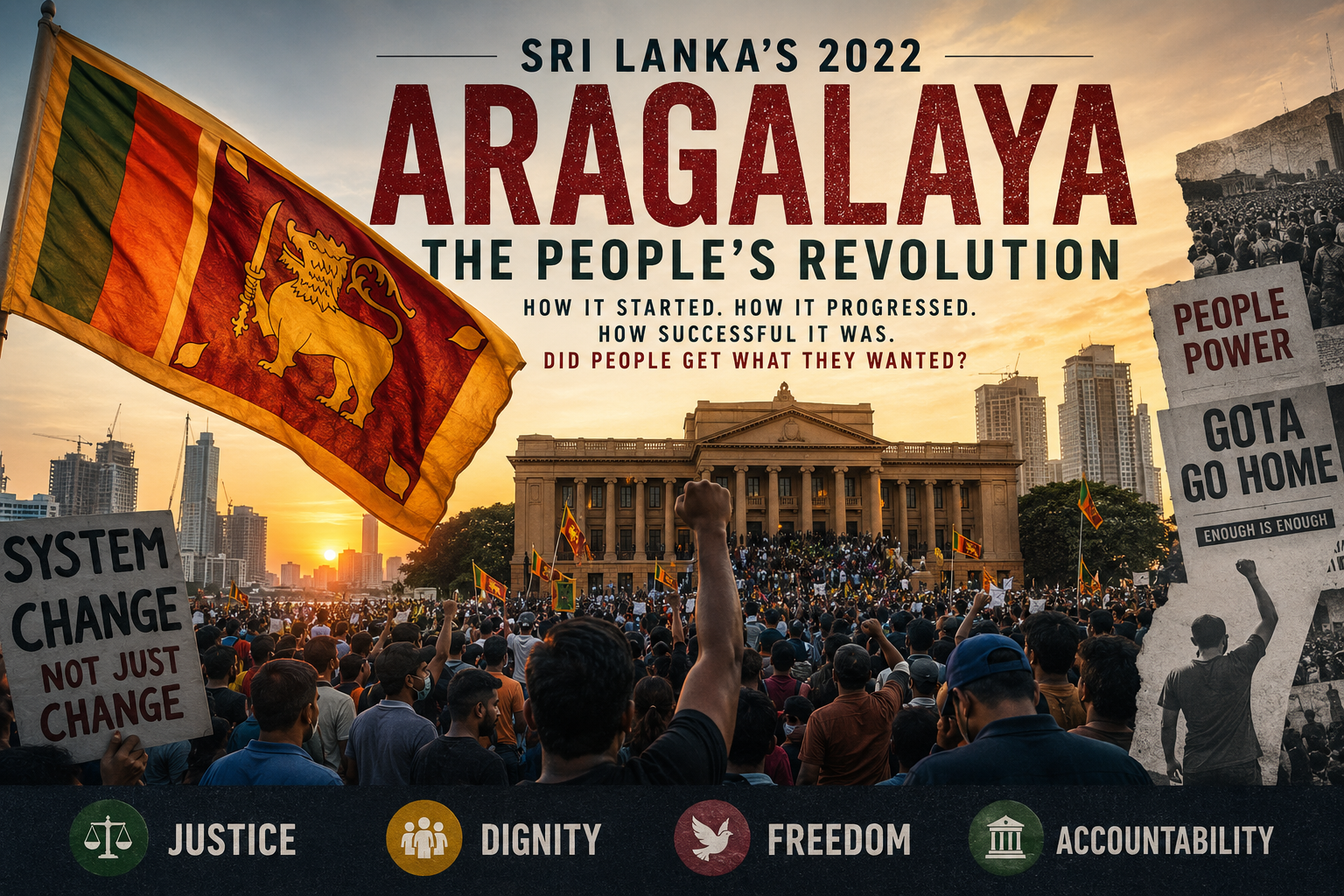
Report: Sri Lankaโ€™s 2022 Aragalaya ย How the Peopleโ€™s Uprising Began, Succeeded, and What It Ultimately Achieved

Report: Sri Lankaโ€™s 2022 โ€œAragalayaโ€, ย How the Peopleโ€™s Uprising Began, Succeeded, and What It Ultimately Achieved

Sri Lankaโ€™s 2022 mass protest movement, commonly called Aragalaya, Sinhala for โ€œstruggleโ€ is often described as a revolution, although technically it was a broad, largely nonviolent popular uprising rather than a conventional armed revolution. It produced an extraordinary result: a sitting president fled the country and resigned. Yet removing President Gotabaya Rajapaksa was only one of the protestersโ€™ objectives. Their larger demand was โ€œsystem changeโ€ an end to corruption, economic mismanagement, elite political privilege, and the dominance of established political families.

Viewed from 2026, the outcome is therefore more complicated than either โ€œthe revolution succeededโ€ or โ€œthe revolution failed.โ€ It succeeded spectacularly in breaking the Rajapaksa government’s hold on power, initially failed to replace the wider political establishment, and then indirectly contributed to a major electoral transformation in 2024. Whether that transformation will deliver the deeper system change protesters demanded remains unresolved.

1. What caused the uprising?

Sri Lanka’s political explosion began with an economic catastrophe.

By late 2021, the country was running dangerously short of foreign currency. By December, its foreign-exchange reserves were sufficient to cover only about one month of imports. Without dollars, Sri Lanka struggled to import fuel, medicines, food and other essentials.

The crisis had several causes rather than one single trigger. The country had accumulated heavy foreign debt; tourism had been badly damaged first by the 2019 Easter bombings and then by COVID-19; the government introduced major tax cuts that weakened state revenue; and President Gotabaya Rajapaksa’s abrupt 2021 ban on chemical fertilizers badly disrupted agriculture. The government was also widely criticized for delaying negotiations with the IMF while its foreign reserves deteriorated.

By early 2022, these macroeconomic problems had become problems of everyday survival.

Sri Lankans faced fuel queues, shortages of medicines and food, rapidly rising prices and prolonged electricity cuts. In April 2022, Sri Lanka announced that it would suspend foreign debt payments, effectively entering sovereign default.

Economic anger rapidly became political anger.

For many protesters, the argument was simple: this was not merely an unavoidable economic disaster; it was the consequence of years of bad governance, corruption, political privilege and mismanagement.

And much of that anger focused on one family: the Rajapaksas.


2. How did the revolution begin?

The movement was unusual because it did not initially have a single political leader, party or revolutionary organization directing it.

It developed organically.

Ordinary citizens began demonstrating as shortages and power cuts worsened. Social media helped mobilize people, while students, activists, trade unions, professionals, businesspeople and middle-class families increasingly joined the protests.

The movement eventually became remarkably broad. Carnegie’s detailed study describes participation across different ages, ethnicities and socioeconomic groups, with university students, unions, activists, professionals and businesses all playing roles.

One slogan captured the immediate political objective:

โ€œGota Go Home.โ€

โ€œGotaโ€ referred to President Gotabaya Rajapaksa.

But another idea was equally important:

โ€œSystem Change.โ€

This distinction is essential to understanding whether the revolution ultimately succeeded.

The protesters were increasingly saying:

Removing one president was not enough. The political system that produced the crisis had to change.


3. Galle Face and the creation of โ€œGotaGoGamaโ€

A defining moment came when protesters established a permanent protest camp near the presidential offices at Galle Face in Colombo.

It became known as GotaGoGama, roughly meaning โ€œGota Go Village.โ€

This transformed scattered public anger into a visible national movement.

The protest site became more than a demonstration. It developed facilities and spaces for speeches, discussions, food distribution and political organizing.

Most importantly, it created a physical symbol of resistance directly beside the country’s political leadership.

The government now faced sustained public pressure rather than occasional demonstrations.


4. The government begins to collapse

As protests continued, the Rajapaksa administration attempted to survive through political reshuffling.

But protesters increasingly rejected cosmetic changes.

They did not merely want different ministers.

They wanted the Rajapaksas out.

Political pressure eventually reached Prime Minister Mahinda Rajapaksa, the president’s brother and one of the country’s most powerful political figures.

In May 2022, after severe political turmoil and violence surrounding demonstrations, Mahinda Rajapaksa resigned as prime minister.

That was a major victory.

But Gotabaya Rajapaksa remained president.

The central demand therefore continued:

Gota Go Home.


5. July 9, 2022 โ€” the decisive moment

The uprising reached its dramatic climax on 9 July 2022.

Huge numbers of demonstrators converged on Colombo.

Protesters overwhelmed security barriers and entered important government buildings, including the presidential residence.

Images of ordinary Sri Lankans inside the president’s residence circulated around the world.

Whatever the symbolism, the political message was unmistakable:

Gotabaya Rajapaksa had lost the ability to govern normally.

He fled the presidential residence and subsequently left Sri Lanka.

On 14 July 2022, Gotabaya Rajapaksa formally resigned as president.

This was the Aragalaya’s greatest immediate achievement.

A mass civilian movement had forced one of Sri Lanka’s most powerful presidents from office.


6. At this point, had the revolution won?

Yes โ€” if the objective was removing Gotabaya Rajapaksa.

No โ€” if the objective was replacing the political system.

This distinction explains almost everything that happened afterward.

The movement had enormous street power, but it lacked a unified leadership capable of taking control of the political transition.

There was no single Aragalaya party.

There was no agreed revolutionary government waiting to assume power.

There was no universally accepted protest leader who could become president.

And Sri Lanka’s constitutional institutions continued functioning.

This created an unexpected outcome.


7. Ranil Wickremesinghe becomes president

After Gotabaya’s departure, Parliament selected Ranil Wickremesinghe as president.

This disappointed many protesters.

Why?

Because Wickremesinghe was hardly an outsider.

He was one of Sri Lanka’s most experienced establishment politicians and had served as prime minister multiple times.

More importantly, he was elected by a Parliament still heavily influenced by the political forces associated with the previous government.

Carnegie’s assessment is important here: Aragalaya had enough power to remove the Rajapaksas but lacked the leadership and organization necessary to determine who replaced them. Wickremesinghe was therefore able to capitalize politically on the opening created by the protests.

From the protesters’ perspective, this produced a strange situation:

They had removed the president without removing the establishment.


8. The protest movement was then suppressed

Wickremesinghe’s government moved against remaining protest encampments and activists.

The movement gradually lost momentum.

Middle-class participation declined, internal disagreements became more significant, and government pressure made continued mobilization harder.

Carnegie concludes that the suppression of the protests exposed an important weakness: the movement had been extraordinarily effective at mobilizing public anger, but lacked the organization and leadership necessary to sustain itself as a long-term political force.

By late 2022, therefore, someone looking only at immediate results might reasonably have concluded:

Aragalaya removed Gotabaya but failed to achieve its revolution.

Then something important happened.

The economic situation began stabilizingโ€”and eventually voters got their opportunity to respond.


9. Economic recovery under Wickremesinghe

The Wickremesinghe government pursued an IMF-backed stabilization program.

Sri Lanka obtained a roughly $2.9 billion IMF program, while the government pursued debt restructuring, tax increases and other economic reforms.

There were measurable improvements.

Inflation, which had reached extraordinary levels during the crisis, fell dramatically, and economic growth resumed.

But stabilization came with substantial social costs.

Higher taxes, reduced purchasing power and continuing high living costs created considerable dissatisfaction.

So Sri Lanka was recovering economically while political anger remained.

And many citizens still wanted the other half of Aragalaya’s promise:

accountability and system change.


10. The real second phase of the revolution: the 2024 election

This is where the historical assessment becomes much more interesting.

Sri Lanka held a presidential election on 21 September 2024.

The major candidates included establishment figures Ranil Wickremesinghe and Sajith Premadasaโ€”but also Anura Kumara Dissanayake (AKD), leader of the National People’s Power (NPP) coalition.

Dissanayake campaigned heavily on themes closely connected with Aragalaya:

  • fighting corruption,
  • political reform,
  • challenging the traditional political elite,
  • improving governance,
  • addressing economic inequality,
  • and delivering broader political change.

Dissanayake won the presidency.

It was a remarkable political transformation.

Wickremesinghe received only about 17% of the vote, while Dissanayake’s victory represented a major break with Sri Lanka’s traditional political establishment.

In that sense, the political earthquake that began on the streets in 2022 had finally reached the ballot box.


11. Then came an even bigger result

President Dissanayake called parliamentary elections for 14 November 2024.

The result was extraordinary.

His NPP coalition won:

159 of 225 parliamentary seats.

That gave the new government a two-thirds parliamentary majority.

This was not simply a change of president.

It represented a major rejection of Sri Lanka’s traditional political establishment.

The NPP even made major gains in areas where traditional ethnic and regional parties had historically been dominant.

Carnegie describes the result as an unprecedented leadership change, although it cautions that whether it produces genuine system change remains an open question.


12. So how successful was Sri Lanka’s revolution?

The best assessment is to separate its objectives.

ObjectiveResult
Remove President Gotabaya RajapaksaAchieved
Remove Mahinda Rajapaksa as PMAchieved
Break the immediate Rajapaksa grip on governmentLargely achieved
Force recognition of economic mismanagementAchieved politically
Produce immediate revolutionary governmentNot achieved
Immediately replace the political establishmentNot achieved
Create economic stabilityEventually improved through IMF-backed reforms
Bring a new political force to powerAchieved electorally in 2024
Give the new government a strong mandateAchieved โ€” two-thirds parliamentary majority
Eliminate corruptionNot yet demonstrably achieved
Deliver complete โ€œsystem changeโ€Still unresolved
Solve ordinary people’s economic problemsOnly partially

13. Did Sri Lankans get what they wanted?

They got some of itโ€”perhaps much more than appeared possible in 2022โ€”but not everything.

The most visible demand was:

โ€œGota Go Home.โ€

Gotabaya went home.

The larger demand was:

โ€œSystem Change.โ€

That is much harder to evaluate.

Immediately after the uprising, system change appeared to have failed because Wickremesingheโ€”an establishment politicianโ€”became president.

But the 2024 elections changed that assessment.

A political movement outside the traditional governing establishment captured the presidency and then secured an extraordinary parliamentary majority. Carnegie consequently argues that, in light of the 2024 election results, simply declaring Aragalaya a failure is no longer convincing. At the same time, it stresses that genuine system change still remains to be demonstrated.

That is probably the fairest conclusion.


14. Did people’s economic lives improve?

This is another important distinction.

Political victory does not automatically mean economic prosperity.

Sri Lanka moved away from the catastrophic conditions of 2022. Inflation declined dramatically and the economy returned to growth as stabilization progressed.

But economic recovery from national bankruptcy takes years.

Households can still experience high prices, taxes and reduced living standards even when national indicators such as inflation, foreign reserves or GDP are improving.

And public expectations of the NPP government remain high.

Recent Sri Lankan online discussions in 2026 illustrate that tension: some NPP supporters acknowledge government initiatives while expressing disappointment about prices, the pace of change and whether campaign expectations have been met. Such comments are anecdotal rather than representative polling, but they demonstrate that the question of whether ordinary citizens feel the revolution delivered its promised transformation remains very much alive.


15. One of the most remarkable results: democracy survived

There is another aspect of Sri Lanka’s experience that deserves attention.

The uprising removed a president, but Sri Lanka did not ultimately transition into military rule or prolonged revolutionary government.

The military largely remained outside politics as an institution, the judiciary continued functioning, constitutional procedures determined the immediate presidential succession, and eventually competitive elections allowed citizens to choose a new government.

Carnegie highlights this as one of the most important aspects of the Sri Lankan case: despite the extraordinary removal of Rajapaksa, the country’s subsequent political transition largely returned to constitutional mechanisms, culminating in competitive elections in 2024.

That makes Sri Lanka’s experience particularly interesting.

The street uprising did not itself become the new government.

Instead:

public protest broke the old political order โ†’ constitutional institutions managed the transition โ†’ voters later transformed the government through elections.


16. The deeper lesson of Sri Lanka

Sri Lanka demonstrates both the power and limitations of mass protest.

Millions of dissatisfied citizens can make a government politically impossible to sustain.

Aragalaya demonstrated that dramatically.

But removing a ruler and rebuilding a political system are two completely different tasks.

The protesters had enough collective power to force Gotabaya Rajapaksa from office.

They did not have the centralized organization, political leadership or parliamentary mechanism necessary to determine his immediate successor.

Consequently, the old political establishment initially survived.

But the uprising damaged its legitimacy.

Two years later, voters completed another stage of that political transformation by electing Dissanayake and giving the NPP an overwhelming parliamentary mandate.


Conclusion

Was Sri Lanka’s revolution successful?

In the short term: partially.

It removed Gotabaya Rajapaksa and dramatically weakened the Rajapaksa political dynasty, but it did not immediately produce the โ€œsystem changeโ€ demanded on the streets.

In the medium term: considerably more successful.

The 2024 elections produced a historic rejection of traditional political leadership. Anura Kumara Dissanayake became president, and the NPP subsequently won 159 of 225 parliamentary seats, giving it the political power to attempt substantial reforms.

In the long term: the verdict is still open.

The decisive question is no longer whether Aragalaya could remove a presidentโ€”it proved that it could.

The question is whether the political transformation that followed can actually deliver lower corruption, accountable government, stronger institutions, sustainable economic recovery and improved living standards.

That is the unfinished part of Sri Lanka’s revolution.

Perhaps the most accurate description is therefore:

Aragalaya won the battle against a government, profoundly changed the country’s political direction, but the struggle to change the system itself continues.

Sources:

๏‚ท  Carnegie Endowment for International Peace โ€” โ€œThe Aragalaya Protest Movement and the Struggle for Political Change in Sri Lankaโ€ (David G. Timberman, 2025). This is the most useful overall source for the report. It covers the origins and organization of Aragalaya, โ€œGota Go Home,โ€ demands for โ€œsystem change,โ€ the removal of Mahinda and Gotabaya Rajapaksa, Ranil Wickremesinghe’s succession, weaknesses of the protest movement, and the connection between Aragalaya and the 2024 electoral transformation.
Read the Carnegie report

๏‚ท  World Bank โ€” Sri Lanka Development Update (2023). A strong source for explaining why the crisis happened: fiscal problems, the 2019 tax cuts, debt vulnerabilities, falling foreign reserves, shortages, the April 2022 debt-service suspension, job losses, increased poverty and food insecurity.
Sri Lanka Development Update

๏‚ท  World Bank โ€” โ€œSri Lanka Faces Unsustainable Debt and Balance of Payment Challengesโ€ (April 13, 2022). Useful as a contemporary source documenting Sri Lanka’s debt, fiscal and external-balance problems while the crisis and protests were unfolding.
World Bank April 2022 assessment

๏‚ท  World Bank โ€” โ€œWorld Bank Statement on Sri Lankaโ€ (July 28, 2022). Documents the severity of shortagesโ€”including medicines, cooking gas and fertilizerโ€”and the need to protect vulnerable Sri Lankans during the crisis.
World Bank July 2022 statement

๏‚ท  World Bank โ€” โ€œDebt Restructuring and Implementation of Deep Reforms Critical for Sri Lankaโ€™s Economic Stabilizationโ€ (October 2022). Useful for the aftermath of the uprising and the economic stabilization/reform challenge facing the country.
World Bank October 2022 assessment

๏‚ท  Associated Press โ€” retrospective coverage of South Asian protest movements. AP’s later assessment places Sri Lanka’s 2022 uprising in context: economic collapse and public anger forced the Rajapaksa leadership from power, while significant economic and human-rights challenges continued afterward.

๏‚ท  The Guardian โ€” โ€œThe hardship is still there: Sri Lanka prepares to vote as hopes of revolution falterโ€ (September 2024). Particularly useful for answering โ€œDid ordinary Sri Lankans get what they wanted?โ€ It documents continuing economic hardship and public frustration two years after Aragalaya, immediately before the presidential election that subsequently brought Anura Kumara Dissanayake to power.