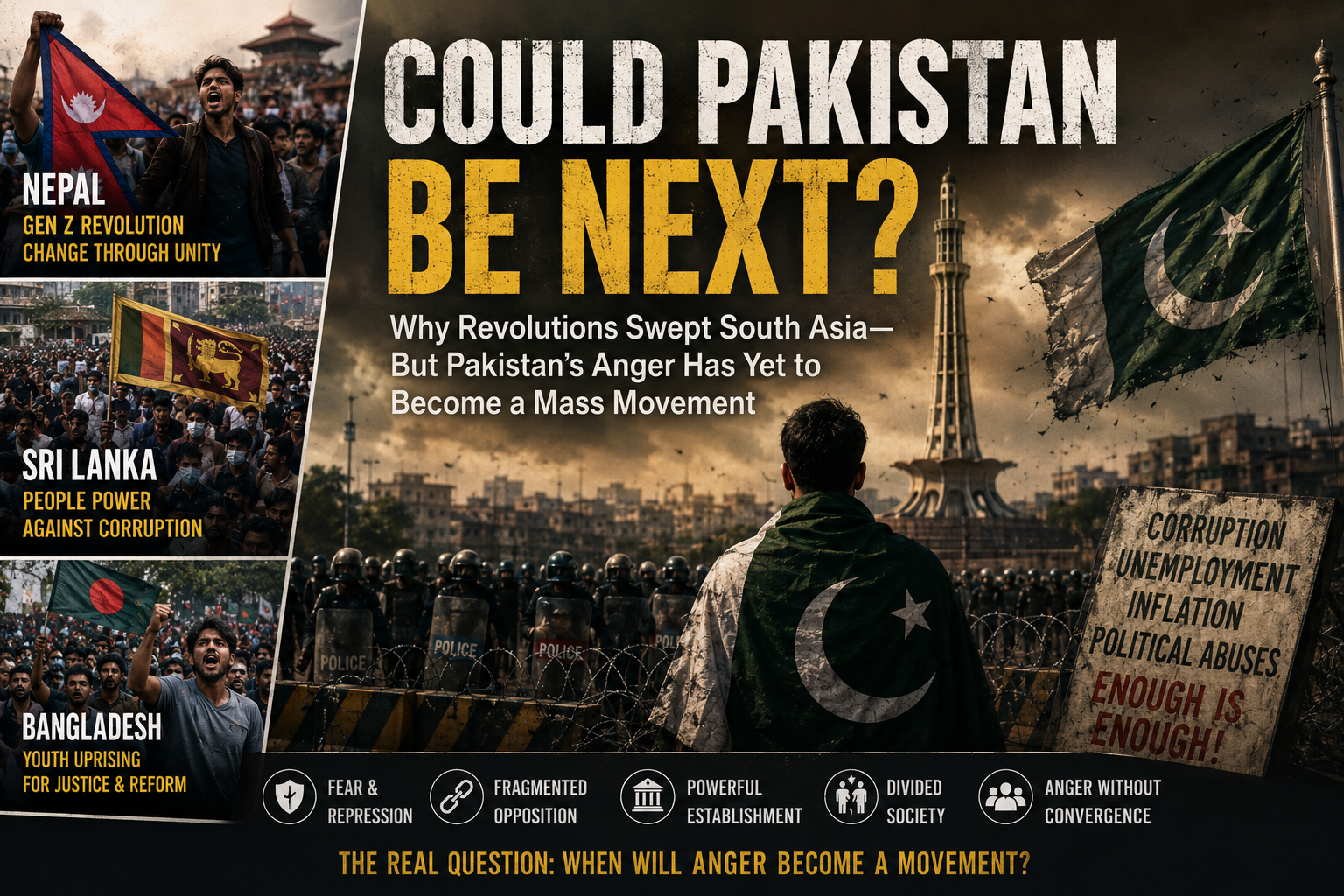
Could Pakistan Be Next? Why Revolutions Swept South Asia—But Pakistan’s Anger Has Yet to Become a Mass Movement
I think your observation—that Pakistan has many of the grievances seen before the upheavals in Sri Lanka, Bangladesh and Nepal, yet no comparable nationwide movement appears imminent—is quite plausible. But fear is only one part of the explanation. Pakistan has several structural differences that make a Bangladesh-, Nepal-, or Sri Lanka-style uprising harder to develop and sustain.
One caution first: nobody can reliably predict a revolution. These events often look impossible until shortly before they occur. What we can examine are the conditions that make mass mobilization more or less likely.
Pakistan has grievances that could produce mass mobilization
There is clearly substantial political frustration. Freedom House’s 2026 assessment gives Pakistan 32/100 for political rights and civil liberties and 27/100 for internet freedom, describing military influence over elections and government formation, restrictions on civil liberties, and pressure on the media. Human Rights Watch similarly says that during 2025 authorities intensified suppression of political opposition, media and civil society.
There is also evidence that opposition sentiment remains electorally substantial. Despite restrictions placed on PTI and the loss of its electoral symbol, PTI-affiliated independents won the largest number of directly elected National Assembly seats in the February 2024 election. Freedom House cites this as evidence that voters showed some resilience despite the constraints surrounding the election.
So I would not interpret the absence of a revolution as absence of public dissatisfaction.
And yes—the fear factor is real
This is probably one significant difference.
Pakistanis have seen what can happen when political demonstrations cross certain lines.
After the May 9, 2023 unrest, arrests, prosecutions and military trials created a powerful deterrent effect. Freedom House reports that all 85 PTI supporters tried in military courts over the May 2023 riots were convicted and received sentences of up to ten years.
Then came the Islamabad protests of November 2024.
Authorities locked down Islamabad and much of Punjab, made mass arrests and suspended internet and mobile services. Freedom House reports that at least six people were killed in clashes involving protesters and security forces.
The exact circumstances and casualty claims surrounding November 26 have been politically contested, so I would be careful about presenting the most dramatic claims from either PTI or the government as established fact. But the broader pattern—roadblocks, arrests, communications restrictions and lethal clashes—is well documented.
That matters psychologically.
A potential demonstrator is not simply asking:
“Do I support this cause?”
He or she may effectively be asking:
“If I go out, could I be arrested, injured, lose my employment, face a criminal case, or put my family at risk?”
Once enough people make that calculation, repression can raise the threshold required for mass mobilization.
Freedom House explicitly reports a deterioration in freedom of assembly, citing authorities’ interference with major rallies through force and mass arrests.
So yes, deterrence and fear are part of the explanation.
But I don’t think they are the whole explanation.
Pakistan’s bigger problem: fragmented anger
This is where Pakistan differs considerably from the recent South Asian examples.
A successful mass uprising normally requires many different sections of society temporarily to agree that one problem is more important than their differences.
Sri Lanka reached something close to that point during the catastrophic 2022 economic crisis.
Bangladesh’s 2024 student movement expanded dramatically beyond its original quota dispute.
Nepal’s Gen-Z movement similarly grew beyond its immediate social-media issue into broader demands concerning corruption and governance.
Pakistan’s dissatisfaction, by contrast, remains highly fragmented.
One Pakistani may see the central problem as the treatment of Imran Khan.
Another may dislike both PTI and the government.
Another is primarily concerned about inflation and employment.
A Baloch activist may be focused on disappearances and provincial rights.
A Pashtun activist may have a different set of grievances.
Urban middle-class voters, farmers, traders, religious organizations, lawyers, students, government employees and industrial workers do not necessarily perceive the country’s crisis through the same political lens.
Anger exists, but anger is not automatically collective action.
That distinction is extremely important.
PTI’s strength may paradoxically limit a broader revolution
There is another interesting factor.
Much of Pakistan’s anti-establishment political energy is associated with one party and one leader—PTI and Imran Khan.
That gives the opposition enormous mobilizing power.
But it also creates a ceiling.
Someone who strongly dislikes the existing political order but also dislikes Imran Khan may refuse to participate in something perceived as a “PTI protest.”
That is different from a genuinely cross-party citizens’ movement.
A revolutionary-type movement would become much more significant if its identity changed from:
“PTI versus the government”
to something closer to:
“citizens versus an unacceptable political system.”
That transformation has not convincingly occurred.
Pakistan’s state is also unusually powerful
This may be the biggest structural difference.
Pakistan isn’t simply governed through a civilian administration.
Its military is one of the country’s strongest and most organized institutions and historically has exercised substantial influence over politics. Freedom House describes the military as exercising enormous influence over elections, government formation and policy.
Compare this with a critical moment in many successful revolutions.
Eventually the state’s coercive apparatus becomes uncertain.
Police hesitate.
Civil servants stop cooperating.
Political allies defect.
Business elites change sides.
Judges resist.
Or security forces decide that preserving the incumbent government is no longer worth the cost.
That elite fracture is frequently more important than the number of protesters.
Pakistan has not clearly reached such a point.
And this is why simply saying “millions should come onto the streets” misses something important.
Revolutions usually succeed not merely because protesters become stronger.
They succeed because the ruling coalition becomes weaker and begins splitting internally.
The internet environment matters too
Pakistan’s authorities have become increasingly capable of disrupting digital mobilization.
Freedom House classifies Pakistan’s internet as “Not Free” at 27/100 and documents internet restrictions during political protests, the prolonged blocking of X, pressure surrounding VPNs and expansion of cybercrime legislation.
That is particularly relevant after Bangladesh and Nepal.
If communications can be throttled or disrupted precisely when demonstrations begin, organizers face a much greater coordination problem.
Yet this also has limits. Governments can suppress communication; they cannot necessarily eliminate the underlying grievance.
One thing could change everything: a non-partisan trigger
This is where I would watch Pakistan carefully.
The next major Pakistani movement may not begin with Imran Khan at all.
Historically, revolutionary situations are frequently triggered by something that initially appears relatively limited.
It could hypothetically be a severe economic shock, a disputed political event, an incident involving students, a major corruption revelation, an unpopular law, an institutional confrontation, or a highly visible incident of state violence.
The important question would not be the original incident.
It would be whether ordinary people suddenly conclude:
“This is no longer about PTI, PML-N, PPP or one politician. This concerns all of us.”
That psychological transition is what Pakistan currently lacks.
There is another paradox about repression
Heavy repression can suppress movements successfully.
But it can also eventually have the opposite effect.
Political scientists sometimes describe this as the backfire effect of repression.
If people believe demonstrations will be punished severely, fear increases and participation falls.
But if an incident is perceived by a sufficiently broad section of society as extraordinarily unjust, repression itself can become the mobilizing grievance.
That appears to have contributed to escalation in Bangladesh and Nepal.
The crucial variable isn’t simply whether protesters are killed.
It is how society interprets those deaths.
If society thinks:
“Those were supporters of Party X fighting the government,”
mobilization may remain partisan.
If society instead thinks:
“Those were our children,”
the political consequences can be radically different.
That distinction is enormous.
So could Pakistan experience something similar?
Yes, absolutely possible.
But based on the present structural conditions, I would not say that a Nepal/Bangladesh-style nationwide revolution is imminent.
I would characterize Pakistan instead as having:
high grievances + strong opposition sentiment + substantial youth frustration + constrained political space + powerful state institutions + fragmented opposition + significant fear of repression.
That combination produces something different from revolutionary momentum:
pressure without convergence.
Pakistan has anger.
Pakistan has grievances.
Pakistan has political polarization.
Pakistan has a large young population.
Pakistan has demonstrated an ability to mobilize very large crowds.
What it presently lacks is the crucial ingredient visible in successful mass uprisings:
a broad coalition crossing party, class, provincial and ideological boundaries.
And until that appears, your observation that you cannot presently see such a movement developing is reasonable.
But there is one lesson from Sri Lanka, Bangladesh and Nepal worth remembering: political stability and revolutionary stability are not the same thing. A country can appear politically frozen for years and then change extraordinarily quickly once economic grievance, political grievance and a catalytic event converge at the same moment.
For Pakistan, therefore, I wouldn’t primarily watch the size of PTI rallies.
I would watch something else:
When people who don’t support PTI begin protesting alongside people who do.
If students, lawyers, traders, workers, professionals, civil-society groups and politically unaffiliated citizens start mobilizing around the same institutional demands rather than around one politician, that would be a much stronger indicator that Pakistan was approaching the kind of political moment recently seen elsewhere in South Asia.
And even then, the preferable outcome would be a peaceful constitutional democratic movement—not violent revolution. Bangladesh, Sri Lanka and Nepal also demonstrate that removing a government is much easier than building stable institutions afterward. The ultimate measure of success is not whether crowds can bring down rulers, but whether citizens can obtain accountable institutions without paying for change with more lives.
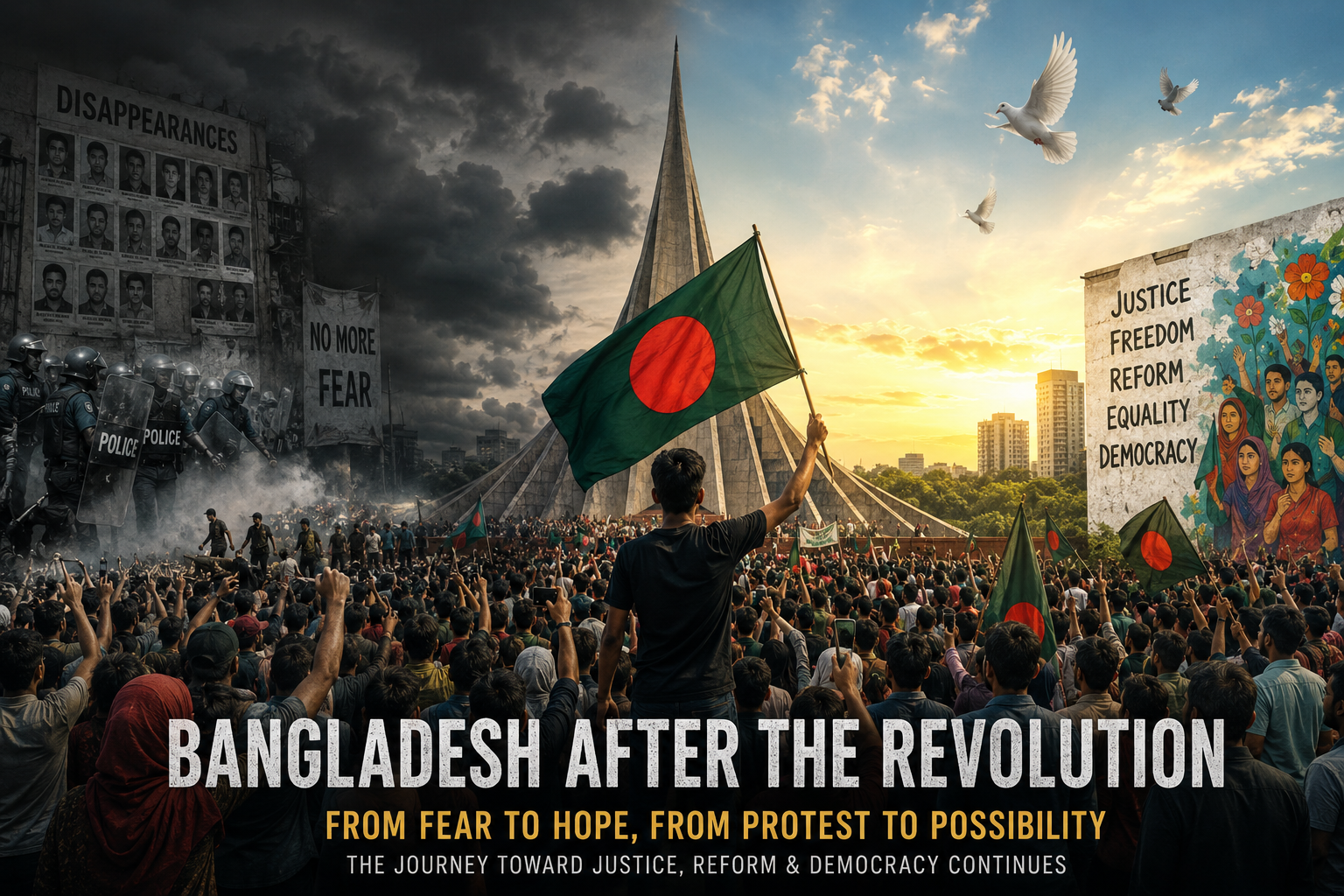
Bangladesh After the July Revolution: Did the People Get What They Wanted?
From the Fall of Sheikh Hasina to the Struggle for a New Political Order!
Bangladesh’s July–August 2024 uprising was one of the most consequential political events in the country’s history. What began as a student movement against quotas in government employment developed into a nationwide revolt against Prime Minister Sheikh Hasina and the political system that had evolved during her roughly fifteen years in power.
By 5 August 2024, Hasina’s government had collapsed and she fled to India. An interim administration headed by Nobel laureate Muhammad Yunus subsequently took responsibility for governing the country and initiating institutional reforms. The transition eventually led to parliamentary elections in February 2026, won decisively by the Bangladesh Nationalist Party (BNP), bringing Tarique Rahman to power. (YouTube)
Two years after the uprising, however, the central question is no longer simply whether the revolution succeeded in removing Sheikh Hasina. It is whether it succeeded in changing the political system that produced the uprising in the first place.
The evidence presents a complicated picture.
Bangladesh has unquestionably changed. The extraordinary concentration of political power that characterized the final years of the Hasina government was broken. Investigations into disappearances and other abuses became possible. Some restrictions on political and civic activity eased, constitutional reform became a national issue, and Bangladesh eventually returned to electoral government.
At the same time, many of the mechanisms that Bangladeshis revolted against—politically motivated arrests, weak institutions, restrictions on expression, police abuses and political intimidation—did not disappear. In addition, the post-revolutionary period produced new problems, particularly mob violence, attacks on minorities and journalists, pressure from religious hardliners, political revenge and concerns about the exclusion of the Awami League.
The revolution therefore achieved regime change much more successfully than it achieved systemic change.
1. What Was the July Revolution Actually About?
Understanding whether Bangladeshis “got what they wanted” requires understanding what protesters wanted.
The immediate issue was relatively narrow: government employment quotas.
A court decision had revived a quota system reserving a substantial proportion of public-sector positions for particular categories, including descendants of veterans of Bangladesh’s 1971 independence war. University students argued that government jobs should primarily be allocated according to merit.
But the quota dispute was only the trigger.
The UN investigation into the uprising concluded that the protests were rooted in broader grievances concerning politics, governance and economic inequality. (YouTube)
The movement consequently evolved.
Stage One: Reform the quota system
The original student demand concerned reforming recruitment to government employment.
Stage Two: Justice for protesters
When security forces and government supporters responded violently, the issue became accountability.
Students began demanding justice for those who had been killed, injured or arrested.
Stage Three: Political change
As deaths increased, the movement became a broader rejection of Hasina’s government.
The demand was no longer simply:
“Reform the quota system.”
It effectively became:
“Change the political system.”
That distinction is essential when judging the revolution’s success.
2. Bangladesh Before the Revolution
Bangladesh under Sheikh Hasina cannot be understood solely through the events of July 2024.
For years before the uprising, international human-rights organizations had documented serious problems involving elections, political opposition, security agencies, disappearances, freedom of expression and the independence of institutions.
Freedom House’s 2024 assessment gave Bangladesh a score of 40 out of 100 and classified it as “Partly Free.” It described sustained harassment of the BNP and other opponents, pressure on independent media and civil society, endemic corruption, weak due-process protections and human-rights violations by security forces operating with substantial impunity. (Freedom House)
These problems developed over many years.
3. Enforced Disappearances and Extrajudicial Abuses
One of the darkest aspects of the pre-revolutionary period involved enforced disappearances.
Human Rights Watch reported that Bangladeshi human-rights monitors had documented more than 600 enforced disappearances since 2009.
Some victims eventually returned home or appeared in court. Others were reported killed.
Nearly 100 remained missing at the time of HRW’s 2024 assessment. (Human Rights Watch)
Security institutions—particularly the police, intelligence agencies and Rapid Action Battalion—were repeatedly accused of serious abuses.
The political consequences were significant.
When opposition activists believed that arrest could lead not simply to prosecution but potentially disappearance, torture or prolonged detention, fear itself became an instrument of political control.
That created a political environment in which formal democratic institutions continued to exist while the practical space for challenging the government became increasingly restricted.
4. Elections Without Effective Political Competition
Another major grievance concerned elections.
Bangladesh continued to hold elections during Hasina’s rule, but opposition parties and international observers increasingly questioned whether genuine political competition remained possible.
The January 2024 election was especially controversial. The BNP boycotted the vote after demanding a neutral caretaker administration.
The Awami League consequently retained overwhelming control.
The deeper problem was therefore institutional.
A democracy requires more than polling stations. It requires:
competitive political parties,
an independent election administration,
freedom of political organization,
independent media,
an impartial judiciary,
and security forces that do not operate as political instruments.
By the end of Hasina’s rule, critics argued that several of these safeguards had become seriously weakened.
5. Freedom of Expression Before the Revolution
Restrictions on speech were another major source of criticism.
Bangladesh’s Digital Security Act, followed by the Cyber Security Act of 2023, allowed authorities considerable power over online expression.
Journalists, activists, writers and government critics could face legal consequences for speech.
Amnesty International concluded that the Cyber Security Act essentially repackaged many of the repressive characteristics of earlier legislation and had been used against journalists, human-rights defenders and political dissent. (Amnesty International)
This produced an important secondary effect:
self-censorship.
People do not need to be arrested every time they criticize a government for political repression to work. If journalists, academics and ordinary citizens believe criticism could result in arrest, harassment or prosecution, many will simply remain silent.
6. The 2024 Crackdown Changed Everything
The decisive turning point came when the government attempted to suppress the student protests.
The UN Human Rights Office later conducted an extensive investigation.
Its findings were devastating.
The UN estimated that as many as 1,400 people may have been killed between 1 July and 15 August 2024, with thousands more injured. The majority of those killed were reportedly shot by Bangladeshi security forces.
The report estimated that approximately 12–13 percent of those killed were children. (YouTube)
The UN investigation concluded that there were reasonable grounds to believe that hundreds of extrajudicial killings, arbitrary arrests, torture and other serious violations occurred as part of a coordinated strategy to suppress the demonstrations.
It also found reasonable grounds for further investigation into whether some violations constituted crimes against humanity. (YouTube)
This changed the character of the movement.
The government’s violence did not destroy the protest movement.
It expanded it.
Students who originally demanded employment reform were joined by families, professionals, workers and ordinary citizens increasingly outraged by the deaths.
The government’s attempt to preserve itself ultimately accelerated its collapse.
7. 5 August 2024: Victory or Merely the Beginning?
When Sheikh Hasina left Bangladesh, millions of people understandably viewed the moment as liberation.
But removing an authoritarian leader is easier than removing authoritarian political structures.
That became the central problem of post-revolution Bangladesh.
The Muhammad Yunus-led interim government inherited:
weakened institutions,
a politicized bureaucracy,
deeply distrusted police forces,
economic difficulties,
political polarization,
demands for justice,
demands for elections,
and demands for constitutional transformation.
Those goals frequently conflicted.
Some Bangladeshis wanted elections immediately.
Others argued that elections without institutional reform would simply reproduce the old political system with a different party controlling it.
The fundamental post-revolutionary debate therefore became:
Reform first, or elections first?
8. What Improved After the Revolution?
Despite today’s frustrations, it would be inaccurate to claim that nothing changed.
Several important developments occurred.
The atmosphere of state fear weakened
Human Rights Watch’s assessment of 2025 concluded that some of the fear and repression characteristic of Hasina’s rule—including widespread enforced disappearances—appeared to have ended. (Human Rights Watch)
That is significant.
For families who spent years searching for relatives allegedly taken by security agencies, even the possibility of investigating what happened represented an enormous political change.
9. Investigations Into Enforced Disappearances
The interim government established a commission investigating enforced disappearances and extrajudicial killings committed during Awami League rule.
By August 2025, the commission had reportedly received more than 1,850 complaints.
Investigators told Human Rights Watch that they had collected significant evidence.
However, they also alleged that security officials had destroyed evidence, refused cooperation and resisted accountability. (Human Rights Watch)
This illustrates both the achievement and limitation of the revolution.
Before August 2024, the state largely rejected accusations of systematic disappearances.
After the revolution, the state itself began investigating them.
That represents genuine progress.
But an investigation is not the same thing as institutional transformation.
10. International Human-Rights Cooperation Increased
Another positive development was greater cooperation with international human-rights institutions.
The interim government invited the UN Human Rights Office to investigate the 2024 violence and provided substantial cooperation with the investigation. (YouTube)
Bangladesh subsequently agreed to establish a UN human-rights presence in the country and acceded in 2025 to the Optional Protocol to the Convention Against Torture, an international mechanism intended to strengthen safeguards against torture and mistreatment in detention. (Amnesty International)
These were meaningful departures from the defensive approach that had characterized earlier responses to international criticism.
The revolution also opened political space for discussions that would previously have been extraordinarily difficult.
The interim government established multiple commissions addressing areas including:
constitutional reform,
electoral reform,
judiciary reform,
police reform,
women’s rights,
labor rights,
and governance.
A National Consensus Commission attempted to convert these recommendations into an agreed reform package.
The resulting July Charter became one of the most important political legacies of the uprising. (Human Rights Watch)
Ideas discussed included limiting prime-ministerial power, strengthening judicial independence, changing constitutional appointments, strengthening fundamental rights and restructuring Parliament.
This is arguably where the revolution’s most important long-term legacy may eventually lie.
12. But the Reform Process Disappointed Many
The problem was implementation.
Human Rights Watch concluded that many promised reforms stalled because political actors failed to reach agreement and relatively few changes were implemented quickly. (Human Rights Watch)
This created growing frustration among people who believed the revolution had created a once-in-a-generation opportunity to redesign Bangladesh’s political institutions.
The fear was straightforward:
If institutional reform remained incomplete and conventional political parties simply returned to power, Bangladesh could eventually recreate the same system under different leadership.
That concern remains relevant today.
13. Political Arrests Did Not Disappear
Perhaps the clearest contradiction of post-revolutionary Bangladesh was the continuation of politically motivated detention.
The victims changed.
The method did not entirely disappear.
Human Rights Watch documented thousands of arrests of people perceived as political opponents during the interim period.
After clashes in February 2025, the government’s “Operation Devil Hunt” reportedly resulted in at least 8,600 arrests.
Hundreds of Awami League figures and supporters were detained, sometimes in cases containing huge numbers of unnamed suspects. (Human Rights Watch)
This creates an uncomfortable parallel.
Under Hasina:
Opposition supporters complained of politically motivated arrests.
After Hasina:
Awami League supporters complained of politically motivated arrests.
The political identity of the accused changed.
The weakness of due process did not disappear.
That is precisely the kind of institutional continuity protesters hoped the revolution would end.
14. The Awami League Ban Created a Democratic Contradiction
The interim government’s decision in May 2025 to ban Awami League activities became one of the most controversial developments of the transition.
The restrictions included meetings, publications and some forms of online political advocacy.
Human-rights organizations questioned whether such measures were compatible with freedom of association. (Amnesty International)
There is an obvious dilemma.
Senior officials responsible for grave crimes should face prosecution.
Political organizations implicated in violence cannot simply demand immunity.
But criminal responsibility should ordinarily be individualized.
Punishing an entire political constituency risks reproducing the exclusionary political logic that the revolution was supposed to overcome.
This is one reason the post-revolutionary human-rights record cannot be described simply as democratic liberation.
15. Freedom of Speech: Better, but Still Vulnerable
Freedom of expression illustrates the same pattern.
The revolution created a much broader political debate and destroyed many of the psychological barriers surrounding criticism of the Hasina government.
But legal restrictions did not disappear.
The Cyber Security Act continued operating during the interim period before being replaced in 2025 by a Cyber Security Ordinance.
Amnesty International found that although the new system represented change, broad or vaguely defined provisions remained that could potentially be abused. (Amnesty International)
Journalists and writers continued facing harassment, violence and legal action.
Therefore:
The space for speech expanded politically, but the institutional protection of free speech remained incomplete.
16. The Rise of Mob Violence
One of the most disturbing developments after the revolution was the growth of mob violence.
When an authoritarian state collapses, state repression may decrease without the rule of law automatically improving.
That appears to have happened to some extent in Bangladesh.
Police forces, discredited by their role in suppressing the uprising, became less effective in maintaining public order.
Human Rights Watch reported an alarming increase in violence by political groups, mobs and religious hardliners.
According to figures cited by HRW from Ain O Salish Kendra, at least 124 people were killed in mob attacks between June and August 2025 alone. (Human Rights Watch)
This demonstrates an important distinction:
Freedom from an oppressive state is not necessarily the same as security under the rule of law.
Citizens require protection from both.
17. Minorities and Religious Freedom
Another major concern involves religious and ethnic minorities.
Bangladesh has long struggled with periodic attacks against Hindus, Buddhists, indigenous communities and other minorities.
Political instability following the revolution created additional vulnerabilities.
Human Rights Watch documented attacks against ethnic and religious minorities during the transition. (Human Rights Watch)
Some attacks were politically motivated, some communal and some involved overlapping political and religious identities.
This issue has also become heavily politicized internationally, particularly in relations between Bangladesh and India.
Nevertheless, the broader conclusion from human-rights organizations is clear:
The post-revolutionary government did not consistently provide sufficient protection against communal and mob violence.
18. Women’s Rights: A Particularly Important Test
Women played an important role in the July uprising.
Yet the political transition did not necessarily translate into greater protection for women’s rights.
A government-appointed women’s rights commission proposed reforms including stronger representation, changes to family laws and criminalization of marital rape.
The proposals produced strong opposition from Islamist organizations.
Human Rights Watch reported that nearly 20,000 supporters of Hefazat-e-Islam demonstrated in Dhaka against proposed reforms and related issues. (Human Rights Watch)
This reveals another contradiction of the revolution.
A movement in which young women participated prominently helped overthrow an authoritarian government.
Yet the political opening that followed also created greater space for socially conservative and Islamist movements.
Political liberalization therefore does not automatically produce social liberalization.
19. Accountability for Sheikh Hasina
One of the clearest demands after the uprising was justice for the people killed in 2024.
The post-revolutionary authorities pursued cases against Hasina and other former officials.
Bangladesh’s International Crimes Tribunal eventually convicted Hasina in absentia of crimes against humanity related to the suppression of the uprising and sentenced her to death. (Human Rights Watch)
For families of victims, accountability represented a central demand of the revolution.
But human-rights organizations raised serious concerns about the tribunal’s procedures.
Human Rights Watch argued that despite reforms, important due-process problems remained and criticized the continued use of the death penalty. (Human Rights Watch)
That creates another important principle.
Justice after authoritarianism must not become revenge administered through another flawed judicial process.
If the revolution was partly about restoring rule of law, trials of former rulers must meet especially high standards.
20. The Return to Electoral Government
Bangladesh eventually held parliamentary elections in February 2026.
The BNP won decisively, bringing Tarique Rahman to power and ending the interim phase. Reuters described the result as a landslide BNP victory. (YouTube)
This represented a major milestone.
For the first time since the revolution, Bangladesh again had an elected government.
But elections themselves do not settle the revolution’s central question.
The question now becomes whether the BNP government will institutionalize the reforms promised after July 2024—or gradually return Bangladesh to the winner-takes-all politics that characterized previous decades.
Recent analysis has also emphasized the continuing political and economic influence of the military, suggesting that strengthening civilian institutions remains essential to Bangladesh’s democratic consolidation. (Financial Times)
21. So, Did the People Get What They Wanted?
There is no single answer because the revolution contained different groups with different expectations.
But we can evaluate several major demands.
Demand
Outcome
Removal of Sheikh Hasina
Achieved
End of Awami League monopoly on power
Achieved
Accountability for July killings
Partially achieved / ongoing
Investigation of disappearances
Significant progress
End politically motivated arrests
Not achieved
Independent institutions
Partially achieved / unfinished
Greater freedom of expression
Improved but incomplete
Police/security-sector reform
Incomplete
Constitutional reform
Partially achieved / continuing
End authoritarian political culture
Not yet achieved
Protection of minorities
Insufficient
Protection of women and vulnerable groups
Mixed
Restoration of competitive elections
Substantially achieved
Stable rule of law
Not achieved sufficiently
Therefore, the most defensible conclusion is:
Bangladeshis won the right to attempt to build a different political system. They did not automatically receive that system when Sheikh Hasina fell.
22. Human Rights Before and After: The Fundamental Difference
The character of human-rights problems has changed.
Before the revolution
The greatest danger came from an increasingly centralized state.
The main problems included:
enforced disappearances,
security-force impunity,
suppression of opposition parties,
politically motivated detention,
restrictions on journalism,
restrictive cyber laws,
questionable elections,
concentration of executive power,
and finally massive state violence against protesters.
After the revolution
Some of those dangers declined, particularly systematic disappearances and the extreme concentration of political power.
But other problems became more prominent:
mob violence,
political revenge,
arbitrary arrests of former ruling-party supporters,
restrictions on Awami League political activity,
attacks on journalists,
religious intolerance,
threats against women and minorities,
weak policing,
incomplete institutional reform,
and continuing problems with due process.
In simplified terms:
Before 2024, Bangladesh’s central human-rights problem was an increasingly authoritarian state.
After 2024, the central problem became building a functioning democratic state capable of protecting rights while preventing political revenge, mob rule and another concentration of power.
23. Has Bangladesh Become More Democratic?
In certain respects, yes.
Freedom House’s current country profile gives Bangladesh 44/100, compared with 40/100 in its 2024 report. Both assessments classify the country as “Partly Free.” (Freedom House)
That four-point difference should not be exaggerated.
But it illustrates the broader pattern.
Bangladesh is not simply where it was before August 2024.
Nor has it become a consolidated liberal democracy.
It is somewhere in between.
The country has moved from an entrenched political order into a contested transition.
24. The Greatest Risk: Replacing One Ruling Elite With Another
The history of revolutions shows that removing an individual is considerably easier than changing institutions.
Bangladesh’s old political system concentrated enormous power in whoever controlled the executive branch.
That creates a recurring danger.
If institutions remain weak, every opposition party campaigns for democracy while outside government—and discovers the advantages of centralized authority after winning power.
That cycle has affected Bangladeshi politics for decades.
The real success of the July Revolution will therefore not be determined by whether Sheikh Hasina returns.
It will be determined by whether future governments become institutionally incapable of governing the way her government eventually did.
That requires:
independent courts, professional police, accountable intelligence services, competitive elections, independent media, protection for opposition parties and constitutional limitations on executive authority.
Without these safeguards, Bangladesh could eventually reproduce authoritarianism under a different political banner.
25. The Revolution’s Unfinished Promise
Two years later, describing Bangladesh’s revolution as either a complete success or complete failure is misleading.
It succeeded at its first historical task:
breaking an entrenched government that had become increasingly authoritarian.
It has only partially succeeded at its second:
creating a political system in which authoritarianism cannot easily return.
And it has struggled considerably with its third:
establishing effective rule of law while protecting minorities, political opponents, journalists, women and ordinary citizens from both state and non-state violence.
The distinction between these achievements matters.
Removing a government can happen in days.
Reforming police forces takes years.
Building independent courts takes years.
Changing political culture may take generations.
Conclusion
The July 2024 uprising fundamentally altered Bangladesh’s political trajectory.
Before the revolution, the country had experienced years of increasing political centralization, harassment of opposition parties, restrictions on expression, allegations of disappearances and security-force abuses, culminating in an extraordinarily violent crackdown in which the United Nations estimates that as many as 1,400 people were killed. (YouTube)
The revolution ended that political order.
But it did not eliminate the institutions and political habits that sustained it.
Post-revolutionary Bangladesh experienced genuine improvements: greater scrutiny of security agencies, investigations into disappearances, international human-rights cooperation, constitutional reform efforts and ultimately a return to electoral government.
At the same time, arbitrary detention continued, mob violence increased, journalists and minorities faced threats, Islamist pressure on social issues became more visible, the Awami League was banned from political activity during the transition, and major institutional reforms remained incomplete. Human Rights Watch consequently concluded that the interim government struggled both to maintain law and order and to deliver promised human-rights reforms. (Human Rights Watch)
The answer to “Did the people get what they wanted?” is therefore:
Partly.
They removed the government they revolted against.
They opened the door to accountability.
They reopened fundamental questions about Bangladesh’s constitution and institutions.
They eventually returned the country to elected government.
But they have not yet secured the deeper objective behind the revolution: a political system in which citizens do not need another revolution to remove an abusive government.
That is the unfinished legacy of July 2024.
Bangladesh’s revolution should therefore be understood not as the completion of a democratic transformation, but as the beginning of one.
Whether that transformation ultimately succeeds will depend less on who occupies the prime minister’s office and more on whether Bangladesh can build institutions strong enough to restrain whoever occupies it.
References and Sources
United Nations Office of the High Commissioner for Human Rights (OHCHR) — Fact-finding investigation into human-rights violations during the July–August 2024 protests. The UN investigation is the principal source for the estimate of up to 1,400 deaths and findings concerning extrajudicial killings, arbitrary detention and torture. (YouTube)
Human Rights Watch — World Report 2024: Bangladesh. Useful for establishing the human-rights situation immediately before the revolution, particularly disappearances, political repression, security-force abuses and opposition arrests. (Human Rights Watch) Human Rights Watch: Bangladesh 2024
Human Rights Watch — World Report 2026: Bangladesh. One of the main sources for evaluating the post-revolutionary period, including arrests, mob violence, reform efforts, accountability, minority rights and freedom of expression. (Human Rights Watch) Human Rights Watch: Bangladesh 2026
Amnesty International — Bangladesh human-rights reporting. Used particularly for freedom of expression, political association and developments involving the Cyber Security Act and Cyber Security Ordinance. (Amnesty International) Amnesty International: Bangladesh
Amnesty International — “Repackaging Repression: The Cyber Security Act and the Continuing Lawfare Against Dissent in Bangladesh.” Important background on restrictions on expression under the pre-revolutionary government. (Amnesty International) Amnesty report on the Cyber Security Act
Freedom House — Freedom in the World 2024: Bangladesh. Used for the pre-revolution assessment of political rights, civil liberties, opposition harassment, corruption and security-force impunity. (Freedom House) Freedom House: Bangladesh 2024
Freedom House — Bangladesh Country Profile / Freedom in the World 2026. Useful for comparing Bangladesh’s international democracy and civil-liberties assessment before and after the uprising. (Freedom House) Freedom House: Bangladesh country profile
Reuters — February 2026 Bangladesh election reporting. Used to confirm the BNP’s victory and Bangladesh’s return to elected government. (YouTube)
Associated Press — August 2026 reporting on Sheikh Hasina, the uprising and current Bangladesh political situation. Useful for checking developments around the second anniversary of the revolution. (AP News)
Financial Times — August 2026 analysis of Bangladesh’s military and political transition. Used particularly for the continuing question of military influence and institutional democratic consolidation. (Financial Times)
Research note: The article evaluates the situation through 8 August 2026. Human-rights conditions and implementation of the July-era reforms remain fluid, so conclusions about the revolution’s ultimate success should be treated as provisional rather than final.
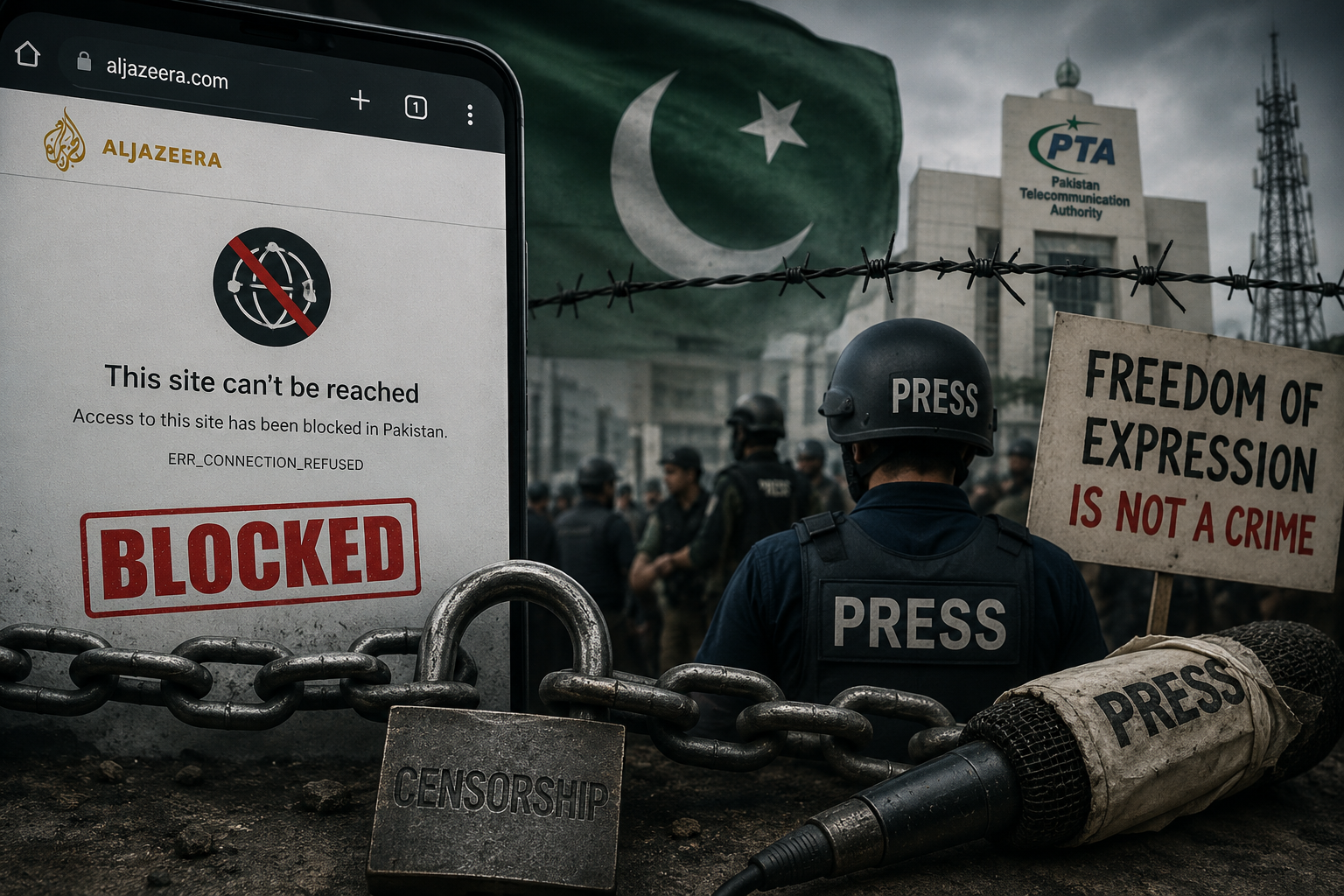
Pakistan’s Shrinking Civic Space: Media Restrictions and Human Rights Concerns
Recent reports regarding the inaccessibility of Al Jazeera’s English website in Pakistan have once again raised concerns about press freedom and the broader state of civil liberties in the country. While this incident has attracted international attention, many journalists, human rights organizations, and media observers argue that it reflects a wider trend of increasing restrictions on independent reporting and democratic freedoms.
Al Jazeera Access Restrictions
Following Al Jazeera’s coverage of protests and election-related developments in Pakistan-administered Kashmir (Azad Jammu & Kashmir), many internet users in Pakistan reported being unable to access the broadcaster’s English website. Although no publicly available order from the Pakistan Telecommunication Authority (PTA) has been released confirming the restriction, Pakistan’s Ministry of Information publicly criticized Al Jazeera’s reporting, describing it as “selective reporting” and “yellow journalism.”
The reported restrictions have drawn criticism from international media organizations and press freedom advocates, who argue that access to diverse sources of information is an essential component of a democratic society.
A Broader Pattern of Media Restrictions
The Al Jazeera incident is viewed by many observers as part of a broader pattern of increasing regulation and control over media reporting in Pakistan.
Recent developments reported by international and local media include:
New guidelines requiring foreign journalists to obtain official permission before reporting from many parts of the country.
Expanded accreditation requirements for Pakistani journalists working with international media organizations.
Broad provisions allowing authorities to suspend or revoke journalist accreditation under certain conditions.
Continued concerns regarding internet disruptions, content blocking, and restrictions on digital platforms during politically sensitive events.
Journalist organizations, including the Pakistan Federal Union of Journalists (PFUJ), the Human Rights Commission of Pakistan (HRCP), the Committee to Protect Journalists (CPJ), and Reporters Without Borders (RSF), have expressed concern that these measures may discourage independent journalism and reduce transparency.
Human Rights and Democratic Concerns
Beyond media freedom, international human rights organizations have continued to express concern over the broader civic environment in Pakistan.
Reports from organizations such as Human Rights Watch, Amnesty International, the Human Rights Commission of Pakistan, and Reporters Without Borders have highlighted issues including:
Restrictions on freedom of expression.
Pressure on journalists and independent media outlets.
Arrests and legal proceedings involving political activists.
Internet shutdowns and online censorship.
Limitations on peaceful assembly and public protest.
Concerns regarding judicial independence and due process in politically sensitive cases.
While the government has consistently stated that many of these measures are necessary to maintain national security, public order, and combat misinformation, critics argue that the cumulative effect has been a narrowing of democratic space.
Public Debate
Social media platforms, independent commentators, and international observers continue to debate the balance between national security and civil liberties.
Supporters of the government’s approach argue that stronger regulation is necessary to protect national interests and counter misinformation, particularly during periods of political tension.
Critics contend that increasing restrictions on journalists, media organizations, and online platforms reduce government accountability, limit access to independent information, and weaken democratic institutions.
These discussions remain highly polarized, reflecting Pakistan’s broader political divisions.
Conclusion
The reported restriction of Al Jazeera’s website has become another focal point in an ongoing debate about media freedom and human rights in Pakistan. Although opinions differ sharply regarding the government’s actions, international press freedom organizations and human rights groups continue to warn that expanding restrictions on journalism, public expression, and access to information may have long-term implications for democratic governance and the protection of fundamental rights.
References
The Guardian. Pakistani authorities ban international media from reporting in most of country (2026).
Associated Press (AP). Coverage of restrictions affecting Al Jazeera and media regulations in Pakistan (2026).
Human Rights Watch – Pakistan reports.
Amnesty International – Pakistan reports.
Human Rights Commission of Pakistan (HRCP).
Committee to Protect Journalists (CPJ).
Reporters Without Borders (RSF) – World Press Freedom Index and Pakistan reports.
Comprehensive Country-by-Country Assessment of Global Human Rights, Civil Liberties, and Institutional Protections.
Executive Summary & Methodology
Evaluating human rights requires moving beyond superficial political labels. The Lakho Human Freedom & Rights Index (LHFRI) assesses 130 countries using a composite evaluation model. The index synthesizes data from global civil society trackers, judicial monitors, press freedom groups, and international legal repositories.
Each country receives an overall score on a 0 to 100 scale, calculated across four core, equally weighted pillars (25% each):
Physical Integrity & Safety (25%): Freedom from extrajudicial killing, state torture, arbitrary detention, political violence, and forced disappearance.
Civil & Political Liberties (25%): Freedom of speech, press independence, freedom of assembly, electoral integrity, and religious liberty.
Rule of Law & Institutional Integrity (25%): Judicial independence, anti-corruption safeguards, equal protection under the law, and limits on state power.
Nations in Tier 1 feature robust judicial checks, strong protections for political and civil liberties, independent media, and minimal state repression.
Rank
Country
Region
LHFRI Score
Key Evaluation Summary
1
Finland
Europe
98.8
Unmatched press freedom, judicial independence, and low corruption.
2
Norway
Europe
98.5
High individual safety, worker protections, and prison rehabilitation standards.
3
New Zealand
Oceania
98.1
Global lead in public transparency, civic participation, and indigenous rights frameworks.
4
Sweden
Europe
97.7
Comprehensive gender equality, social protections, and civil liberties safeguards.
5
Denmark
Europe
97.4
Highest rule-of-law metrics, institutional trust, and strong press protections.
6
Ireland
Europe
96.2
Rapid expansion of individual rights, press protections, and judicial autonomy.
7
Switzerland
Europe
95.8
Direct democratic checks, strong personal freedoms, and economic autonomy.
8
Iceland
Europe
95.5
Top global rankings for gender equality, safety, and press freedom.
9
Luxembourg
Europe
95.1
Strong institutional safeguards, civic freedoms, and anti-discrimination laws.
10
Netherlands
Europe
94.7
Pioneer in LGBTQ+ legal equality, bodily autonomy, and anti-discrimination protections.
11
Canada
Americas
94.2
Strong civil liberties, minority protections, and independent judiciary.
12
Estonia
Europe
93.8
Global leader in digital rights, information access, and transparent governance.
13
Uruguay
Americas
92.5
Top Latin American country in democratic stability, political rights, and secular law.
14
Australia
Oceania
92.1
Strong democratic mechanisms, free press, and personal safety guarantees.
15
Taiwan
Asia
91.6
East Asia’s most progressive nation for LGBTQ+ rights, press freedom, and open elections.
16
Belgium
Europe
91.2
Robust judicial protections, labor rights, and vibrant civic participation.
17
Austria
Europe
90.9
Solid rule-of-law baseline, strong privacy protections, and political stability.
18
Portugal
Europe
90.5
Progressive drug-decriminalization model, low violent crime, and strong civil rights.
19
Slovenia
Europe
90.2
Strong social equality metrics, press freedoms, and environmental justice protections.
20
San Marino
Europe
90.0
High civic participation, low state overreach, and strong civil liberties.
Tier 2: Strong Protections with Minor Vulnerabilities (Score: 75.0–89.9)
Countries in this tier maintain overall democratic integrity and protection of rights, but face specific challenges like institutional friction, legislative overreach, or systemic inequalities.
Rank
Country
Region
LHFRI Score
Key Evaluation Summary
21
Germany
Europe
89.6
Excellent rights protections; minor concerns over domestic surveillance expansion.
22
Japan
Asia
88.7
High personal safety; areas for improvement in LGBTQ+ equality and criminal defense rights.
23
Spain
Europe
88.1
Broad social liberties; occasional friction over regional political expression.
24
Lithuania
Europe
87.5
High civic rights; strong media protections and anti-corruption efforts.
25
Latvia
Europe
86.9
Strong democratic institutions; ongoing work regarding non-citizen integration.
26
Czechia
Europe
86.4
Strong civil liberties; minor concerns around political polarization.
27
Costa Rica
Americas
85.8
Central America’s model for political stability, human rights, and environmental protections.
28
Chile
Americas
85.0
Strong democratic baseline; ongoing reforms in indigenous representation and policing.
29
United Kingdom
Europe
84.2
Longstanding rights tradition; penalized for protest restrictions and public surveillance laws.
30
Italy
Europe
83.6
Free press and democratic elections; challenged by judicial backlogs and migrant rights policy.
31
Slovakia
Europe
83.0
Robust basic freedoms; recent pressures on public broadcasting and judicial reforms.
32
France
Europe
82.5
Strong legal protections; points deducted for police conduct during protests and secularism laws affecting religious expression.
33
South Korea
Asia
81.8
Vibrant democratic culture; limitations remain on national security laws and labor union actions.
34
United States
Americas
81.0
Broad free speech protections; reduced score due to criminal justice disparities, voting access restrictions, and political polarization.
35
Barbados
Americas
80.5
Strong Caribbean leader in republican governance, personal liberties, and safety.
36
Malta
Europe
80.1
High personal liberties; ongoing international oversight regarding media safety and judicial delays.
37
Croatia
Europe
79.6
Stable democratic baseline; room for growth in whistle-blower protections.
38
Panama
Americas
79.2
Free elections and trade freedoms; challenges in judicial corruption and social equity.
39
Cyprus
Europe
78.7
Solid institutional rights; complicated by island partition and migrant processing facilities.
40
Greece
Europe
78.1
High constitutional safeguards; docked for press monitoring incidents and border management policies.
41
Cabo Verde
Africa
77.6
Africa’s top tier performer in electoral integrity, civil rights, and free expression.
42
Mauritius
Africa
77.0
Stable democratic institution, multi-ethnic civil protections, and strong rule of law.
43
Bahamas
Americas
76.5
Strong civic freedoms; minor challenges regarding prison conditions and judicial backlogs.
44
Trinidad & Tobago
Americas
75.8
Free press and vibrant political debate; impacted by high violent crime rates.
45
Jamaica
Americas
75.1
Strong free expression; penalized for systemic violent crime and police accountability gaps.
Tier 3: Moderate Risk / Hybrid Systems (Score: 50.0–74.9)
Countries where basic rights exist legally, but execution is inconsistent due to corruption, government pressure, security threats, or social tensions.
Rank
Country
Region
LHFRI Score
Key Evaluation Summary
46
Poland
Europe
74.5
Active civil society; rebounding judicial independence following political transitions.
47
Romania
Europe
73.8
Strong EU rights baseline; ongoing struggle against institutional corruption.
48
Mongolia
Asia
73.2
Vibrant democratic island in Central Asia; impacted by resource governance issues.
49
Argentina
Americas
72.5
Strong social movements and free press; economic instability risks social rights delivery.
50
Suriname
Americas
71.8
Independent judiciary; modest infrastructure for protecting economic rights.
51
Ghana
Africa
71.0
Strong democratic transitions in West Africa; recent legislative friction on minority rights.
52
Bulgaria
Europe
70.2
Open political competition; media ownership concentration remains a key vulnerability.
53
Namibia
Africa
69.5
Press freedom beacon in Africa; inequality and land rights remain key challenges.
54
Botswana
Africa
68.8
Longstanding political stability; penalized for criminal justice death penalty retention.
55
Montenegro
Europe
68.1
NATO/EU candidate status; ongoing anti-corruption efforts and media independence struggles.
56
Brazil
Americas
67.4
Strong voting infrastructure; severe risks from police violence, land conflicts, and impunity.
57
South Africa
Africa
66.8
Progressive constitution and independent courts; undermined by high crime, corruption, and inequality.
58
Moldova
Europe
65.9
Active civil society; vulnerable to foreign political interference and security pressures.
59
Dominican Rep.
Americas
65.2
Open elections; systemic issues regarding Haitian migrant status and labor protections.
60
Colombia
Americas
64.5
Vibrant democracy; severe ongoing violence against human rights defenders and social leaders.
61
Georgia
Europe/Asia
63.8
Active public participation; sharp decline due to foreign-agent style legislation and opposition friction.
62
North Macedonia
Europe
63.0
Electoral competition intact; weak judicial execution and public trust issues.
Rapid economic transformation; institutional safeguards trying to keep pace with growth.
65
Malaysia
Asia
60.8
Stable electoral system; legal restrictions on free speech, assembly, and religious converts.
66
Armenia
Asia
60.0
Democratic reforms since 2018; external security threats strain domestic stability.
67
Peru
Americas
59.2
Continuous political instability, executive-legislative deadlocks, and protest suppression.
68
Fiji
Oceania
58.5
Recent democratic normalization; historical legacy of military political intervention.
69
Paraguay
Americas
57.9
Electoral democracy; deep structural corruption and weak land rights enforcement.
70
Senegal
Africa
57.1
Rebounded democratic institution after election disputes; civil space remains under watch.
71
Hungary
Europe
56.3
EU member state with severe democratic backsliding, judicial capture, and media centralized control.
72
Indonesia
Asia
55.5
Large electoral democracy; penalized for criminal code updates restricting personal autonomy.
73
Philippines
Asia
54.8
Active press and civil society; legacy of drug-war violence and extrajudicial pressure.
74
Ecuador
Americas
54.0
Institutional baseline threatened by gang violence, emergency states, and security crises.
75
Bosnia & Herz.
Europe
53.2
Complex Dayton governance model; ethnic polarization and administrative gridlock.
76
India
Asia
52.5
Mass democratic participation; sharp score cuts for press freedom curbs and minority tensions.
77
Sri Lanka
Asia
51.8
Democratic transitions post-economic crisis; lingering military accountability issues.
78
Tunisia
Africa
51.0
Post-Arab Spring leader severely degraded by executive centralisation and opposition arrests.
79
Serbia
Europe
50.4
Candidate EU nation suffering from media dominance, electoral irregularities, and executive control.
80
Nepal
Asia
50.0
Federal republic transition; slow judicial resolution for civil-war era human rights claims.
Tier 4: Severe Risks & Systemic Violations (Score: 25.0–49.9)
Nations where state oversight, restricted political competition, weak judicial systems, or active conflict severely compress basic human liberties.
Rank
Country
Region
LHFRI Score
Key Evaluation Summary
81
Singapore
Asia
49.2
High physical safety and rule of law in commerce; severe restrictions on political speech, press, and assembly.
82
Kenya
Africa
48.5
Vibrant press and judiciary; offset by excessive police force during public protests.
83
Mexico
Americas
47.8
High mortality rates for journalists, systemic impunity, and cartel violence.
84
Ukraine
Europe
47.0
Resilience under Russian martial invasion; domestic rights impacted by martial law state of emergency.
85
Guatemala
Americas
46.2
Democratic survival post-elections; ongoing judicial targeting of anti-corruption prosecutors.
86
Morocco
Africa
45.5
Monarchy-led governance; strict limits on critical reporting regarding sensitive sovereign topics.
87
Zambia
Africa
44.8
Democratic transition underway; persistent economic pressures on social rights.
88
Ivory Coast
Africa
44.0
Post-conflict economic stability; opposition political participation remains restricted.
89
El Salvador
Americas
43.1
Massive reduction in violent crime; significant trade-off in mass detentions without due process.
90
Thailand
Asia
42.4
Active parliamentary politics; strict lese-majeste laws restrict political expression.
91
Jordan
Middle East
41.5
Relative regional security; restricted freedom of assembly and political party activities.
92
Nigeria
Africa
40.8
Vibrant media scene; plagued by security force abuses, religious conflict, and kidnapping risks.
93
Kuwait
Middle East
39.8
Active parliament historically; recent suspension of assembly and press limitations.
94
Angola
Africa
39.0
Anti-corruption reform rhetoric; tight state control on political gatherings and media.
95
Lebanon
Middle East
38.2
Political freedom tradition crippled by systemic state breakdown and external conflict.
96
Pakistan
Asia
37.0
Dynamic media and judiciary; heavy political interference, military authority, and blasphemy law misuse.
97
Algeria
Africa
36.2
Civic space heavily restricted following Hirak protest bans; opposition journalists detained.
98
Turkey
Europe/Asia
35.5
Major NATO country with centralized executive power, opposition jailing, and media controls.
99
Kazakhstan
Asia
34.8
Economic modernization efforts; tight limits on political opposition and unauthorized protests.
100
Iraq
Middle East
33.9
Competitive local elections; militia impunity, corruption, and safety threats for activists.
101
Bangladesh
Asia
33.0
Political volatility post-regime changes; judicial independence and police reform in flux.
102
Tanzania
Africa
32.2
Partial opening of political space; historical restrictions on political opposition remain.
103
Vietnam
Asia
31.5
Single-party state; strict economic growth paired with total suppression of political dissent.
104
Uganda
Africa
30.2
Longstanding executive control; severe legal crackdowns on opposition figures and minority groups.
105
Zimbabwe
Africa
29.5
Contested elections; harassment of civil society leaders and severe economic human rights degradation.
106
Cambodia
Asia
28.8
De-facto single-party state; exile or imprisonment of major political opposition leaders.
107
Rwanda
Africa
28.0
High public order and gender equity in parliament; tight control over political opponents and free speech.
108
Uzbekistan
Asia
27.2
Incremental administrative reforms; key political and media activities remain under state supervision.
109
Azerbaijan
Europe/Asia
26.0
Dynamic energy state; absolute suppression of domestic political opposition and independent media.
110
Egypt
Africa/M.East
25.2
Extensive security apparatus, tens of thousands of political prisoners, and banned opposition parties.
Tier 5: Extreme Rights Peril (Score: 0.0–24.9)
Countries exhibiting severe state autocracy, total suppression of civil liberties, systemic torture, state-led violence, or collapse into war.
Rank
Country
Region
LHFRI Score
Key Evaluation Summary
111
Ethiopia
Africa
24.5
Internal conflict, regional civil war abuses, and severe press restrictions.
112
Chad
Africa
23.8
Military-led dynastic transition; lethal suppression of political demonstrations.
113
Cameroon
Africa
23.0
Decades of single-executive rule; ongoing violence in Anglophone regions and anti-opposition crackdowns.
114
****
Middle East
22.2
Modern infrastructure; zero legal political parties, strict digital surveillance, and banned labor unions.
115
Democratic Rep. Congo
Africa
21.5
Mass humanitarian crises in eastern regions, rebel violent displacement, and weak state protection.
116
Saudi Arabia
Middle East
20.0
Social reforms underway; non-existent political rights, severe anti-dissent laws, and capital punishment.
117
Venezuela
Americas
18.5
Total judicial capture, disqualified political opposition, arbitrary detentions, and economic collapse.
118
Mali
Africa
17.2
Military junta governance; suspended elections, foreign mercenary presence, and security breakdown.
119
Libya
Africa/M.East
16.0
Dual rival governments; human trafficking hubs, militia violence, and absence of unified rule of law.
120
Somalia
Africa
14.8
Federal state struggles against insurgent terror networks; severe physical integrity threats.
121
Iran
Middle East
13.5
Severe suppression of women’s bodily autonomy, lethal protest crackdowns, and high execution rates.
122
Nicaragua
Americas
12.0
Total police-state transition; stripping citizenship from political dissidents and banning civil NGOs.
123
Russia
Europe/Asia
10.5
Near-total elimination of independent reporting, political imprisonment, and wartime domestic censorship.
124
China
Asia
9.2
One-party state with pervasive surveillance, repression in Xinjiang/Tibet, and total media censorship.
125
Cuba
Americas
8.5
Single-party socialist republic; prohibition of political opposition, press control, and jailing of protesters.
126
Belarus
Europe
7.0
Autocracy dependent on political arrests, torture of opposition members, and total media censorship.
127
Eritrea
Africa
5.5
Totalitarian control, indefinite military conscription, no independent press, and no elections.
128
Syria
Middle East
4.2
Massive post-war structural destruction, displacement, political repression, and lawlessness.
129
North Korea
Asia
2.5
Total state control over all aspects of life, complete censorship, and state labor camps.
130
South Sudan
Africa
0.8
Complete collapse of institutional protections, endemic conflict, and total absence of civil rights.
Regional Analysis & Key Takeaways
Key Insights from the Lakho Index
The Nordic Standard: Western Europe and the Nordic region continue to define the global benchmark for human freedom, maintaining strong institutions alongside broad personal liberties.
Democracies Under Pressure: Established powers like the United States (81.0) and the United Kingdom (84.2) maintain strong legal rights, but suffer score drops due to public assembly restrictions, criminal justice inequities, and institutional polarization.
The Autocratic Bottom: The bottom 10 countries suffer from near-complete institutional failure or total state control, where basic individual autonomy is systematically denied.