
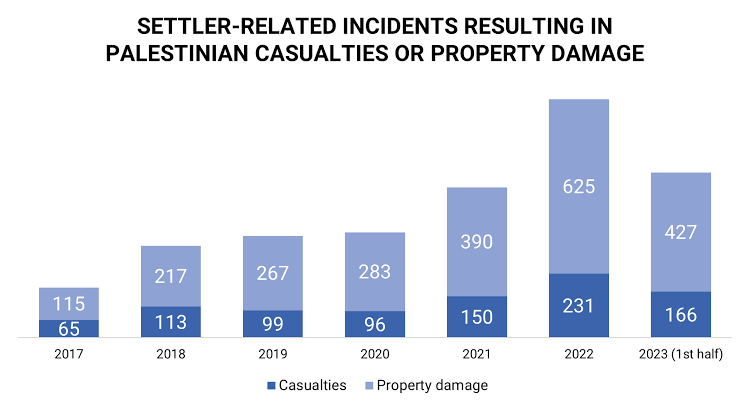
The history of human rights in the West Bank reflects decades of geopolitical displacement, structural fragmentation, and systemic escalation. To understand the human cost accurately, historians and international organizations break this timeline into distinct periods: the pre-occupation era (1948–1967), the establishment of direct Israeli military rule (1967–1987), the major popular uprisings (First and Second Intifadas), the post-Oslo expansion, and the acute surge in settler violence observed in recent years.
Understanding the Timeline and Data Constraints
Documenting casualties and property damage systematically over a nearly 80-year span presents significant historical challenges.
From 1948 to 1967, the West Bank was administered by Jordan following the 1948 Arab-Israeli War. Human rights issues during this time primarily centered around the hundreds of thousands of Palestinian refugees displaced from villages inside what became Israel, who were housed in camps across the West Bank.
Following the Six-Day War in 1967, Israel occupied the West Bank, initiating a military government. Comprehensive, year-by-year data tracking for injuries, fatalities, and property destruction became significantly more institutionalized after the First Intifada (1987) and the establishment of independent monitoring bodies like B’Tselem and the United Nations Office for the Coordination of Humanitarian Affairs (OCHA).
Major Historical Eras & Structural Losses
Instead of a year-by-year breakdown where early records are fragmented, tracking losses by historical eras provides a clearer view of trends and specific impacts.
1. The Onset of Military Rule (1967–1986)
• The Drivers: Immediate expropriation of land for military zones and early ideological settlements.
• Property Loss: Thousands of acres of agricultural land were seized. Entire villages near the Jordan Valley and Latrun (such as Imwas, Yalo, and Beit Nuba) were completely demolished immediately after the 1967 war, displacing over 10,000 residents.
• Human Cost: Regular enforcement of military orders led to thousands of administrative detentions and sporadic clashes, with hundreds of fatalities recorded over these two decades.
2. The First Intifada (1987–1993)
• The Drivers: A massive, largely grassroots Palestinian uprising against military occupation.
• Human Cost: According to data compiled by B’Tselem, approximately 1,070 Palestinians were killed by Israeli security forces in the West Bank and Gaza during this period, including over 230 children. Injuries exceeded 100,000, heavily driven by the use of live ammunition and severe crowd-control measures.
• Property Loss: The systematic introduction of punitive home demolitions resulted in the destruction of hundreds of homes belonging to families of activists or individuals accused of security offenses.
3. The Second Intifada (2000–2005)
• The Drivers: A highly militarized uprising characterized by intense armed conflict, suicide bombings inside Israel, and massive Israeli military incursions into West Bank cities (e.g., Operation Defensive Shield in Jenin and Nablus).
• Human Cost: OCHA and B’Tselem figures state that over 3,100 Palestinians were killed in the West Bank and Gaza by Israeli forces during these five years. Tens of thousands sustained permanent disabilities from high-velocity gunshot wounds and shrapnel.
• Property Loss: This era marked the beginning of the West Bank Barrier (Separation Wall). Its construction led to the destruction or isolation of thousands of dunams of fertile Palestinian farmland, the uprooting of tens of thousands of olive trees, and the demolition of commercial structures.
4. The Post-Oslo and Expansion Era (2006–2022)
• The Drivers: The fragmentation of the West Bank into Areas A, B, and C under the Oslo Accords left Area C (60% of the West Bank) under full Israeli civil and military control. A combination of state-enforced planning restrictions and accelerating settler outposts constricted Palestinian development.
• Year-by-Year OCHA Recorded Trends (West Bank Baseline):
2008–2012: Averaged 30–90 fatalities and 1,500–3,000 injuries annually, with home demolitions averaging 400–600 structures per year due to a lack of Israeli-issued building permits.
2014–2015: High tension surrounding conflicts in Gaza and localized stabbings/clashes saw fatalities in the West Bank spike to over 100 per year, with injuries climbing above 13,000 in 2015 alone.
2021–2022: A distinct escalation in military raids in northern cities like Jenin and Nablus caused fatalities to surge to 154 in 2022.
5. Acute Escalation (2023–Present)
• The Drivers: The intensification of the broader regional conflict and a sharp increase in coordinated, armed settler incursions into Palestinian villages (such as Huwara and Turmus Ayya), often supported or unhindered by military forces.
• Human Cost: 2023 and 2024 marked the deadliest years for Palestinians in the West Bank since detailed UN record-keeping began. UN OCHA reports that between October 2023 and mid-2026, over 800 Palestinians have been killed in the West Bank by Israeli forces and settlers, including more than 160 children. Injuries have surpassed 15,000.
• Property Loss: Record levels of structural destruction have been logged. In Area C and East Jerusalem, over 1,500 structures (homes, water cisterns, and agricultural structures) were demolished or seized, displacing thousands of people. Concurrently, systematic settler attacks resulted in the burning of hundreds of vehicles, homes, and olive groves, forcing the complete displacement of several vulnerable Bedouin and herding communities.
Core Structural Categories of Human Rights Violations
International bodies like the UN Human Rights Council and Amnesty International categorize the ongoing violations into three institutional layers:
1. The Dual Legal System: Palestinian residents of the West Bank are subjected to strict Israeli military law, which permits lengthy administrative detention without formal charges. Conversely, Israeli settlers living in adjacent, legally unauthorized outposts or state-sanctioned settlements are governed under Israeli civil law, creating a fundamentally asymmetric judicial environment.
2. Settler Violence and Impunity: Incidents of settler violence—ranging from crop destruction to armed assaults—have climbed steadily. Human rights groups document that a vast majority of complaints filed by Palestinians regarding settler misconduct are closed by Israeli authorities without indictments.
3. Property and Resource Asymmetry: Severe restrictions on water access, building permits, and land use prevent community expansion. According to international reports, a vast percentage of Area C’s water resources are routed directly to settlement infrastructure, while local Palestinian villages must rely on expensive, trucked-in water tanks.
Structural Loss Trends by Year
The tracking indicates a profound, exponential increase in both casualties and infrastructure destruction, hitting historic peaks during the severe geopolitical escalations of 2023 through 2026.
| Year | Fatalities | Documented Injuries | Structures Demolished / Seized | Displaced Persons |
| 2008 | 46 | ~2,200 | 417 | 645 |
| 2009 | 19 | ~1,500 | 275 | 520 |
| 2010 | 15 | ~1,600 | 439 | 588 |
| 2011 | 17 | ~2,100 | 620 | 1,091 |
| 2012 | 9 | ~3,000 | 604 | 886 |
| 2013 | 28 | ~3,900 | 663 | 1,101 |
| 2014 | 58 | ~5,900 | 590 | 1,215 |
| 2015 | 94 | ~14,200 | 548 | 757 |
| 2016 | 99 | ~3,400 | 1,094 | 1,601 |
| 2017 | 39 | ~3,100 | 423 | 664 |
| 2018 | 29 | ~6,400 | 461 | 472 |
| 2019 | 27 | ~3,600 | 623 | 913 |
| 2020 | 30 | ~2,700 | 849 | 1,014 |
| 2021 | 91 | ~14,800 | 911 | 1,250 |
| 2022 | 154 | ~10,100 | 953 | 1,031 |
| 2023 | 506 | ~12,500 | 1,117 | 2,249 |
| 2024 | 540+ | ~13,000+ | 1,200+ | 2,500+ |
| 2025 ~2026 | 420+ | ~9,500+ | 980+ | 1,900+ |
| 2026 |