Every year on 14 August, Pakistan celebrates Independence Day. Green flags fill our streets, patriotic songs echo everywhere, and we proudly remember the struggle that created an independent homeland in 1947. But amid these celebrations, there is a difficult question worth asking:
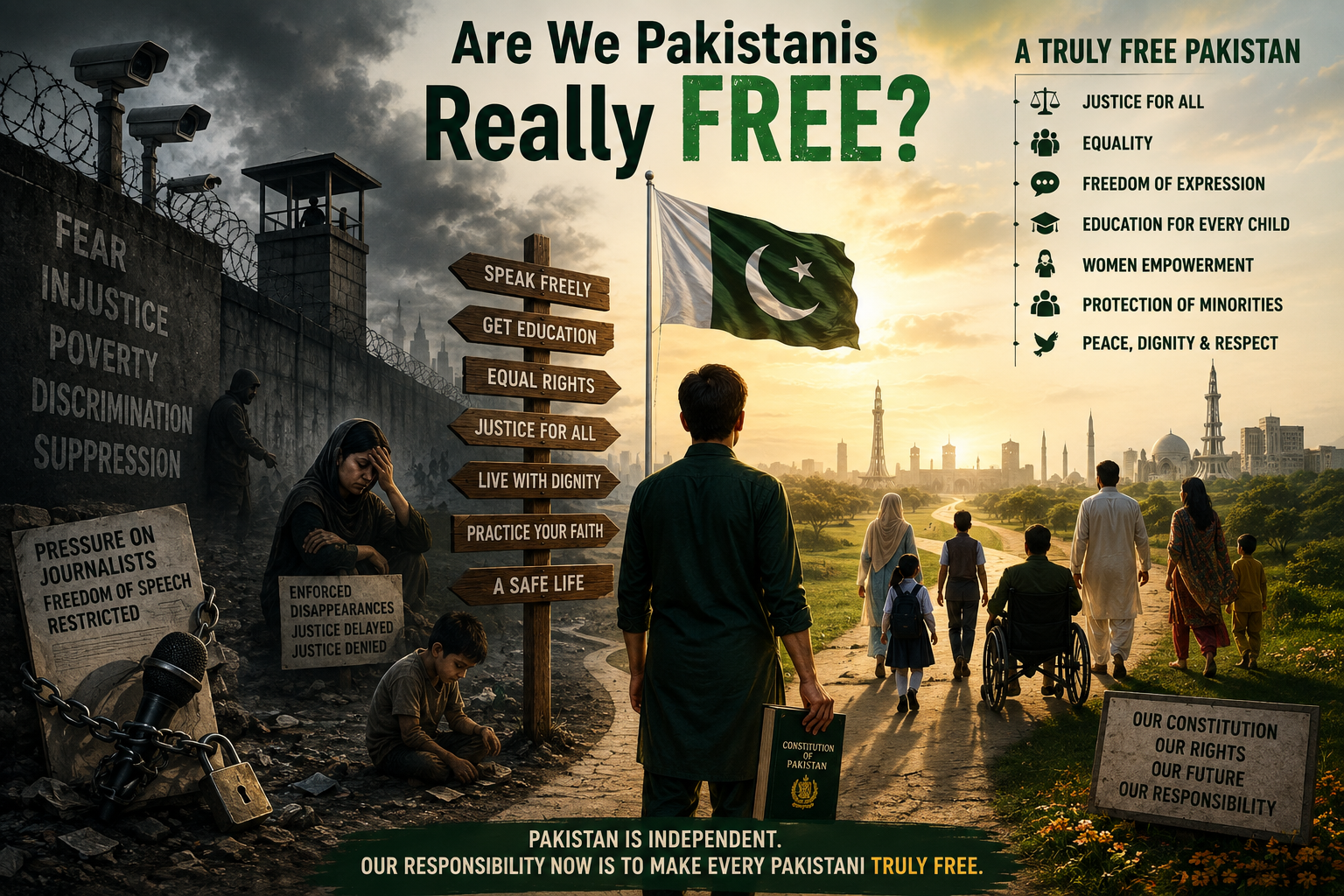
Are we Pakistanis really free?
Pakistan is certainly an independent and sovereign country. But independence of a country and freedom of its people are not exactly the same thing. True freedom means more than having our own flag, borders and government. It means living with dignity, justice, equality and security.
Our Constitution guarantees fundamental rights, including protection of life and liberty, dignity, fair trial, freedom of speech and association, religious freedom, equality before the law, access to information, and free and compulsory education for children aged 5–16.
Yet the real question is whether every Pakistani can equally enjoy these rights in everyday life.
For many citizens, justice can feel distant or difficult to obtain. Poverty deprives families of quality education, healthcare and opportunity. Women and children continue to face violence and exploitation. Religious minorities can face discrimination and insecurity. Concerns over enforced disappearances, restrictions on dissent, internet disruptions, pressure on journalists and limits on freedom of expression also challenge the meaning of liberty. As recently as August 2026, Pakistani and international civil-society organisations raised concerns about increasing restrictions on press freedom, access to information and human-rights advocacy.
So perhaps the question is not whether Pakistan became free in 1947. It did.
The question is whether we have completed the promise of that freedom.
Can a poor person obtain the same justice as a powerful person? Can a journalist speak without fear? Can a child receive education regardless of the wealth of their parents? Can a woman walk, work and make choices without fear? Can minorities practise their faith with dignity and security? Can an ordinary citizen question those in power without being treated as an enemy of the state?
If the answer to these questions is not always yes, then our journey toward freedom is still unfinished.
This Independence Day should therefore be more than a celebration of the freedom our ancestors won. It should also be a reminder of the freedom we owe to one another.
A truly free Pakistan will not simply be a country free from foreign rule. It will be a country where the Constitution protects the weak as strongly as the powerful, where disagreement is not considered disloyalty, where justice does not depend on status, and where every Pakistani can live with dignity.
Pakistan is independent. Our responsibility now is to make every Pakistani truly free.
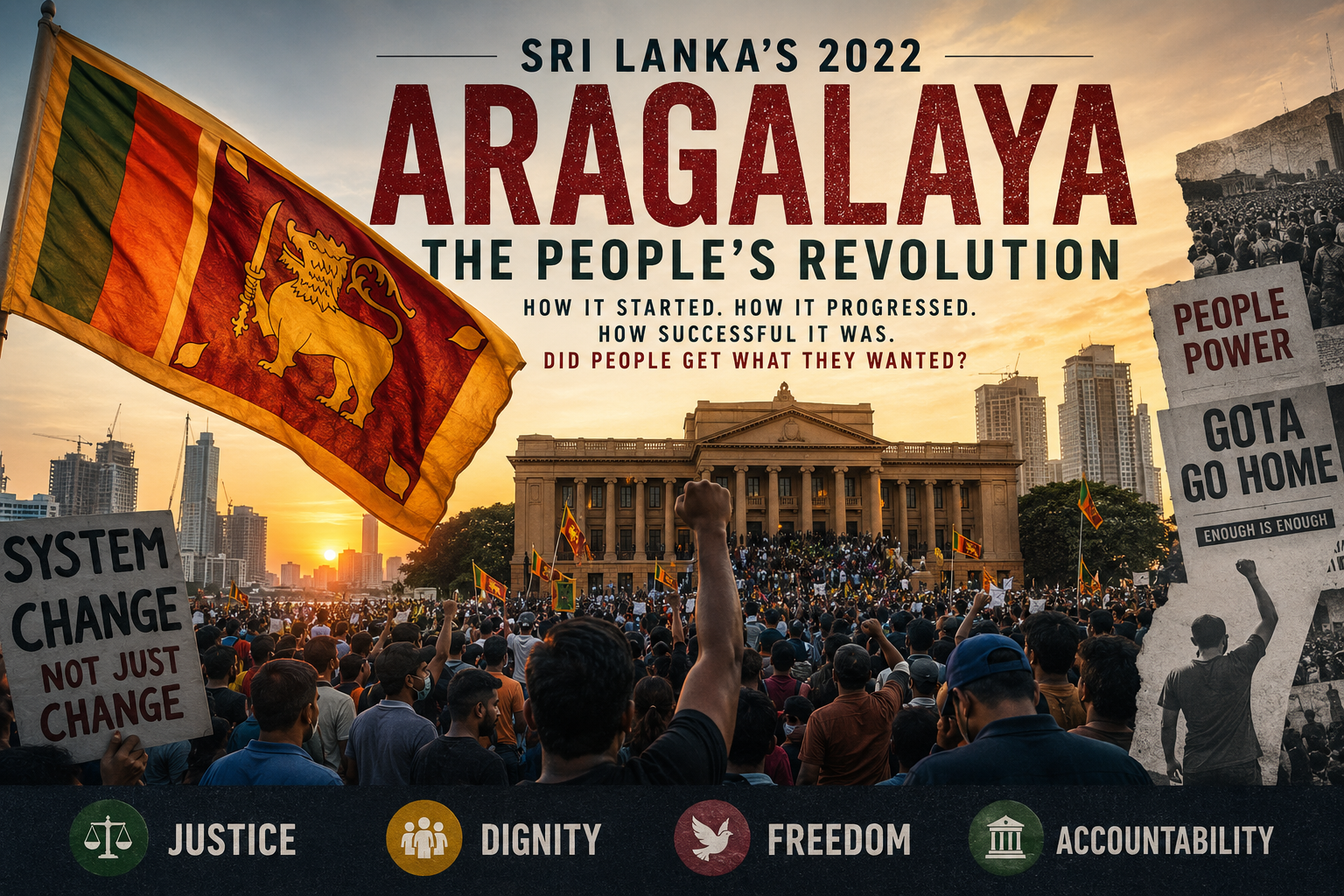
Report: Sri Lanka’s 2022 “Aragalaya”, How the People’s Uprising Began, Succeeded, and What It Ultimately Achieved
Sri Lanka’s 2022 mass protest movement, commonly called Aragalaya, Sinhala for “struggle” is often described as a revolution, although technically it was a broad, largely nonviolent popular uprising rather than a conventional armed revolution. It produced an extraordinary result: a sitting president fled the country and resigned. Yet removing President Gotabaya Rajapaksa was only one of the protesters’ objectives. Their larger demand was “system change” an end to corruption, economic mismanagement, elite political privilege, and the dominance of established political families.
Viewed from 2026, the outcome is therefore more complicated than either “the revolution succeeded” or “the revolution failed.” It succeeded spectacularly in breaking the Rajapaksa government’s hold on power, initially failed to replace the wider political establishment, and then indirectly contributed to a major electoral transformation in 2024. Whether that transformation will deliver the deeper system change protesters demanded remains unresolved.
1. What caused the uprising?
Sri Lanka’s political explosion began with an economic catastrophe.
By late 2021, the country was running dangerously short of foreign currency. By December, its foreign-exchange reserves were sufficient to cover only about one month of imports. Without dollars, Sri Lanka struggled to import fuel, medicines, food and other essentials.
The crisis had several causes rather than one single trigger. The country had accumulated heavy foreign debt; tourism had been badly damaged first by the 2019 Easter bombings and then by COVID-19; the government introduced major tax cuts that weakened state revenue; and President Gotabaya Rajapaksa’s abrupt 2021 ban on chemical fertilizers badly disrupted agriculture. The government was also widely criticized for delaying negotiations with the IMF while its foreign reserves deteriorated.
By early 2022, these macroeconomic problems had become problems of everyday survival.
Sri Lankans faced fuel queues, shortages of medicines and food, rapidly rising prices and prolonged electricity cuts. In April 2022, Sri Lanka announced that it would suspend foreign debt payments, effectively entering sovereign default.
Economic anger rapidly became political anger.
For many protesters, the argument was simple: this was not merely an unavoidable economic disaster; it was the consequence of years of bad governance, corruption, political privilege and mismanagement.
And much of that anger focused on one family: the Rajapaksas.
2. How did the revolution begin?
The movement was unusual because it did not initially have a single political leader, party or revolutionary organization directing it.
It developed organically.
Ordinary citizens began demonstrating as shortages and power cuts worsened. Social media helped mobilize people, while students, activists, trade unions, professionals, businesspeople and middle-class families increasingly joined the protests.
The movement eventually became remarkably broad. Carnegie’s detailed study describes participation across different ages, ethnicities and socioeconomic groups, with university students, unions, activists, professionals and businesses all playing roles.
One slogan captured the immediate political objective:
“Gota Go Home.”
“Gota” referred to President Gotabaya Rajapaksa.
But another idea was equally important:
“System Change.”
This distinction is essential to understanding whether the revolution ultimately succeeded.
The protesters were increasingly saying:
Removing one president was not enough. The political system that produced the crisis had to change.
3. Galle Face and the creation of “GotaGoGama”
A defining moment came when protesters established a permanent protest camp near the presidential offices at Galle Face in Colombo.
It became known as GotaGoGama, roughly meaning “Gota Go Village.”
This transformed scattered public anger into a visible national movement.
The protest site became more than a demonstration. It developed facilities and spaces for speeches, discussions, food distribution and political organizing.
Most importantly, it created a physical symbol of resistance directly beside the country’s political leadership.
The government now faced sustained public pressure rather than occasional demonstrations.
4. The government begins to collapse
As protests continued, the Rajapaksa administration attempted to survive through political reshuffling.
But protesters increasingly rejected cosmetic changes.
They did not merely want different ministers.
They wanted the Rajapaksas out.
Political pressure eventually reached Prime Minister Mahinda Rajapaksa, the president’s brother and one of the country’s most powerful political figures.
In May 2022, after severe political turmoil and violence surrounding demonstrations, Mahinda Rajapaksa resigned as prime minister.
That was a major victory.
But Gotabaya Rajapaksa remained president.
The central demand therefore continued:
Gota Go Home.
5. July 9, 2022 — the decisive moment
The uprising reached its dramatic climax on 9 July 2022.
Huge numbers of demonstrators converged on Colombo.
Protesters overwhelmed security barriers and entered important government buildings, including the presidential residence.
Images of ordinary Sri Lankans inside the president’s residence circulated around the world.
Whatever the symbolism, the political message was unmistakable:
Gotabaya Rajapaksa had lost the ability to govern normally.
He fled the presidential residence and subsequently left Sri Lanka.
On 14 July 2022, Gotabaya Rajapaksa formally resigned as president.
This was the Aragalaya’s greatest immediate achievement.
A mass civilian movement had forced one of Sri Lanka’s most powerful presidents from office.
6. At this point, had the revolution won?
Yes — if the objective was removing Gotabaya Rajapaksa.
No — if the objective was replacing the political system.
This distinction explains almost everything that happened afterward.
The movement had enormous street power, but it lacked a unified leadership capable of taking control of the political transition.
There was no single Aragalaya party.
There was no agreed revolutionary government waiting to assume power.
There was no universally accepted protest leader who could become president.
And Sri Lanka’s constitutional institutions continued functioning.
This created an unexpected outcome.
7. Ranil Wickremesinghe becomes president
After Gotabaya’s departure, Parliament selected Ranil Wickremesinghe as president.
This disappointed many protesters.
Why?
Because Wickremesinghe was hardly an outsider.
He was one of Sri Lanka’s most experienced establishment politicians and had served as prime minister multiple times.
More importantly, he was elected by a Parliament still heavily influenced by the political forces associated with the previous government.
Carnegie’s assessment is important here: Aragalaya had enough power to remove the Rajapaksas but lacked the leadership and organization necessary to determine who replaced them. Wickremesinghe was therefore able to capitalize politically on the opening created by the protests.
From the protesters’ perspective, this produced a strange situation:
They had removed the president without removing the establishment.
8. The protest movement was then suppressed
Wickremesinghe’s government moved against remaining protest encampments and activists.
The movement gradually lost momentum.
Middle-class participation declined, internal disagreements became more significant, and government pressure made continued mobilization harder.
Carnegie concludes that the suppression of the protests exposed an important weakness: the movement had been extraordinarily effective at mobilizing public anger, but lacked the organization and leadership necessary to sustain itself as a long-term political force.
By late 2022, therefore, someone looking only at immediate results might reasonably have concluded:
Aragalaya removed Gotabaya but failed to achieve its revolution.
Then something important happened.
The economic situation began stabilizing—and eventually voters got their opportunity to respond.
9. Economic recovery under Wickremesinghe
The Wickremesinghe government pursued an IMF-backed stabilization program.
Sri Lanka obtained a roughly $2.9 billion IMF program, while the government pursued debt restructuring, tax increases and other economic reforms.
There were measurable improvements.
Inflation, which had reached extraordinary levels during the crisis, fell dramatically, and economic growth resumed.
But stabilization came with substantial social costs.
Higher taxes, reduced purchasing power and continuing high living costs created considerable dissatisfaction.
So Sri Lanka was recovering economically while political anger remained.
And many citizens still wanted the other half of Aragalaya’s promise:
accountability and system change.
10. The real second phase of the revolution: the 2024 election
This is where the historical assessment becomes much more interesting.
Sri Lanka held a presidential election on 21 September 2024.
The major candidates included establishment figures Ranil Wickremesinghe and Sajith Premadasa—but also Anura Kumara Dissanayake (AKD), leader of the National People’s Power (NPP) coalition.
Dissanayake campaigned heavily on themes closely connected with Aragalaya:
fighting corruption,
political reform,
challenging the traditional political elite,
improving governance,
addressing economic inequality,
and delivering broader political change.
Dissanayake won the presidency.
It was a remarkable political transformation.
Wickremesinghe received only about 17% of the vote, while Dissanayake’s victory represented a major break with Sri Lanka’s traditional political establishment.
In that sense, the political earthquake that began on the streets in 2022 had finally reached the ballot box.
11. Then came an even bigger result
President Dissanayake called parliamentary elections for 14 November 2024.
The result was extraordinary.
His NPP coalition won:
159 of 225 parliamentary seats.
That gave the new government a two-thirds parliamentary majority.
This was not simply a change of president.
It represented a major rejection of Sri Lanka’s traditional political establishment.
The NPP even made major gains in areas where traditional ethnic and regional parties had historically been dominant.
Carnegie describes the result as an unprecedented leadership change, although it cautions that whether it produces genuine system change remains an open question.
12. So how successful was Sri Lanka’s revolution?
The best assessment is to separate its objectives.
Objective
Result
Remove President Gotabaya Rajapaksa
Achieved
Remove Mahinda Rajapaksa as PM
Achieved
Break the immediate Rajapaksa grip on government
Largely achieved
Force recognition of economic mismanagement
Achieved politically
Produce immediate revolutionary government
Not achieved
Immediately replace the political establishment
Not achieved
Create economic stability
Eventually improved through IMF-backed reforms
Bring a new political force to power
Achieved electorally in 2024
Give the new government a strong mandate
Achieved — two-thirds parliamentary majority
Eliminate corruption
Not yet demonstrably achieved
Deliver complete “system change”
Still unresolved
Solve ordinary people’s economic problems
Only partially
13. Did Sri Lankans get what they wanted?
They got some of it—perhaps much more than appeared possible in 2022—but not everything.
The most visible demand was:
“Gota Go Home.”
Gotabaya went home.
The larger demand was:
“System Change.”
That is much harder to evaluate.
Immediately after the uprising, system change appeared to have failed because Wickremesinghe—an establishment politician—became president.
But the 2024 elections changed that assessment.
A political movement outside the traditional governing establishment captured the presidency and then secured an extraordinary parliamentary majority. Carnegie consequently argues that, in light of the 2024 election results, simply declaring Aragalaya a failure is no longer convincing. At the same time, it stresses that genuine system change still remains to be demonstrated.
That is probably the fairest conclusion.
14. Did people’s economic lives improve?
This is another important distinction.
Political victory does not automatically mean economic prosperity.
Sri Lanka moved away from the catastrophic conditions of 2022. Inflation declined dramatically and the economy returned to growth as stabilization progressed.
But economic recovery from national bankruptcy takes years.
Households can still experience high prices, taxes and reduced living standards even when national indicators such as inflation, foreign reserves or GDP are improving.
And public expectations of the NPP government remain high.
Recent Sri Lankan online discussions in 2026 illustrate that tension: some NPP supporters acknowledge government initiatives while expressing disappointment about prices, the pace of change and whether campaign expectations have been met. Such comments are anecdotal rather than representative polling, but they demonstrate that the question of whether ordinary citizens feel the revolution delivered its promised transformation remains very much alive.
15. One of the most remarkable results: democracy survived
There is another aspect of Sri Lanka’s experience that deserves attention.
The uprising removed a president, but Sri Lanka did not ultimately transition into military rule or prolonged revolutionary government.
The military largely remained outside politics as an institution, the judiciary continued functioning, constitutional procedures determined the immediate presidential succession, and eventually competitive elections allowed citizens to choose a new government.
Carnegie highlights this as one of the most important aspects of the Sri Lankan case: despite the extraordinary removal of Rajapaksa, the country’s subsequent political transition largely returned to constitutional mechanisms, culminating in competitive elections in 2024.
That makes Sri Lanka’s experience particularly interesting.
The street uprising did not itself become the new government.
Instead:
public protest broke the old political order → constitutional institutions managed the transition → voters later transformed the government through elections.
16. The deeper lesson of Sri Lanka
Sri Lanka demonstrates both the power and limitations of mass protest.
Millions of dissatisfied citizens can make a government politically impossible to sustain.
Aragalaya demonstrated that dramatically.
But removing a ruler and rebuilding a political system are two completely different tasks.
The protesters had enough collective power to force Gotabaya Rajapaksa from office.
They did not have the centralized organization, political leadership or parliamentary mechanism necessary to determine his immediate successor.
Consequently, the old political establishment initially survived.
But the uprising damaged its legitimacy.
Two years later, voters completed another stage of that political transformation by electing Dissanayake and giving the NPP an overwhelming parliamentary mandate.
Conclusion
Was Sri Lanka’s revolution successful?
In the short term: partially.
It removed Gotabaya Rajapaksa and dramatically weakened the Rajapaksa political dynasty, but it did not immediately produce the “system change” demanded on the streets.
In the medium term: considerably more successful.
The 2024 elections produced a historic rejection of traditional political leadership. Anura Kumara Dissanayake became president, and the NPP subsequently won 159 of 225 parliamentary seats, giving it the political power to attempt substantial reforms.
In the long term: the verdict is still open.
The decisive question is no longer whether Aragalaya could remove a president—it proved that it could.
The question is whether the political transformation that followed can actually deliver lower corruption, accountable government, stronger institutions, sustainable economic recovery and improved living standards.
That is the unfinished part of Sri Lanka’s revolution.
Perhaps the most accurate description is therefore:
Aragalaya won the battle against a government, profoundly changed the country’s political direction, but the struggle to change the system itself continues.
Sources:
Carnegie Endowment for International Peace — “The Aragalaya Protest Movement and the Struggle for Political Change in Sri Lanka” (David G. Timberman, 2025). This is the most useful overall source for the report. It covers the origins and organization of Aragalaya, “Gota Go Home,” demands for “system change,” the removal of Mahinda and Gotabaya Rajapaksa, Ranil Wickremesinghe’s succession, weaknesses of the protest movement, and the connection between Aragalaya and the 2024 electoral transformation. Read the Carnegie report
World Bank — Sri Lanka Development Update (2023). A strong source for explaining why the crisis happened: fiscal problems, the 2019 tax cuts, debt vulnerabilities, falling foreign reserves, shortages, the April 2022 debt-service suspension, job losses, increased poverty and food insecurity. Sri Lanka Development Update
World Bank — “Sri Lanka Faces Unsustainable Debt and Balance of Payment Challenges” (April 13, 2022). Useful as a contemporary source documenting Sri Lanka’s debt, fiscal and external-balance problems while the crisis and protests were unfolding. World Bank April 2022 assessment
World Bank — “World Bank Statement on Sri Lanka” (July 28, 2022). Documents the severity of shortages—including medicines, cooking gas and fertilizer—and the need to protect vulnerable Sri Lankans during the crisis. World Bank July 2022 statement
World Bank — “Debt Restructuring and Implementation of Deep Reforms Critical for Sri Lanka’s Economic Stabilization” (October 2022). Useful for the aftermath of the uprising and the economic stabilization/reform challenge facing the country. World Bank October 2022 assessment
Associated Press — retrospective coverage of South Asian protest movements. AP’s later assessment places Sri Lanka’s 2022 uprising in context: economic collapse and public anger forced the Rajapaksa leadership from power, while significant economic and human-rights challenges continued afterward.
The Guardian — “The hardship is still there: Sri Lanka prepares to vote as hopes of revolution falter” (September 2024). Particularly useful for answering “Did ordinary Sri Lankans get what they wanted?” It documents continuing economic hardship and public frustration two years after Aragalaya, immediately before the presidential election that subsequently brought Anura Kumara Dissanayake to power.
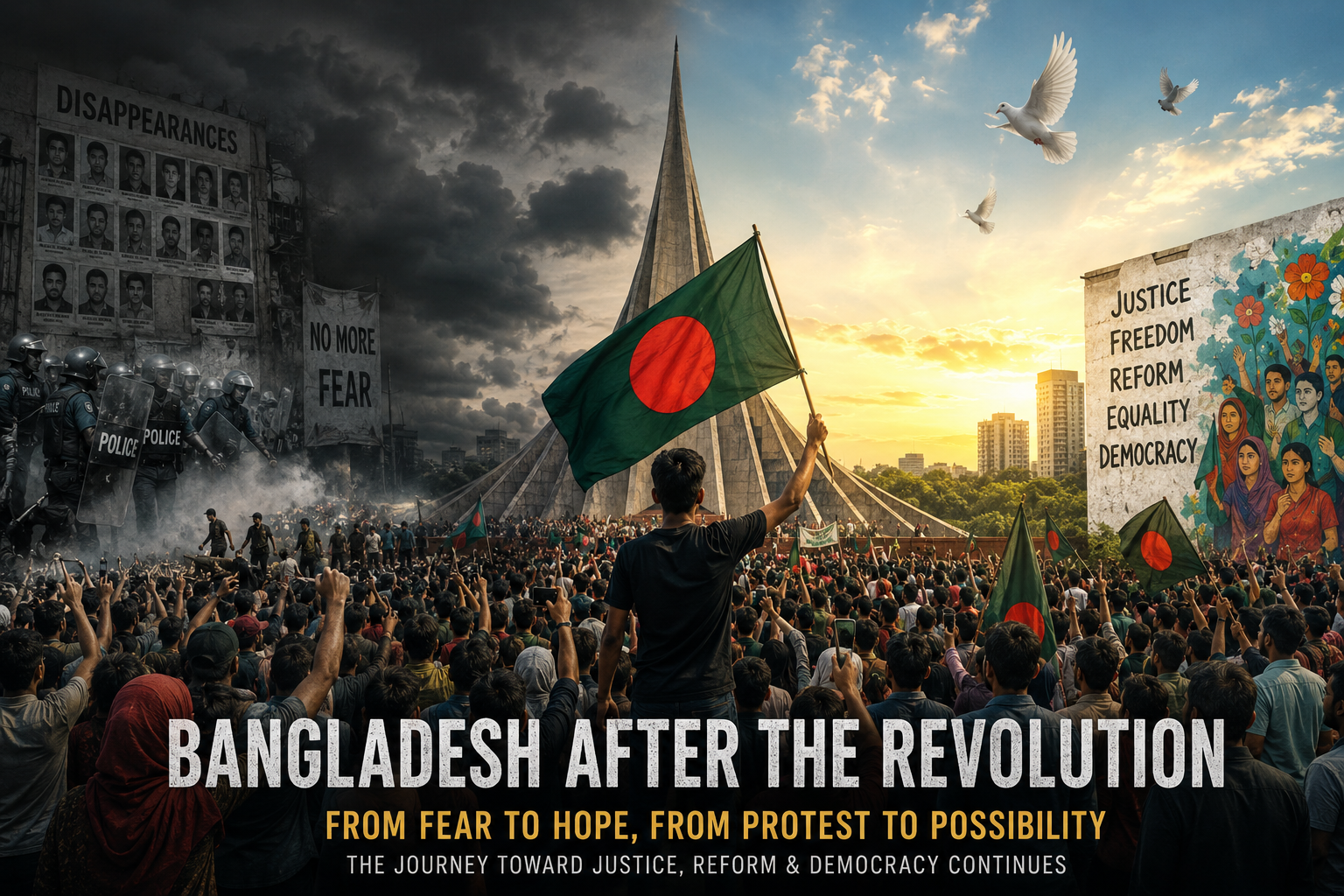
Bangladesh After the July Revolution: Did the People Get What They Wanted?
From the Fall of Sheikh Hasina to the Struggle for a New Political Order!
Bangladesh’s July–August 2024 uprising was one of the most consequential political events in the country’s history. What began as a student movement against quotas in government employment developed into a nationwide revolt against Prime Minister Sheikh Hasina and the political system that had evolved during her roughly fifteen years in power.
By 5 August 2024, Hasina’s government had collapsed and she fled to India. An interim administration headed by Nobel laureate Muhammad Yunus subsequently took responsibility for governing the country and initiating institutional reforms. The transition eventually led to parliamentary elections in February 2026, won decisively by the Bangladesh Nationalist Party (BNP), bringing Tarique Rahman to power. (YouTube)
Two years after the uprising, however, the central question is no longer simply whether the revolution succeeded in removing Sheikh Hasina. It is whether it succeeded in changing the political system that produced the uprising in the first place.
The evidence presents a complicated picture.
Bangladesh has unquestionably changed. The extraordinary concentration of political power that characterized the final years of the Hasina government was broken. Investigations into disappearances and other abuses became possible. Some restrictions on political and civic activity eased, constitutional reform became a national issue, and Bangladesh eventually returned to electoral government.
At the same time, many of the mechanisms that Bangladeshis revolted against—politically motivated arrests, weak institutions, restrictions on expression, police abuses and political intimidation—did not disappear. In addition, the post-revolutionary period produced new problems, particularly mob violence, attacks on minorities and journalists, pressure from religious hardliners, political revenge and concerns about the exclusion of the Awami League.
The revolution therefore achieved regime change much more successfully than it achieved systemic change.
1. What Was the July Revolution Actually About?
Understanding whether Bangladeshis “got what they wanted” requires understanding what protesters wanted.
The immediate issue was relatively narrow: government employment quotas.
A court decision had revived a quota system reserving a substantial proportion of public-sector positions for particular categories, including descendants of veterans of Bangladesh’s 1971 independence war. University students argued that government jobs should primarily be allocated according to merit.
But the quota dispute was only the trigger.
The UN investigation into the uprising concluded that the protests were rooted in broader grievances concerning politics, governance and economic inequality. (YouTube)
The movement consequently evolved.
Stage One: Reform the quota system
The original student demand concerned reforming recruitment to government employment.
Stage Two: Justice for protesters
When security forces and government supporters responded violently, the issue became accountability.
Students began demanding justice for those who had been killed, injured or arrested.
Stage Three: Political change
As deaths increased, the movement became a broader rejection of Hasina’s government.
The demand was no longer simply:
“Reform the quota system.”
It effectively became:
“Change the political system.”
That distinction is essential when judging the revolution’s success.
2. Bangladesh Before the Revolution
Bangladesh under Sheikh Hasina cannot be understood solely through the events of July 2024.
For years before the uprising, international human-rights organizations had documented serious problems involving elections, political opposition, security agencies, disappearances, freedom of expression and the independence of institutions.
Freedom House’s 2024 assessment gave Bangladesh a score of 40 out of 100 and classified it as “Partly Free.” It described sustained harassment of the BNP and other opponents, pressure on independent media and civil society, endemic corruption, weak due-process protections and human-rights violations by security forces operating with substantial impunity. (Freedom House)
These problems developed over many years.
3. Enforced Disappearances and Extrajudicial Abuses
One of the darkest aspects of the pre-revolutionary period involved enforced disappearances.
Human Rights Watch reported that Bangladeshi human-rights monitors had documented more than 600 enforced disappearances since 2009.
Some victims eventually returned home or appeared in court. Others were reported killed.
Nearly 100 remained missing at the time of HRW’s 2024 assessment. (Human Rights Watch)
Security institutions—particularly the police, intelligence agencies and Rapid Action Battalion—were repeatedly accused of serious abuses.
The political consequences were significant.
When opposition activists believed that arrest could lead not simply to prosecution but potentially disappearance, torture or prolonged detention, fear itself became an instrument of political control.
That created a political environment in which formal democratic institutions continued to exist while the practical space for challenging the government became increasingly restricted.
4. Elections Without Effective Political Competition
Another major grievance concerned elections.
Bangladesh continued to hold elections during Hasina’s rule, but opposition parties and international observers increasingly questioned whether genuine political competition remained possible.
The January 2024 election was especially controversial. The BNP boycotted the vote after demanding a neutral caretaker administration.
The Awami League consequently retained overwhelming control.
The deeper problem was therefore institutional.
A democracy requires more than polling stations. It requires:
competitive political parties,
an independent election administration,
freedom of political organization,
independent media,
an impartial judiciary,
and security forces that do not operate as political instruments.
By the end of Hasina’s rule, critics argued that several of these safeguards had become seriously weakened.
5. Freedom of Expression Before the Revolution
Restrictions on speech were another major source of criticism.
Bangladesh’s Digital Security Act, followed by the Cyber Security Act of 2023, allowed authorities considerable power over online expression.
Journalists, activists, writers and government critics could face legal consequences for speech.
Amnesty International concluded that the Cyber Security Act essentially repackaged many of the repressive characteristics of earlier legislation and had been used against journalists, human-rights defenders and political dissent. (Amnesty International)
This produced an important secondary effect:
self-censorship.
People do not need to be arrested every time they criticize a government for political repression to work. If journalists, academics and ordinary citizens believe criticism could result in arrest, harassment or prosecution, many will simply remain silent.
6. The 2024 Crackdown Changed Everything
The decisive turning point came when the government attempted to suppress the student protests.
The UN Human Rights Office later conducted an extensive investigation.
Its findings were devastating.
The UN estimated that as many as 1,400 people may have been killed between 1 July and 15 August 2024, with thousands more injured. The majority of those killed were reportedly shot by Bangladeshi security forces.
The report estimated that approximately 12–13 percent of those killed were children. (YouTube)
The UN investigation concluded that there were reasonable grounds to believe that hundreds of extrajudicial killings, arbitrary arrests, torture and other serious violations occurred as part of a coordinated strategy to suppress the demonstrations.
It also found reasonable grounds for further investigation into whether some violations constituted crimes against humanity. (YouTube)
This changed the character of the movement.
The government’s violence did not destroy the protest movement.
It expanded it.
Students who originally demanded employment reform were joined by families, professionals, workers and ordinary citizens increasingly outraged by the deaths.
The government’s attempt to preserve itself ultimately accelerated its collapse.
7. 5 August 2024: Victory or Merely the Beginning?
When Sheikh Hasina left Bangladesh, millions of people understandably viewed the moment as liberation.
But removing an authoritarian leader is easier than removing authoritarian political structures.
That became the central problem of post-revolution Bangladesh.
The Muhammad Yunus-led interim government inherited:
weakened institutions,
a politicized bureaucracy,
deeply distrusted police forces,
economic difficulties,
political polarization,
demands for justice,
demands for elections,
and demands for constitutional transformation.
Those goals frequently conflicted.
Some Bangladeshis wanted elections immediately.
Others argued that elections without institutional reform would simply reproduce the old political system with a different party controlling it.
The fundamental post-revolutionary debate therefore became:
Reform first, or elections first?
8. What Improved After the Revolution?
Despite today’s frustrations, it would be inaccurate to claim that nothing changed.
Several important developments occurred.
The atmosphere of state fear weakened
Human Rights Watch’s assessment of 2025 concluded that some of the fear and repression characteristic of Hasina’s rule—including widespread enforced disappearances—appeared to have ended. (Human Rights Watch)
That is significant.
For families who spent years searching for relatives allegedly taken by security agencies, even the possibility of investigating what happened represented an enormous political change.
9. Investigations Into Enforced Disappearances
The interim government established a commission investigating enforced disappearances and extrajudicial killings committed during Awami League rule.
By August 2025, the commission had reportedly received more than 1,850 complaints.
Investigators told Human Rights Watch that they had collected significant evidence.
However, they also alleged that security officials had destroyed evidence, refused cooperation and resisted accountability. (Human Rights Watch)
This illustrates both the achievement and limitation of the revolution.
Before August 2024, the state largely rejected accusations of systematic disappearances.
After the revolution, the state itself began investigating them.
That represents genuine progress.
But an investigation is not the same thing as institutional transformation.
10. International Human-Rights Cooperation Increased
Another positive development was greater cooperation with international human-rights institutions.
The interim government invited the UN Human Rights Office to investigate the 2024 violence and provided substantial cooperation with the investigation. (YouTube)
Bangladesh subsequently agreed to establish a UN human-rights presence in the country and acceded in 2025 to the Optional Protocol to the Convention Against Torture, an international mechanism intended to strengthen safeguards against torture and mistreatment in detention. (Amnesty International)
These were meaningful departures from the defensive approach that had characterized earlier responses to international criticism.
The revolution also opened political space for discussions that would previously have been extraordinarily difficult.
The interim government established multiple commissions addressing areas including:
constitutional reform,
electoral reform,
judiciary reform,
police reform,
women’s rights,
labor rights,
and governance.
A National Consensus Commission attempted to convert these recommendations into an agreed reform package.
The resulting July Charter became one of the most important political legacies of the uprising. (Human Rights Watch)
Ideas discussed included limiting prime-ministerial power, strengthening judicial independence, changing constitutional appointments, strengthening fundamental rights and restructuring Parliament.
This is arguably where the revolution’s most important long-term legacy may eventually lie.
12. But the Reform Process Disappointed Many
The problem was implementation.
Human Rights Watch concluded that many promised reforms stalled because political actors failed to reach agreement and relatively few changes were implemented quickly. (Human Rights Watch)
This created growing frustration among people who believed the revolution had created a once-in-a-generation opportunity to redesign Bangladesh’s political institutions.
The fear was straightforward:
If institutional reform remained incomplete and conventional political parties simply returned to power, Bangladesh could eventually recreate the same system under different leadership.
That concern remains relevant today.
13. Political Arrests Did Not Disappear
Perhaps the clearest contradiction of post-revolutionary Bangladesh was the continuation of politically motivated detention.
The victims changed.
The method did not entirely disappear.
Human Rights Watch documented thousands of arrests of people perceived as political opponents during the interim period.
After clashes in February 2025, the government’s “Operation Devil Hunt” reportedly resulted in at least 8,600 arrests.
Hundreds of Awami League figures and supporters were detained, sometimes in cases containing huge numbers of unnamed suspects. (Human Rights Watch)
This creates an uncomfortable parallel.
Under Hasina:
Opposition supporters complained of politically motivated arrests.
After Hasina:
Awami League supporters complained of politically motivated arrests.
The political identity of the accused changed.
The weakness of due process did not disappear.
That is precisely the kind of institutional continuity protesters hoped the revolution would end.
14. The Awami League Ban Created a Democratic Contradiction
The interim government’s decision in May 2025 to ban Awami League activities became one of the most controversial developments of the transition.
The restrictions included meetings, publications and some forms of online political advocacy.
Human-rights organizations questioned whether such measures were compatible with freedom of association. (Amnesty International)
There is an obvious dilemma.
Senior officials responsible for grave crimes should face prosecution.
Political organizations implicated in violence cannot simply demand immunity.
But criminal responsibility should ordinarily be individualized.
Punishing an entire political constituency risks reproducing the exclusionary political logic that the revolution was supposed to overcome.
This is one reason the post-revolutionary human-rights record cannot be described simply as democratic liberation.
15. Freedom of Speech: Better, but Still Vulnerable
Freedom of expression illustrates the same pattern.
The revolution created a much broader political debate and destroyed many of the psychological barriers surrounding criticism of the Hasina government.
But legal restrictions did not disappear.
The Cyber Security Act continued operating during the interim period before being replaced in 2025 by a Cyber Security Ordinance.
Amnesty International found that although the new system represented change, broad or vaguely defined provisions remained that could potentially be abused. (Amnesty International)
Journalists and writers continued facing harassment, violence and legal action.
Therefore:
The space for speech expanded politically, but the institutional protection of free speech remained incomplete.
16. The Rise of Mob Violence
One of the most disturbing developments after the revolution was the growth of mob violence.
When an authoritarian state collapses, state repression may decrease without the rule of law automatically improving.
That appears to have happened to some extent in Bangladesh.
Police forces, discredited by their role in suppressing the uprising, became less effective in maintaining public order.
Human Rights Watch reported an alarming increase in violence by political groups, mobs and religious hardliners.
According to figures cited by HRW from Ain O Salish Kendra, at least 124 people were killed in mob attacks between June and August 2025 alone. (Human Rights Watch)
This demonstrates an important distinction:
Freedom from an oppressive state is not necessarily the same as security under the rule of law.
Citizens require protection from both.
17. Minorities and Religious Freedom
Another major concern involves religious and ethnic minorities.
Bangladesh has long struggled with periodic attacks against Hindus, Buddhists, indigenous communities and other minorities.
Political instability following the revolution created additional vulnerabilities.
Human Rights Watch documented attacks against ethnic and religious minorities during the transition. (Human Rights Watch)
Some attacks were politically motivated, some communal and some involved overlapping political and religious identities.
This issue has also become heavily politicized internationally, particularly in relations between Bangladesh and India.
Nevertheless, the broader conclusion from human-rights organizations is clear:
The post-revolutionary government did not consistently provide sufficient protection against communal and mob violence.
18. Women’s Rights: A Particularly Important Test
Women played an important role in the July uprising.
Yet the political transition did not necessarily translate into greater protection for women’s rights.
A government-appointed women’s rights commission proposed reforms including stronger representation, changes to family laws and criminalization of marital rape.
The proposals produced strong opposition from Islamist organizations.
Human Rights Watch reported that nearly 20,000 supporters of Hefazat-e-Islam demonstrated in Dhaka against proposed reforms and related issues. (Human Rights Watch)
This reveals another contradiction of the revolution.
A movement in which young women participated prominently helped overthrow an authoritarian government.
Yet the political opening that followed also created greater space for socially conservative and Islamist movements.
Political liberalization therefore does not automatically produce social liberalization.
19. Accountability for Sheikh Hasina
One of the clearest demands after the uprising was justice for the people killed in 2024.
The post-revolutionary authorities pursued cases against Hasina and other former officials.
Bangladesh’s International Crimes Tribunal eventually convicted Hasina in absentia of crimes against humanity related to the suppression of the uprising and sentenced her to death. (Human Rights Watch)
For families of victims, accountability represented a central demand of the revolution.
But human-rights organizations raised serious concerns about the tribunal’s procedures.
Human Rights Watch argued that despite reforms, important due-process problems remained and criticized the continued use of the death penalty. (Human Rights Watch)
That creates another important principle.
Justice after authoritarianism must not become revenge administered through another flawed judicial process.
If the revolution was partly about restoring rule of law, trials of former rulers must meet especially high standards.
20. The Return to Electoral Government
Bangladesh eventually held parliamentary elections in February 2026.
The BNP won decisively, bringing Tarique Rahman to power and ending the interim phase. Reuters described the result as a landslide BNP victory. (YouTube)
This represented a major milestone.
For the first time since the revolution, Bangladesh again had an elected government.
But elections themselves do not settle the revolution’s central question.
The question now becomes whether the BNP government will institutionalize the reforms promised after July 2024—or gradually return Bangladesh to the winner-takes-all politics that characterized previous decades.
Recent analysis has also emphasized the continuing political and economic influence of the military, suggesting that strengthening civilian institutions remains essential to Bangladesh’s democratic consolidation. (Financial Times)
21. So, Did the People Get What They Wanted?
There is no single answer because the revolution contained different groups with different expectations.
But we can evaluate several major demands.
Demand
Outcome
Removal of Sheikh Hasina
Achieved
End of Awami League monopoly on power
Achieved
Accountability for July killings
Partially achieved / ongoing
Investigation of disappearances
Significant progress
End politically motivated arrests
Not achieved
Independent institutions
Partially achieved / unfinished
Greater freedom of expression
Improved but incomplete
Police/security-sector reform
Incomplete
Constitutional reform
Partially achieved / continuing
End authoritarian political culture
Not yet achieved
Protection of minorities
Insufficient
Protection of women and vulnerable groups
Mixed
Restoration of competitive elections
Substantially achieved
Stable rule of law
Not achieved sufficiently
Therefore, the most defensible conclusion is:
Bangladeshis won the right to attempt to build a different political system. They did not automatically receive that system when Sheikh Hasina fell.
22. Human Rights Before and After: The Fundamental Difference
The character of human-rights problems has changed.
Before the revolution
The greatest danger came from an increasingly centralized state.
The main problems included:
enforced disappearances,
security-force impunity,
suppression of opposition parties,
politically motivated detention,
restrictions on journalism,
restrictive cyber laws,
questionable elections,
concentration of executive power,
and finally massive state violence against protesters.
After the revolution
Some of those dangers declined, particularly systematic disappearances and the extreme concentration of political power.
But other problems became more prominent:
mob violence,
political revenge,
arbitrary arrests of former ruling-party supporters,
restrictions on Awami League political activity,
attacks on journalists,
religious intolerance,
threats against women and minorities,
weak policing,
incomplete institutional reform,
and continuing problems with due process.
In simplified terms:
Before 2024, Bangladesh’s central human-rights problem was an increasingly authoritarian state.
After 2024, the central problem became building a functioning democratic state capable of protecting rights while preventing political revenge, mob rule and another concentration of power.
23. Has Bangladesh Become More Democratic?
In certain respects, yes.
Freedom House’s current country profile gives Bangladesh 44/100, compared with 40/100 in its 2024 report. Both assessments classify the country as “Partly Free.” (Freedom House)
That four-point difference should not be exaggerated.
But it illustrates the broader pattern.
Bangladesh is not simply where it was before August 2024.
Nor has it become a consolidated liberal democracy.
It is somewhere in between.
The country has moved from an entrenched political order into a contested transition.
24. The Greatest Risk: Replacing One Ruling Elite With Another
The history of revolutions shows that removing an individual is considerably easier than changing institutions.
Bangladesh’s old political system concentrated enormous power in whoever controlled the executive branch.
That creates a recurring danger.
If institutions remain weak, every opposition party campaigns for democracy while outside government—and discovers the advantages of centralized authority after winning power.
That cycle has affected Bangladeshi politics for decades.
The real success of the July Revolution will therefore not be determined by whether Sheikh Hasina returns.
It will be determined by whether future governments become institutionally incapable of governing the way her government eventually did.
That requires:
independent courts, professional police, accountable intelligence services, competitive elections, independent media, protection for opposition parties and constitutional limitations on executive authority.
Without these safeguards, Bangladesh could eventually reproduce authoritarianism under a different political banner.
25. The Revolution’s Unfinished Promise
Two years later, describing Bangladesh’s revolution as either a complete success or complete failure is misleading.
It succeeded at its first historical task:
breaking an entrenched government that had become increasingly authoritarian.
It has only partially succeeded at its second:
creating a political system in which authoritarianism cannot easily return.
And it has struggled considerably with its third:
establishing effective rule of law while protecting minorities, political opponents, journalists, women and ordinary citizens from both state and non-state violence.
The distinction between these achievements matters.
Removing a government can happen in days.
Reforming police forces takes years.
Building independent courts takes years.
Changing political culture may take generations.
Conclusion
The July 2024 uprising fundamentally altered Bangladesh’s political trajectory.
Before the revolution, the country had experienced years of increasing political centralization, harassment of opposition parties, restrictions on expression, allegations of disappearances and security-force abuses, culminating in an extraordinarily violent crackdown in which the United Nations estimates that as many as 1,400 people were killed. (YouTube)
The revolution ended that political order.
But it did not eliminate the institutions and political habits that sustained it.
Post-revolutionary Bangladesh experienced genuine improvements: greater scrutiny of security agencies, investigations into disappearances, international human-rights cooperation, constitutional reform efforts and ultimately a return to electoral government.
At the same time, arbitrary detention continued, mob violence increased, journalists and minorities faced threats, Islamist pressure on social issues became more visible, the Awami League was banned from political activity during the transition, and major institutional reforms remained incomplete. Human Rights Watch consequently concluded that the interim government struggled both to maintain law and order and to deliver promised human-rights reforms. (Human Rights Watch)
The answer to “Did the people get what they wanted?” is therefore:
Partly.
They removed the government they revolted against.
They opened the door to accountability.
They reopened fundamental questions about Bangladesh’s constitution and institutions.
They eventually returned the country to elected government.
But they have not yet secured the deeper objective behind the revolution: a political system in which citizens do not need another revolution to remove an abusive government.
That is the unfinished legacy of July 2024.
Bangladesh’s revolution should therefore be understood not as the completion of a democratic transformation, but as the beginning of one.
Whether that transformation ultimately succeeds will depend less on who occupies the prime minister’s office and more on whether Bangladesh can build institutions strong enough to restrain whoever occupies it.
References and Sources
United Nations Office of the High Commissioner for Human Rights (OHCHR) — Fact-finding investigation into human-rights violations during the July–August 2024 protests. The UN investigation is the principal source for the estimate of up to 1,400 deaths and findings concerning extrajudicial killings, arbitrary detention and torture. (YouTube)
Human Rights Watch — World Report 2024: Bangladesh. Useful for establishing the human-rights situation immediately before the revolution, particularly disappearances, political repression, security-force abuses and opposition arrests. (Human Rights Watch) Human Rights Watch: Bangladesh 2024
Human Rights Watch — World Report 2026: Bangladesh. One of the main sources for evaluating the post-revolutionary period, including arrests, mob violence, reform efforts, accountability, minority rights and freedom of expression. (Human Rights Watch) Human Rights Watch: Bangladesh 2026
Amnesty International — Bangladesh human-rights reporting. Used particularly for freedom of expression, political association and developments involving the Cyber Security Act and Cyber Security Ordinance. (Amnesty International) Amnesty International: Bangladesh
Amnesty International — “Repackaging Repression: The Cyber Security Act and the Continuing Lawfare Against Dissent in Bangladesh.” Important background on restrictions on expression under the pre-revolutionary government. (Amnesty International) Amnesty report on the Cyber Security Act
Freedom House — Freedom in the World 2024: Bangladesh. Used for the pre-revolution assessment of political rights, civil liberties, opposition harassment, corruption and security-force impunity. (Freedom House) Freedom House: Bangladesh 2024
Freedom House — Bangladesh Country Profile / Freedom in the World 2026. Useful for comparing Bangladesh’s international democracy and civil-liberties assessment before and after the uprising. (Freedom House) Freedom House: Bangladesh country profile
Reuters — February 2026 Bangladesh election reporting. Used to confirm the BNP’s victory and Bangladesh’s return to elected government. (YouTube)
Associated Press — August 2026 reporting on Sheikh Hasina, the uprising and current Bangladesh political situation. Useful for checking developments around the second anniversary of the revolution. (AP News)
Financial Times — August 2026 analysis of Bangladesh’s military and political transition. Used particularly for the continuing question of military influence and institutional democratic consolidation. (Financial Times)
Research note: The article evaluates the situation through 8 August 2026. Human-rights conditions and implementation of the July-era reforms remain fluid, so conclusions about the revolution’s ultimate success should be treated as provisional rather than final.
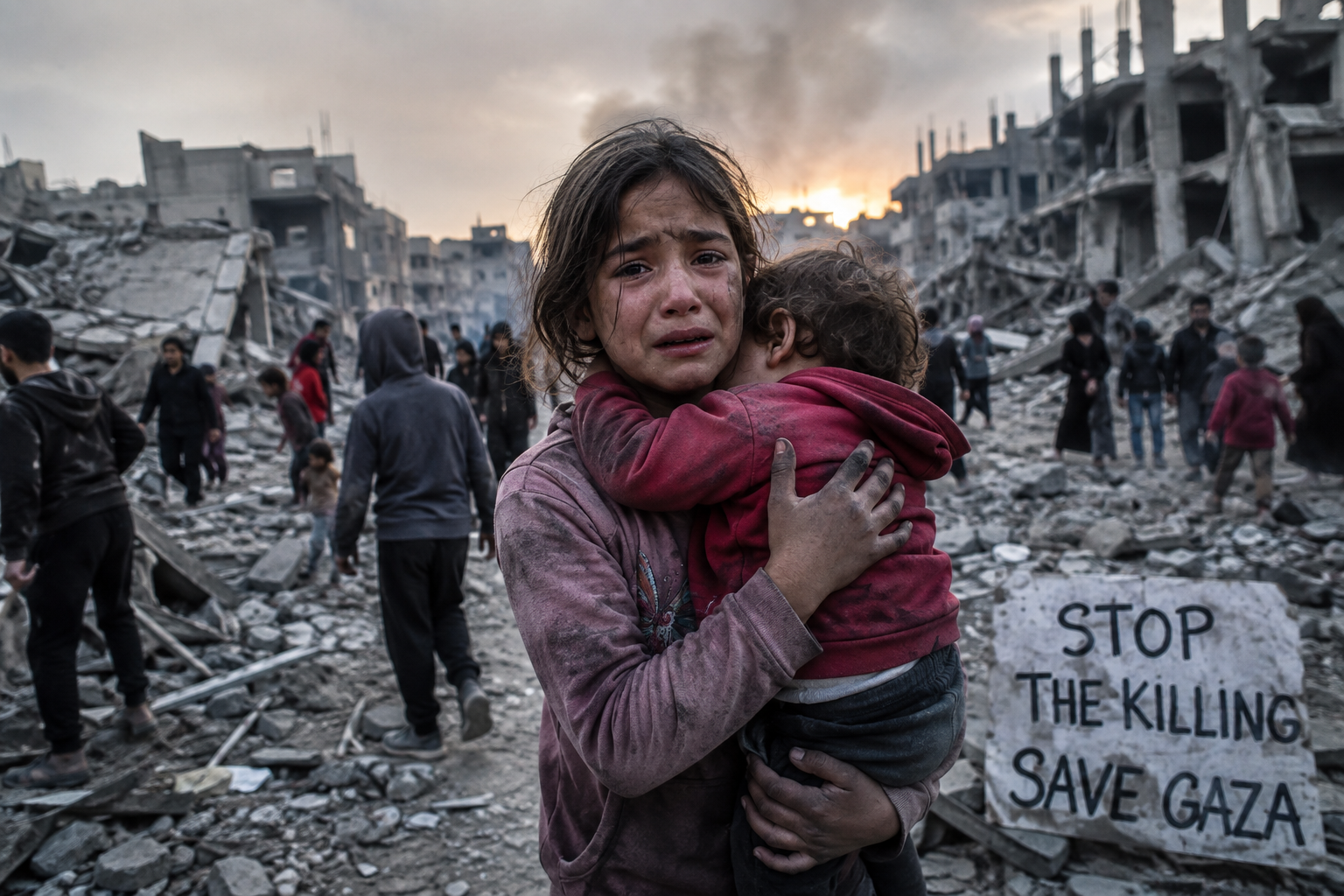
Gaza’s Unanswered Cry: When Promises of Peace Fail to Stop the Killing
The announcement last week that Hamas had agreed to a framework involving the phased surrender and storage of its weapons, tied to an Israeli withdrawal from Gaza, was seen by many as a potential turning point in one of the world’s deadliest conflicts. While the agreement remains conditional and faces major implementation challenges, it offered a rare glimpse of hope after years of bloodshed.
Yet, for countless civilians in Gaza, that hope has been overshadowed by continued violence.
Reports indicate that military operations have continued despite the political breakthrough, with civilians—including children—continuing to lose their lives. Homes, schools, and essential infrastructure remain under threat, while families already displaced by months of conflict continue to endure unimaginable hardship.
This raises a painful question: if there is a pathway toward ending the conflict, why does the suffering continue?
For many observers, the silence of the international community is becoming increasingly difficult to understand. Statements expressing “deep concern” and calls for restraint have become routine. Emergency meetings are held, resolutions are debated, and leaders issue carefully worded declarations. But for parents burying their children, words alone offer little comfort.
History will not judge the world by the number of speeches delivered or diplomatic press releases issued. It will judge whether those with influence acted when innocent lives were at stake.
The humanitarian crisis in Gaza continues to deepen. Families struggle to access food, clean water, medical care, and shelter. Hospitals operate under extraordinary pressure, while humanitarian organizations repeatedly warn that civilians are paying the highest price for a conflict they did not choose.
No political objective can justify the loss of innocent lives.
Every child killed is a future erased. Every family destroyed leaves wounds that may take generations to heal. Every day the violence continues makes peace more distant and reconciliation more difficult.
The international community has both a legal and moral responsibility to protect civilians, ensure that international humanitarian law is respected by all parties, and support meaningful efforts toward a lasting peace. Accountability cannot be selective, and concern for human life cannot depend on geography or politics.
The people of Gaza deserve more than sympathy. They deserve protection. They deserve dignity. Above all, they deserve the chance to live without fear.
Peace cannot be measured only by political agreements signed on paper. It must be measured by whether children can sleep safely, families can return home, and communities can rebuild their lives.
Until that happens, the world cannot claim that peace has truly begun.
Sources:
Associated Press (AP) – Hamas says it has agreed to disarm after U.S.-backed peace plan; Israel raises security concerns (Published August 2026). This covers Hamas’ agreement in principle to disarm, Israel’s response, and the continued military operations.
The Guardian – Hamas offers to hand over authority in Gaza to US-backed administration (July 2026). Explains Hamas’ political position, the proposed transition of governance, and the conditions surrounding disarmament.
Associated Press – Middle East news roundup (August 2026). Provides updates on the ongoing conflict, regional developments, and the Gaza situation.
The Guardian – Coverage of continuing developments in Gaza and regional diplomacy, including reports on ongoing attacks and humanitarian concerns.
United Nations Office for the Coordination of Humanitarian Affairs (UNOCHA) https://www.ochaopt.org/ Regular humanitarian situation reports on civilian casualties, displacement, access to aid, and infrastructure damage.
UNICEF https://www.unicef.org/ Reports on the impact of the conflict on children, education, healthcare, and child protection.
International Committee of the Red Cross (ICRC) https://www.icrc.org/ Updates on humanitarian law, protection of civilians, and medical assistance in Gaza.
World Health Organization (WHO) https://www.who.int/ Situation reports on healthcare facilities, disease outbreaks, and medical access in Gaza.
Pakistan’s Shrinking Civic Space: Media Restrictions and Human Rights Concerns
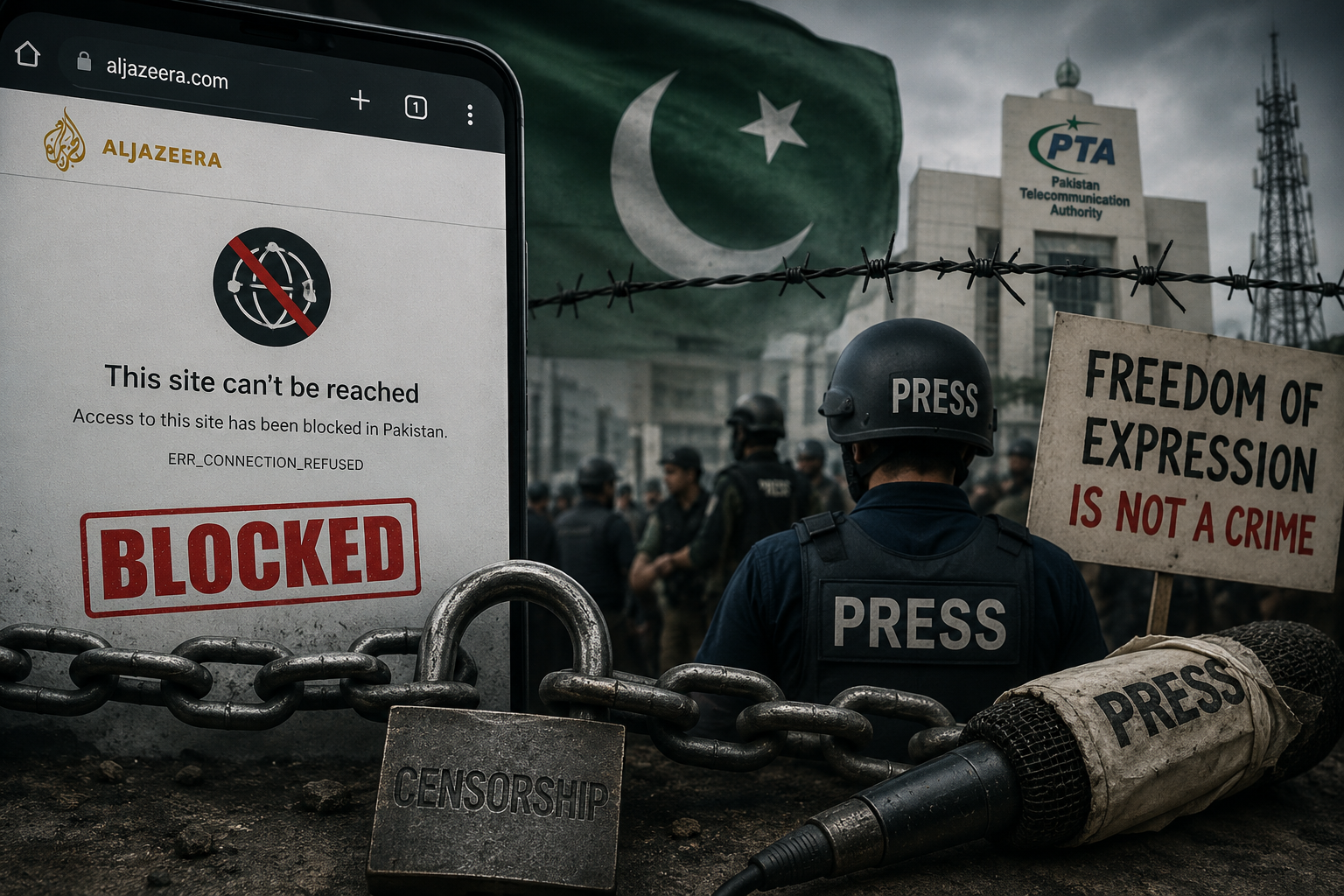
Recent reports regarding the inaccessibility of Al Jazeera’s English website in Pakistan have once again raised concerns about press freedom and the broader state of civil liberties in the country. While this incident has attracted international attention, many journalists, human rights organizations, and media observers argue that it reflects a wider trend of increasing restrictions on independent reporting and democratic freedoms.
Al Jazeera Access Restrictions
Following Al Jazeera’s coverage of protests and election-related developments in Pakistan-administered Kashmir (Azad Jammu & Kashmir), many internet users in Pakistan reported being unable to access the broadcaster’s English website. Although no publicly available order from the Pakistan Telecommunication Authority (PTA) has been released confirming the restriction, Pakistan’s Ministry of Information publicly criticized Al Jazeera’s reporting, describing it as “selective reporting” and “yellow journalism.”
The reported restrictions have drawn criticism from international media organizations and press freedom advocates, who argue that access to diverse sources of information is an essential component of a democratic society.
A Broader Pattern of Media Restrictions
The Al Jazeera incident is viewed by many observers as part of a broader pattern of increasing regulation and control over media reporting in Pakistan.
Recent developments reported by international and local media include:
New guidelines requiring foreign journalists to obtain official permission before reporting from many parts of the country.
Expanded accreditation requirements for Pakistani journalists working with international media organizations.
Broad provisions allowing authorities to suspend or revoke journalist accreditation under certain conditions.
Continued concerns regarding internet disruptions, content blocking, and restrictions on digital platforms during politically sensitive events.
Journalist organizations, including the Pakistan Federal Union of Journalists (PFUJ), the Human Rights Commission of Pakistan (HRCP), the Committee to Protect Journalists (CPJ), and Reporters Without Borders (RSF), have expressed concern that these measures may discourage independent journalism and reduce transparency.
Human Rights and Democratic Concerns
Beyond media freedom, international human rights organizations have continued to express concern over the broader civic environment in Pakistan.
Reports from organizations such as Human Rights Watch, Amnesty International, the Human Rights Commission of Pakistan, and Reporters Without Borders have highlighted issues including:
Restrictions on freedom of expression.
Pressure on journalists and independent media outlets.
Arrests and legal proceedings involving political activists.
Internet shutdowns and online censorship.
Limitations on peaceful assembly and public protest.
Concerns regarding judicial independence and due process in politically sensitive cases.
While the government has consistently stated that many of these measures are necessary to maintain national security, public order, and combat misinformation, critics argue that the cumulative effect has been a narrowing of democratic space.
Public Debate
Social media platforms, independent commentators, and international observers continue to debate the balance between national security and civil liberties.
Supporters of the government’s approach argue that stronger regulation is necessary to protect national interests and counter misinformation, particularly during periods of political tension.
Critics contend that increasing restrictions on journalists, media organizations, and online platforms reduce government accountability, limit access to independent information, and weaken democratic institutions.
These discussions remain highly polarized, reflecting Pakistan’s broader political divisions.
Conclusion
The reported restriction of Al Jazeera’s website has become another focal point in an ongoing debate about media freedom and human rights in Pakistan. Although opinions differ sharply regarding the government’s actions, international press freedom organizations and human rights groups continue to warn that expanding restrictions on journalism, public expression, and access to information may have long-term implications for democratic governance and the protection of fundamental rights.
References
The Guardian. Pakistani authorities ban international media from reporting in most of country (2026).
Associated Press (AP). Coverage of restrictions affecting Al Jazeera and media regulations in Pakistan (2026).
Human Rights Watch – Pakistan reports.
Amnesty International – Pakistan reports.
Human Rights Commission of Pakistan (HRCP).
Committee to Protect Journalists (CPJ).
Reporters Without Borders (RSF) – World Press Freedom Index and Pakistan reports.
Humanity Is Bleeding: Pakistan’s Crisis of Power, Rights and Federation
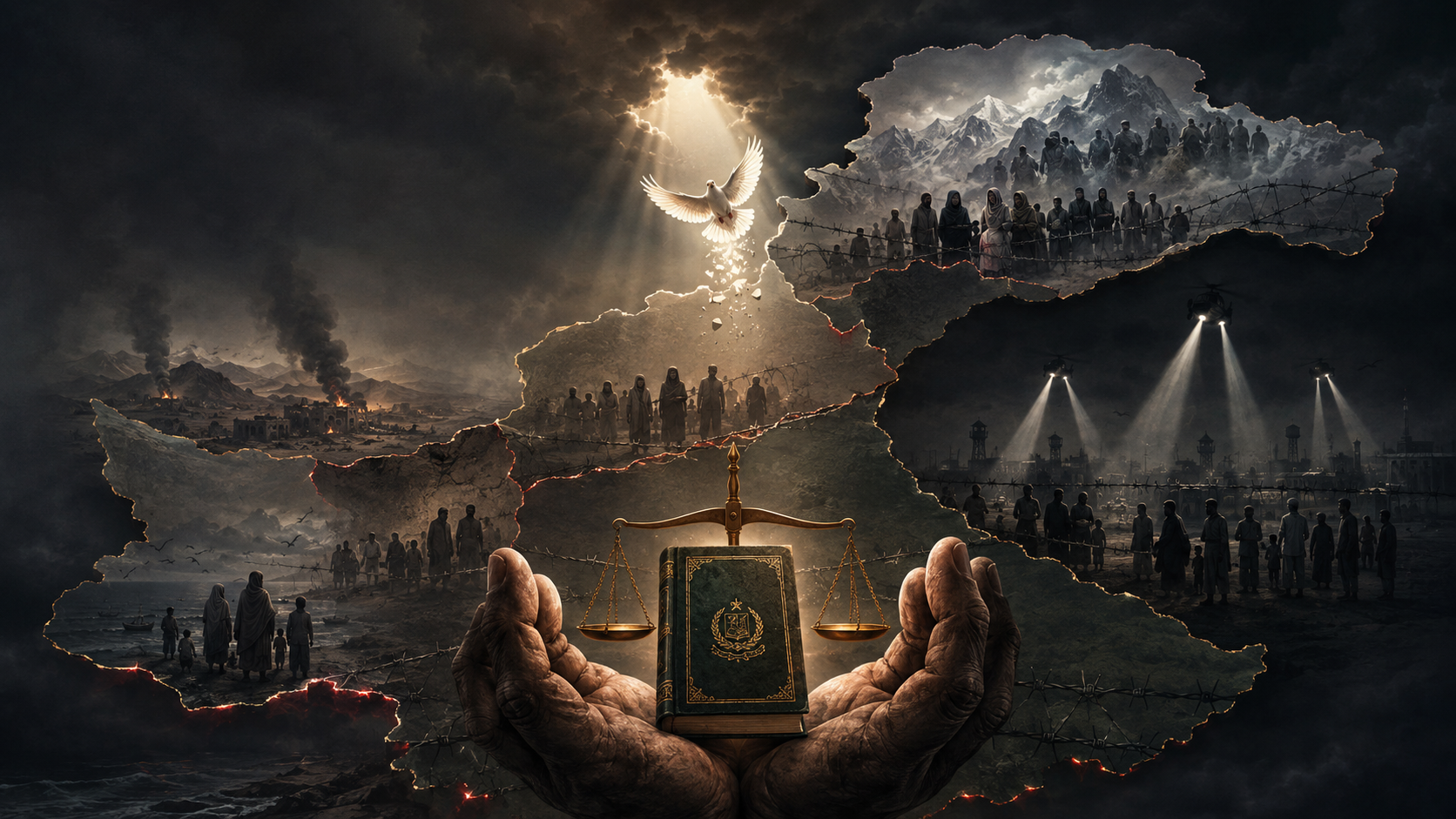
Pakistan is not merely passing through another period of political instability. It is facing a profound crisis of constitutional government, national cohesion and human dignity. From Balochistan to Khyber Pakhtunkhwa, and from Gilgit-Baltistan and Azad Jammu and Kashmir to Sindh and Punjab, citizens increasingly feel that their constitutional rights are conditional—and that the state listens only when people remain silent.
The Human Rights Commission of Pakistan’s latest annual assessment describes a severe contraction of civic space, weakening judicial independence, restrictions on freedom of expression and the growing use of legal and institutional mechanisms against journalists, political workers, activists and lawyers. It also records continuing allegations of enforced disappearances, arbitrary detention, extrajudicial killings and collective punishment. These are not merely partisan accusations; they are warnings from one of Pakistan’s most established independent human-rights organizations. HRCP: State of Human Rights in 2025
A democratic structure without democratic authority
Pakistan still possesses the outward machinery of democracy: a parliament, elections, courts, political parties, commissions and a written constitution. Yet institutions cannot protect democracy when their independence is compromised or when important decisions appear to be made outside the authority of elected representatives.
The term “hybrid government” has consequently become part of Pakistan’s political vocabulary. It describes a system in which a civilian administration formally governs while unelected institutions are widely perceived to exercise decisive influence behind the scenes.
The legitimacy crisis surrounding the February 2024 general election has never been adequately resolved. The United States and European Union raised concerns about restrictions on expression, association and peaceful assembly, the absence of a level playing field and the suspension of mobile services on election day. Pakistan’s government and Election Commission rejected allegations of systematic manipulation, but public distrust cannot be eliminated through official denials alone. It requires transparent investigations, independent courts and verifiable electoral records.
When votes are disputed, opposition leaders are imprisoned, political workers face mass prosecutions, television coverage is controlled and digital speech can lead to criminal charges, democratic government begins to resemble administrative control.
Balochistan: violence cannot resolve political grievances
Balochistan remains the most tragic illustration of the consequences of replacing politics with coercion.
The province has suffered deadly attacks by armed separatist groups, including attacks against civilians and security personnel. Such violence must be condemned without qualification. No political grievance can justify killing passengers, children, labourers or other innocent people.
But terrorism cannot be used as a blanket justification for silencing an entire population. Baloch families have been demanding answers about enforced disappearances for years. Peaceful demonstrators have faced arrests, road blockades, internet shutdowns and anti-terrorism charges. Amnesty International described the 2025 crackdown on Baloch activists as involving arbitrary detention, unlawful force and attacks on peaceful assembly. Amnesty International
The arrest and continued prosecution of peaceful rights advocates send a dangerous message: that constitutional protest offers no meaningful path to justice. When peaceful political space is closed, militant organizations gain an opportunity to present themselves as the only remaining form of resistance.
Balochistan does not need collective punishment. It needs truth about missing persons, lawful investigations, accountable policing, political dialogue, local control over resources and confidence that its citizens are equal members of the federation.
Khyber Pakhtunkhwa: civilians trapped between militancy and militarization
Khyber Pakhtunkhwa has once again become a battlefield between militant organizations and the state. Police officers, soldiers, community elders, children and ordinary residents have all paid a terrible price.
The state has a duty to protect citizens from the Tehreek-e-Taliban Pakistan and other violent groups. However, counterterrorism operations must remain subject to the Constitution and international humanitarian standards. Amnesty International reported that recurrent drone strikes in Khyber Pakhtunkhwa killed at least 17 people, including five children, during the first half of 2025. It called for prompt, independent and transparent investigations into responsibility for civilian deaths. Amnesty International on civilian harm in Khyber Pakhtunkhwa
The people of the former tribal districts have already endured displacement, destroyed livelihoods, militant brutality and repeated military operations. They must not be asked to sacrifice another generation without transparency, compensation, rehabilitation and political participation.
Security cannot be measured only by territory controlled or militants killed. It must also be measured by whether a child can attend school, whether a family can return home and whether civilians can question an operation without being labelled disloyal.
Gilgit-Baltistan, Kashmir and Sindh: grievances must not be allowed to become conflicts
Public anger in Gilgit-Baltistan and Azad Jammu and Kashmir has grown around economic hardship, constitutional uncertainty, political representation, natural resources and the cost of basic necessities. Treating every protest as a security threat risks converting manageable political disputes into lasting alienation.
Sindh also carries deep anxieties concerning enforced disappearances, control over land and water, extraction of resources, demographic pressures and the weakening of provincial autonomy. If unidentified or “hidden” forces are attempting to inflame ethnic divisions, the answer is not greater secrecy. It is transparency, constitutional government and independent investigation.
The state must never allow political engineering, manufactured disorder or selective repression to become instruments for prolonging any government’s tenure. However, claims that particular institutions or foreign powers are deliberately creating unrest require credible, independently verifiable evidence. Such allegations should be investigated rather than repeated as established facts.
What can already be established is that unresolved grievances, institutional interference and excessive force create precisely the environment in which conspiracy, militancy and separatism flourish.
Punjab’s enforced calm
Punjab’s relative calm should not automatically be interpreted as democratic stability. As Pakistan’s most populous and politically decisive province, Punjab has historically been central to the survival of federal governments. The old saying that whoever controls Punjab controls Pakistan continues to carry political meaning.
But peace maintained through arrests, intimidation, media restrictions, political exclusion and fear is not genuine peace. It is enforced silence.
Human Rights Watch reported that Pakistani authorities suppressed dissent during 2025 through restrictions on the media, opposition and civil society. Journalists faced harassment, arrests, disappearances and physical attacks, while hundreds of cases were reportedly registered under the Prevention of Electronic Crimes Act. Human Rights Watch: Pakistan—Events of 2025
Punjab cannot remain politically dominant while being democratically constrained. Nor can the federation remain stable if peace in one province depends on violence or deprivation elsewhere.
International silence and strategic interests
Western governments frequently speak about democracy and human rights, yet their relationships with Pakistan have often been driven by security cooperation, regional strategy, trade and geopolitical convenience.
It would require evidence to claim that Western powers are directing Pakistan’s internal repression. But it is reasonable to question whether their selective criticism—and willingness to continue normal strategic relations—reduces the international cost of authoritarian behaviour.
Foreign governments should apply the same standards to Pakistan that they publicly advocate elsewhere. Security cooperation must not become an excuse for ignoring enforced disappearances, political prisoners, restrictions on the media, military trials of civilians or attacks on peaceful protesters.
Nevertheless, Pakistan’s rulers cannot shift responsibility abroad. The primary duty to protect Pakistan’s people rests with Pakistan’s own government, parliament, judiciary, security institutions and political leadership.
When institutions serve power instead of people
Parliament loses meaning when it merely approves decisions made elsewhere. Courts lose authority when citizens believe justice depends on political alignment. Elections lose credibility when winners appear to be selected after votes are cast. Human-rights institutions lose their purpose when they document violations but cannot protect victims.
Terrorism laws should target terrorists—not peaceful demonstrators, children, journalists or political opponents. Military courts should not replace the ordinary judicial system for civilians. Internet shutdowns should not be used to conceal events or prevent political organization. Enforced disappearance must be treated as a grave crime, whoever commits it and whatever justification is offered.
Pakistan also needs an independent truth-and-accountability process covering enforced disappearances, extrajudicial killings, attacks by militant organizations and civilian casualties during security operations. Victims from every province deserve recognition and remedy without discrimination.
Humanity must come before power
Pakistan cannot be held together indefinitely by force. A federation survives when its people believe that the Constitution protects them equally, their votes carry meaning and their grievances can be heard without fear.
The way forward is neither militancy nor authoritarian control. It is the restoration of constitutional civilian rule, genuinely free elections, judicial independence, freedom of the press, parliamentary oversight of security policy and meaningful dialogue with marginalized regions.
Every murdered civilian, disappeared student, silenced journalist, imprisoned political worker and displaced family represents more than an individual tragedy. Each is evidence of a state moving further away from its constitutional promise.
Pakistan’s greatest threat is not criticism. It is a system that treats criticism as treason, political participation as rebellion and human life as expendable.
Today, humanity is bleeding across Pakistan. Those who benefit from the concentration of power may believe that repression can preserve their rule. History teaches the opposite: force can impose silence for a time, but it cannot manufacture legitimacy, heal a divided federation or extinguish the demand for justice.
No person, party or institution is greater than Pakistan—and no vision of Pakistan is worth defending if humanity must be sacrificed to sustain it.
FURTHER READING
Human Rights Commission of Pakistan: http://hrcp-web.org/hrcpweb/freedom-of-expression-rule-of-law-under-stress-hrcp-launches-2025-report/
Human Rights Watch—Pakistan: http://hrw.org/world-report/2026/country-chapters/pakistan
This independent documentary presents opinion-based analysis for education, public awareness and peaceful discussion. It condemns terrorism and violence by all actors. Allegations discussed should be examined through independent, transparent and lawful investigations. This video does not promote hatred or violence against any ethnic, political, regional or institutional group.