Imran Khan’s Health Is a Human Rights Issue, Not a Political Privilege

Imran Khan’s Health Is a Human Rights Issue, Not a Political Privilege

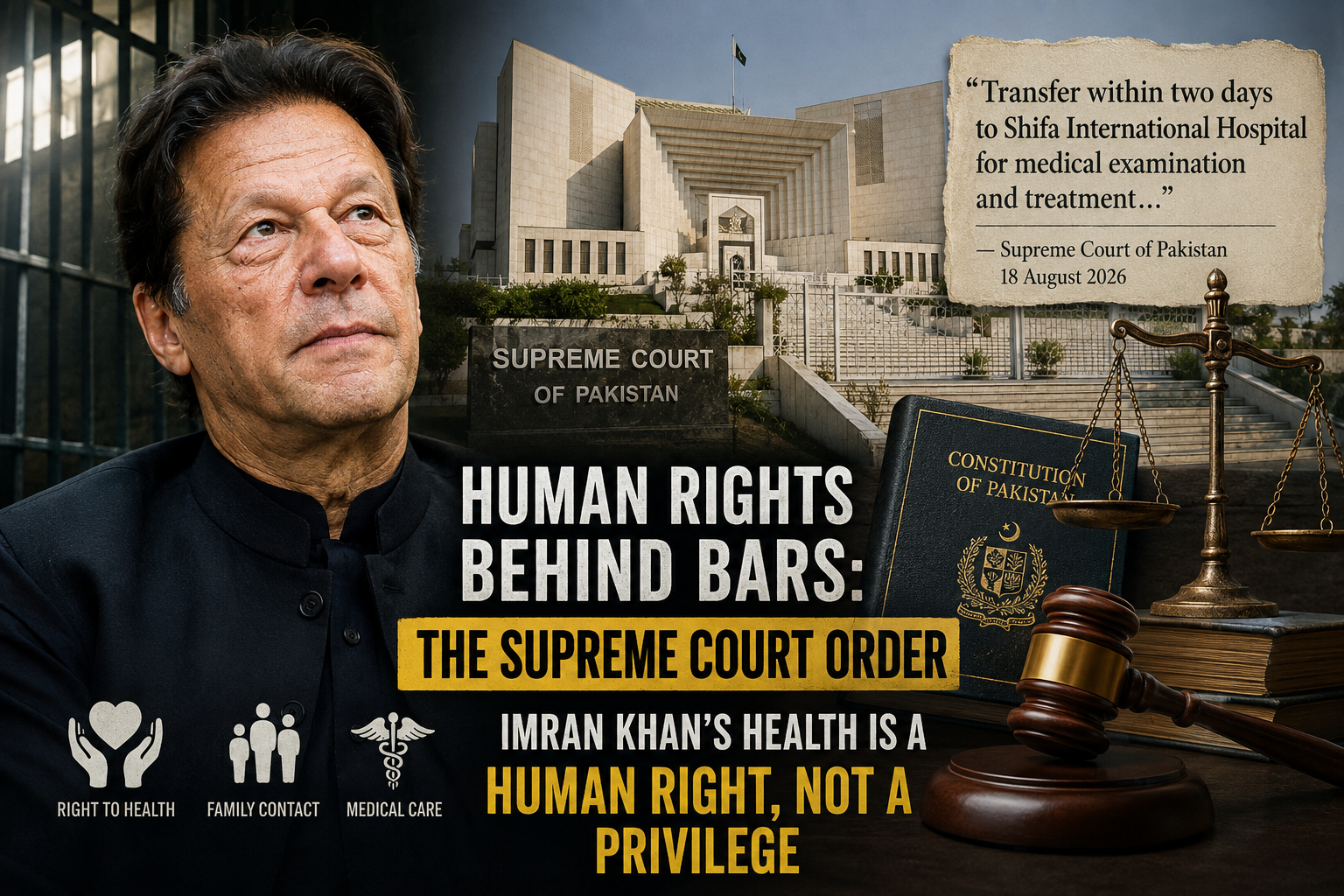
Pakistan’s Supreme Court has issued an important order concerning the health and basic rights of imprisoned former Prime Minister Imran Khan. On August 18, the Court directed the authorities to transfer Khan from Adiala Jail to Shifa International Hospital in Islamabad within two days for examination and treatment by a multidisciplinary medical board. His personal physician and his sister, Dr Uzma Khan, are also to be associated with his medical care.

The Court went further. It directed that Khan be permitted weekly meetings with his family and telephone conversations with his sons twice a week. The government was told that the interim directions were to be complied with “in letter and spirit” until the next hearing.

These directions should not be viewed through the narrow lens of party politics. They concern something much more fundamental: the dignity, health and humane treatment of a person held in state custody.

A prisoner does not cease to be a human being when the prison gates close.

International human-rights standards make this principle particularly clear. Under the United Nations Nelson Mandela Rules, providing healthcare to prisoners is a responsibility of the state, and prisoners should receive standards of healthcare comparable to those available in the wider community, without discrimination because of their legal status. The Rules also require prompt medical attention in urgent cases and contemplate transfer to specialised institutions or civil hospitals where specialised treatment is required.

This principle must apply regardless of whether the prisoner is Imran Khan, one of his political opponents, or an ordinary Pakistani whose name will never appear in a newspaper. Human rights lose their meaning if they depend upon political popularity.

The government’s response therefore deserves close public scrutiny.

Rather than simply implementing the hospital direction, the federal authorities have filed a review petition asking the Supreme Court to reconsider it. The government argues, among other things, that directing treatment at a particular private hospital is discriminatory and conflicts with the applicable prison rules. Information Minister Attaullah Tarar has said the government does not oppose necessary medical treatment but objects to requiring treatment at a private facility.

The government unquestionably has the right to seek judicial review through lawful procedures. But filing a review petition is different from obtaining an order suspending or overturning the existing direction.

That distinction matters.

When the highest court issues an operative order concerning the health of a person in state custody, the authorities carry an especially serious responsibility. Questions about jurisdiction, prison regulations and the appropriate hospital can be argued before the Court. A prisoner’s health, however, should never become leverage in a political contest.

The Supreme Court’s intervention also highlights a broader issue extending far beyond Imran Khan. Pakistan must ask what standard it wishes to establish for every prisoner. Access to necessary healthcare, independent clinical judgment, humane treatment and reasonable family contact should not be privileges reserved for former prime ministers. They should form part of a system that respects the dignity of all persons deprived of liberty.

The Nelson Mandela Rules place responsibility for prisoners’ healthcare squarely upon the state. They also emphasise that medical decisions should be based on clinical considerations rather than being overridden by non-medical prison authorities.

The present controversy is therefore becoming a test larger than one man.

The Supreme Court has spoken. The government has chosen to challenge part of its direction. The legal process may continue, but until a competent court modifies an operative order, respect for judicial authority and protection of a prisoner’s fundamental dignity must remain paramount.

The 48-hour period specified by the Supreme Court should now be watched carefully. If that deadline expires without compliance and without a judicial order suspending or modifying the direction, the issue will become considerably more serious — not merely politically, but from the perspective of the rule of law and the state’s duty toward a person in its custody.

Pakistan’s institutions will ultimately be judged not by how they treat the powerful when they hold office, but by whether they uphold law, dignity and basic human rights even when the person before them is a political adversary.

Human rights are not rewards for political loyalty. They belong to everyone.

Sources:

  Supreme Court order / hospital transfer — Associated Press, 18 August 2026
Reports the Supreme Court’s direction to take Imran Khan to Shifa International Hospital, examination by a medical board including his personal physician, weekly family meetings, and calls with his sons.
AP — Pakistan’s top court orders Imran Khan taken to hospital

  Government review petition — Associated Press, 19 August 2026
Reports that Pakistani authorities asked the Supreme Court to review/withdraw the private-hospital direction and explains the government’s argument that treatment should ordinarily occur in government facilities.
AP — Authorities seek review of hospital order

  Government/Law Minister response — 19 August 2026
Reports Law Minister Azam Nazeer Tarar’s position that the government would challenge the private-hospital direction and records that the Supreme Court specified transfer within two days.
Malay Mail / AFP — Pakistan to challenge Supreme Court order

  United Nations — Nelson Mandela Rules (A/RES/70/175)
This is the strongest primary international source for the human-rights portion. Rule 1 establishes respect for prisoners’ inherent dignity; the Rules also establish standards concerning prisoners’ healthcare.
UN — Nelson Mandela Rules, official resolution

  Nelson Mandela Rules — medical treatment, Rule 27
Particularly important for our article: Rule 27 says prisoners requiring specialised treatment should be transferred to specialised institutions or civil hospitals, and that clinical decisions belong to healthcare professionals and cannot be overridden by non-medical prison staff.
UN — Official Nelson Mandela Rules PDF

  Additional independent coverage — Al Jazeera, 18 August 2026
Covers the Supreme Court hospital-transfer decision and the dispute over access and Khan’s health.
Al Jazeera — Pakistan top court orders Imran Khan’s hospital transfer
Pakistan’s Shrinking Civic Space: Media Restrictions and Human Rights Concerns

Pakistan’s Shrinking Civic Space: Media Restrictions and Human Rights Concerns

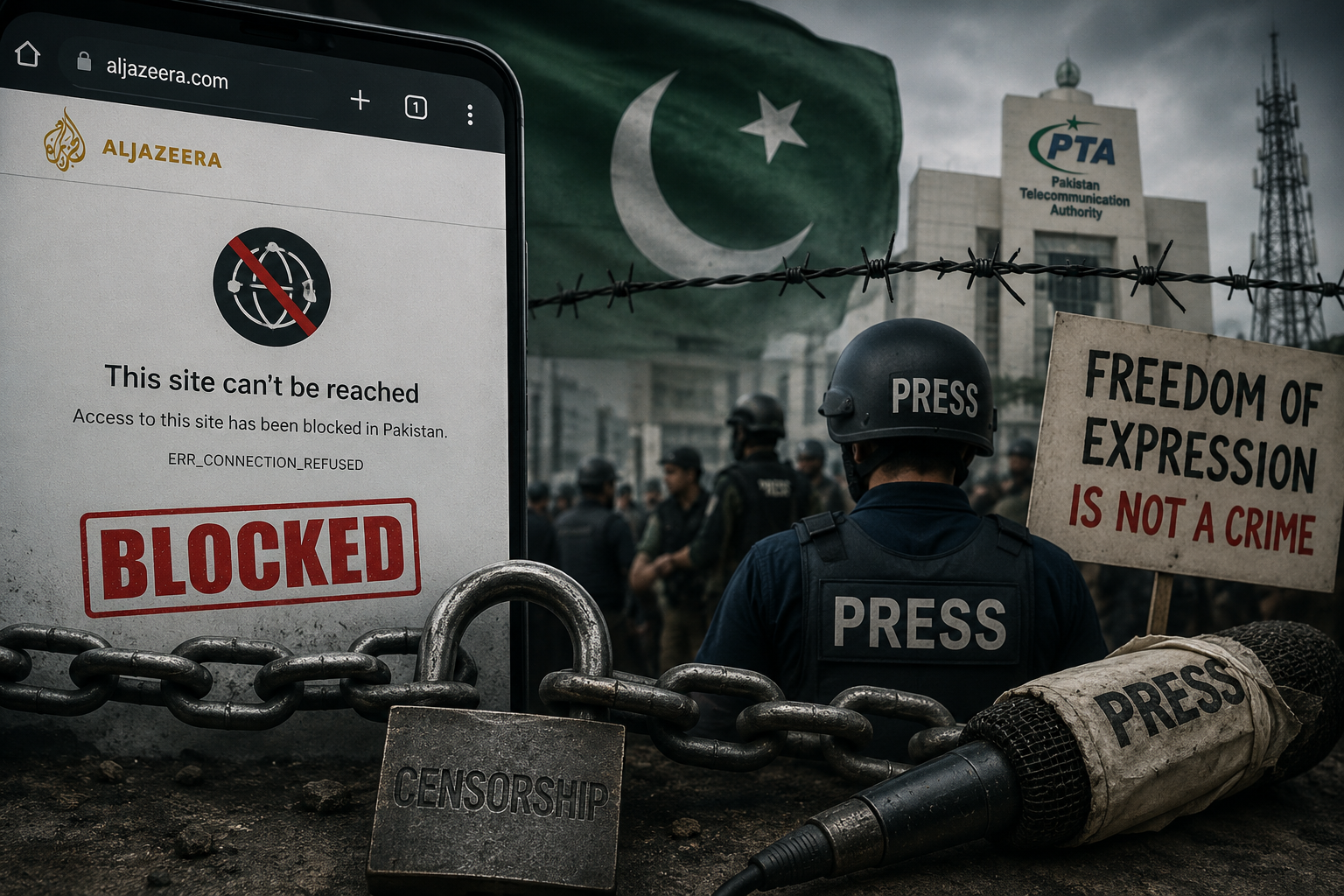
Recent reports regarding the inaccessibility of Al Jazeera’s English website in Pakistan have once again raised concerns about press freedom and the broader state of civil liberties in the country. While this incident has attracted international attention, many journalists, human rights organizations, and media observers argue that it reflects a wider trend of increasing restrictions on independent reporting and democratic freedoms.

Al Jazeera Access Restrictions

Following Al Jazeera’s coverage of protests and election-related developments in Pakistan-administered Kashmir (Azad Jammu & Kashmir), many internet users in Pakistan reported being unable to access the broadcaster’s English website. Although no publicly available order from the Pakistan Telecommunication Authority (PTA) has been released confirming the restriction, Pakistan’s Ministry of Information publicly criticized Al Jazeera’s reporting, describing it as “selective reporting” and “yellow journalism.”

The reported restrictions have drawn criticism from international media organizations and press freedom advocates, who argue that access to diverse sources of information is an essential component of a democratic society.

A Broader Pattern of Media Restrictions

The Al Jazeera incident is viewed by many observers as part of a broader pattern of increasing regulation and control over media reporting in Pakistan.

Recent developments reported by international and local media include:

  • New guidelines requiring foreign journalists to obtain official permission before reporting from many parts of the country.
  • Expanded accreditation requirements for Pakistani journalists working with international media organizations.
  • Broad provisions allowing authorities to suspend or revoke journalist accreditation under certain conditions.
  • Continued concerns regarding internet disruptions, content blocking, and restrictions on digital platforms during politically sensitive events.

Journalist organizations, including the Pakistan Federal Union of Journalists (PFUJ), the Human Rights Commission of Pakistan (HRCP), the Committee to Protect Journalists (CPJ), and Reporters Without Borders (RSF), have expressed concern that these measures may discourage independent journalism and reduce transparency.

Human Rights and Democratic Concerns

Beyond media freedom, international human rights organizations have continued to express concern over the broader civic environment in Pakistan.

Reports from organizations such as Human Rights Watch, Amnesty International, the Human Rights Commission of Pakistan, and Reporters Without Borders have highlighted issues including:

  • Restrictions on freedom of expression.
  • Pressure on journalists and independent media outlets.
  • Arrests and legal proceedings involving political activists.
  • Internet shutdowns and online censorship.
  • Limitations on peaceful assembly and public protest.
  • Concerns regarding judicial independence and due process in politically sensitive cases.

While the government has consistently stated that many of these measures are necessary to maintain national security, public order, and combat misinformation, critics argue that the cumulative effect has been a narrowing of democratic space.

Public Debate

Social media platforms, independent commentators, and international observers continue to debate the balance between national security and civil liberties.

Supporters of the government’s approach argue that stronger regulation is necessary to protect national interests and counter misinformation, particularly during periods of political tension.

Critics contend that increasing restrictions on journalists, media organizations, and online platforms reduce government accountability, limit access to independent information, and weaken democratic institutions.

These discussions remain highly polarized, reflecting Pakistan’s broader political divisions.

Conclusion

The reported restriction of Al Jazeera’s website has become another focal point in an ongoing debate about media freedom and human rights in Pakistan. Although opinions differ sharply regarding the government’s actions, international press freedom organizations and human rights groups continue to warn that expanding restrictions on journalism, public expression, and access to information may have long-term implications for democratic governance and the protection of fundamental rights.

References

  • The Guardian. Pakistani authorities ban international media from reporting in most of country (2026).
  • Associated Press (AP). Coverage of restrictions affecting Al Jazeera and media regulations in Pakistan (2026).
  • Human Rights Watch – Pakistan reports.
  • Amnesty International – Pakistan reports.
  • Human Rights Commission of Pakistan (HRCP).
  • Committee to Protect Journalists (CPJ).
  • Reporters Without Borders (RSF) – World Press Freedom Index and Pakistan reports.

Anatomy of a Crackdown The Systematic Dismantling of Democracy, Human Rights, and Pakistan Tehreek-e-Insaf

Anatomy of a Crackdown: The Systematic Dismantling of Democracy, Human Rights, and Pakistan Tehreek-e-Insaf

The political landscape of Pakistan has undergone a profound, authoritarian transformation. What began as a contest of political wills has evolved into a sweeping state-backed campaign to dismantle the country’s most popular political movement: Pakistan Tehreek-e-Insaf (PTI), led by former Prime Minister Imran Khan.

Characterized by the ouster of Khan through a parliamentary vote of no-confidence, subsequent mass incarcerations, orchestrated false flag operations, and egregious human rights violations, this period represents one of the darkest chapters in Pakistan’s constitutional history.

1. The Ouster and Imprisonment of Imran Khan

The systematic removal of Imran Khan from power in April 2022 via a U.S.-backed or domestic military-engineered vote of no-confidence set off a chain reaction of political volatility. Rather than fading from the political arena, Khan mobilized massive public support, challenging the traditional political dynasties and the military establishment that had long controlled Pakistan’s levers of power.

Fearing an inevitable landslide return for PTI in subsequent democratic exercises, the state apparatus launched an unprecedented legal onslaught. Khan has faced over a hundred disparate charges ranging from corruption to state secrets violations.

In August 2023, Khan was arrested and subsequently sentenced in multiple rushed trials. His incarceration has been marked by conditions that international human rights organizations and legal experts condemn as unlawful:

  • Solitary Confinement and Isolation: Khan has spent extended periods isolated from the outside world, denied standard privileges afforded to political prisoners, and subjected to heavily restricted legal and familial access.
  • Deteriorating Health and Medical Neglect: Reports and court submissions highlighted severe health crises, including a dangerous escalation of eye complications, specifically right central retinal vein occlusion, leaving him with critically compromised vision in his right eye. Despite repeated appeals from international medical experts, domestic courts, and his family (such as his sisters Aleema and Noreen Khanum), access to independent specialists has been routinely blocked or delayed, fueling widespread anxiety over deliberate physical neglect.

2. False Flag Operations and the Criminalization of Dissent

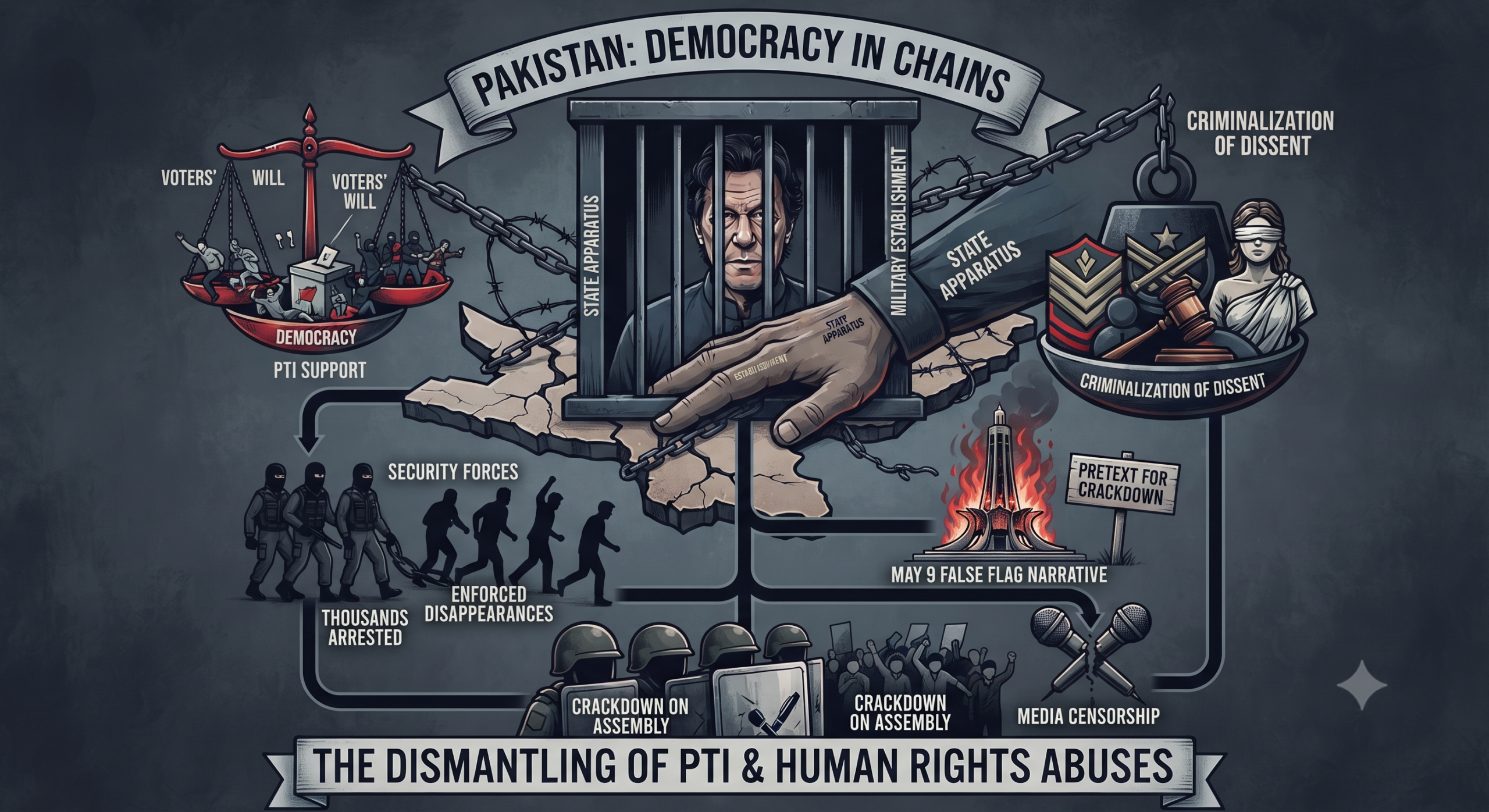
To justify an aggressive crackdown on PTI, the state machinery engineered a series of events designed to criminalize the party, recast political opposition as “anti-state terrorism,” and strip the movement of its democratic legitimacy.

The May 9, 2023 Incident

The turning point for intensified state repression occurred on May 9, 2023, following Khan’s initial dramatic arrest from the Islamabad High Court premises. Spontaneous, massive public protests broke out nationwide.

However, critical security installations and military monuments were breached during the protests under suspicious circumstances, lapses that independent observers and PTI maintain were false flag operations or deliberately enabled security vacuums. The state used these breaches as a blanket pretext to launch an all-out war against PTI, labeling a mainstream political party as a “proscribed terrorist outfit” in practice.

Military Courts and Kangaroo Trials

In the aftermath, the state bypassed constitutional civilian judicial frameworks. Thousands of PTI workers, leaders, and even civilian supporters were rounded up and dragged before military courts, a direct violation of international law and Pakistan’s constitutional guarantees regarding a fair trial.

  • Scores of civilians, including women, activists, and prominent figures, have been handed harsh prison terms, with some receiving life sentences for participating in or merely being associated with the 2023 protests.
  • Human rights watchdogs have routinely criticized these military trials as instruments of political intimidation aimed at neutralizing opposition figures through terror.

3. Systematic Human Rights Violations and Erosion of the Rule of Law

The campaign against PTI is not restricted to prison cells or courtrooms; it represents a comprehensive assault on fundamental human rights across Pakistan, heavily documented by bodies like Human Rights Watch and Amnesty International.

  • Enforced Disappearances and Arbitrary Detentions: Hundreds of PTI local leaders, social media activists, and dissenting journalists have been subjected to short-term or prolonged enforced disappearances. Individuals are frequently abducted by plainclothes intelligence operatives, held without charge, and later released only after abandoning their political affiliations.
  • Muzzling Freedom of Expression and Media Blackouts: The state has systematically suppressed independent journalism. Television channels are heavily censored, preventing any positive coverage or direct statements from Imran Khan. Cybercrime and vague anti-terrorism laws have been weaponized to jail reporters, columnists, and digital creators who question the military establishment. Even popular social media platforms face targeted restrictions and bans to choke off PTI’s primary avenue of communication with the public.
  • Crackdown on Peaceful Assembly: Peaceful protests called by PTI are routinely met with brute force, tear gas, arbitrary road closures, and mass pre-emptive arrests of organizers and attendees. The fundamental right to assemble and petition the government has been effectively suspended.

4. Ongoing Struggles and Recent Developments

Despite facing relentless institutional pressure, financial blockades, and the imprisonment of its core leadership, PTI has stubbornly refused to dissolve. The political deadlock persists as the current coalition government, backed securely by the military establishment, solidifies power through controversial by-elections and amendments while the country struggles with severe economic and security challenges.

Recent months have seen global alarm reach a fever pitch. International coalitions of lawmakers, legal scholars, and human rights defenders have continued to issue urgent appeals demanding Imran Khan’s immediate release, proper medical treatment for his failing eyesight, and an end to the judicial harassment of political opponents.

A Test for Democracy

The ongoing persecution of PTI, the normalization of military trials for civilians, and the systemic silencing of millions of voters highlight a grim reality: Pakistan’s fragile democracy has been hollowed out into a facade managed by unelected power brokers. The ordeal faced by Imran Khan, his family, and thousands of nameless, incarcerated party workers is a stark reminder that when the rule of law is subverted to preserve elite control, basic human rights become the primary casualty.