
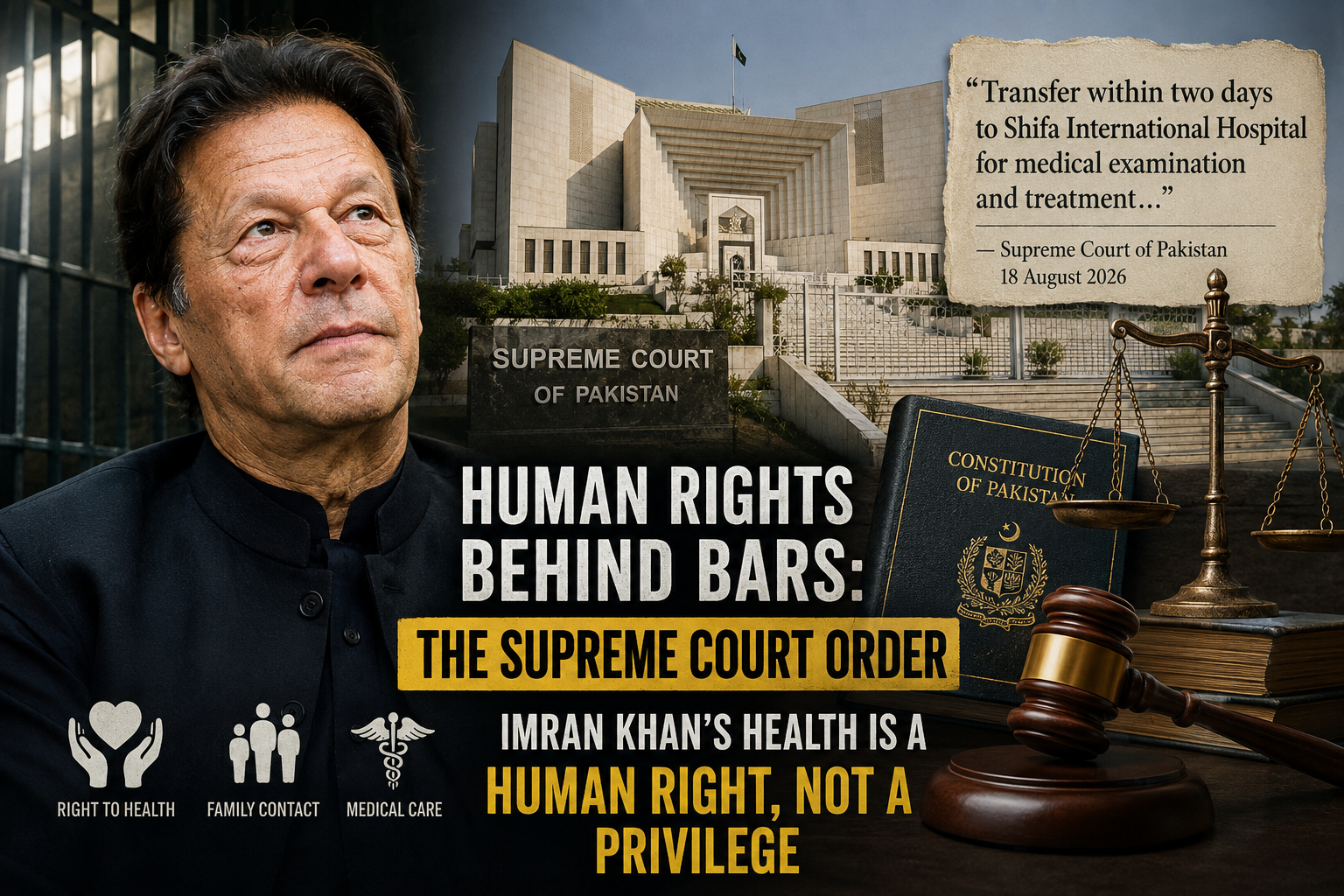
Imran Khan’s Health Is a Human Rights Issue, Not a Political Privilege
Pakistan’s Supreme Court has issued an important order concerning the health and basic rights of imprisoned former Prime Minister Imran Khan. On August 18, the Court directed the authorities to transfer Khan from Adiala Jail to Shifa International Hospital in Islamabad within two days for examination and treatment by a multidisciplinary medical board. His personal physician and his sister, Dr Uzma Khan, are also to be associated with his medical care.
The Court went further. It directed that Khan be permitted weekly meetings with his family and telephone conversations with his sons twice a week. The government was told that the interim directions were to be complied with “in letter and spirit” until the next hearing.
These directions should not be viewed through the narrow lens of party politics. They concern something much more fundamental: the dignity, health and humane treatment of a person held in state custody.
A prisoner does not cease to be a human being when the prison gates close.
International human-rights standards make this principle particularly clear. Under the United Nations Nelson Mandela Rules, providing healthcare to prisoners is a responsibility of the state, and prisoners should receive standards of healthcare comparable to those available in the wider community, without discrimination because of their legal status. The Rules also require prompt medical attention in urgent cases and contemplate transfer to specialised institutions or civil hospitals where specialised treatment is required.
This principle must apply regardless of whether the prisoner is Imran Khan, one of his political opponents, or an ordinary Pakistani whose name will never appear in a newspaper. Human rights lose their meaning if they depend upon political popularity.
The government’s response therefore deserves close public scrutiny.
Rather than simply implementing the hospital direction, the federal authorities have filed a review petition asking the Supreme Court to reconsider it. The government argues, among other things, that directing treatment at a particular private hospital is discriminatory and conflicts with the applicable prison rules. Information Minister Attaullah Tarar has said the government does not oppose necessary medical treatment but objects to requiring treatment at a private facility.
The government unquestionably has the right to seek judicial review through lawful procedures. But filing a review petition is different from obtaining an order suspending or overturning the existing direction.
That distinction matters.
When the highest court issues an operative order concerning the health of a person in state custody, the authorities carry an especially serious responsibility. Questions about jurisdiction, prison regulations and the appropriate hospital can be argued before the Court. A prisoner’s health, however, should never become leverage in a political contest.
The Supreme Court’s intervention also highlights a broader issue extending far beyond Imran Khan. Pakistan must ask what standard it wishes to establish for every prisoner. Access to necessary healthcare, independent clinical judgment, humane treatment and reasonable family contact should not be privileges reserved for former prime ministers. They should form part of a system that respects the dignity of all persons deprived of liberty.
The Nelson Mandela Rules place responsibility for prisoners’ healthcare squarely upon the state. They also emphasise that medical decisions should be based on clinical considerations rather than being overridden by non-medical prison authorities.
The present controversy is therefore becoming a test larger than one man.
The Supreme Court has spoken. The government has chosen to challenge part of its direction. The legal process may continue, but until a competent court modifies an operative order, respect for judicial authority and protection of a prisoner’s fundamental dignity must remain paramount.
The 48-hour period specified by the Supreme Court should now be watched carefully. If that deadline expires without compliance and without a judicial order suspending or modifying the direction, the issue will become considerably more serious — not merely politically, but from the perspective of the rule of law and the state’s duty toward a person in its custody.
Pakistan’s institutions will ultimately be judged not by how they treat the powerful when they hold office, but by whether they uphold law, dignity and basic human rights even when the person before them is a political adversary.
Human rights are not rewards for political loyalty. They belong to everyone.
Sources:
Supreme Court order / hospital transfer — Associated Press, 18 August 2026
Reports the Supreme Court’s direction to take Imran Khan to Shifa International Hospital, examination by a medical board including his personal physician, weekly family meetings, and calls with his sons.
AP — Pakistan’s top court orders Imran Khan taken to hospital
Government review petition — Associated Press, 19 August 2026
Reports that Pakistani authorities asked the Supreme Court to review/withdraw the private-hospital direction and explains the government’s argument that treatment should ordinarily occur in government facilities.
AP — Authorities seek review of hospital order
Government/Law Minister response — 19 August 2026
Reports Law Minister Azam Nazeer Tarar’s position that the government would challenge the private-hospital direction and records that the Supreme Court specified transfer within two days.
Malay Mail / AFP — Pakistan to challenge Supreme Court order
United Nations — Nelson Mandela Rules (A/RES/70/175)
This is the strongest primary international source for the human-rights portion. Rule 1 establishes respect for prisoners’ inherent dignity; the Rules also establish standards concerning prisoners’ healthcare.
UN — Nelson Mandela Rules, official resolution
Nelson Mandela Rules — medical treatment, Rule 27
Particularly important for our article: Rule 27 says prisoners requiring specialised treatment should be transferred to specialised institutions or civil hospitals, and that clinical decisions belong to healthcare professionals and cannot be overridden by non-medical prison staff.
UN — Official Nelson Mandela Rules PDF
Additional independent coverage — Al Jazeera, 18 August 2026
Covers the Supreme Court hospital-transfer decision and the dispute over access and Khan’s health.
Al Jazeera — Pakistan top court orders Imran Khan’s hospital transfer