








From Bread Subsidies to the “Terror” Tag: The Escalating Crisis in Pakistan-Administered Kashmir

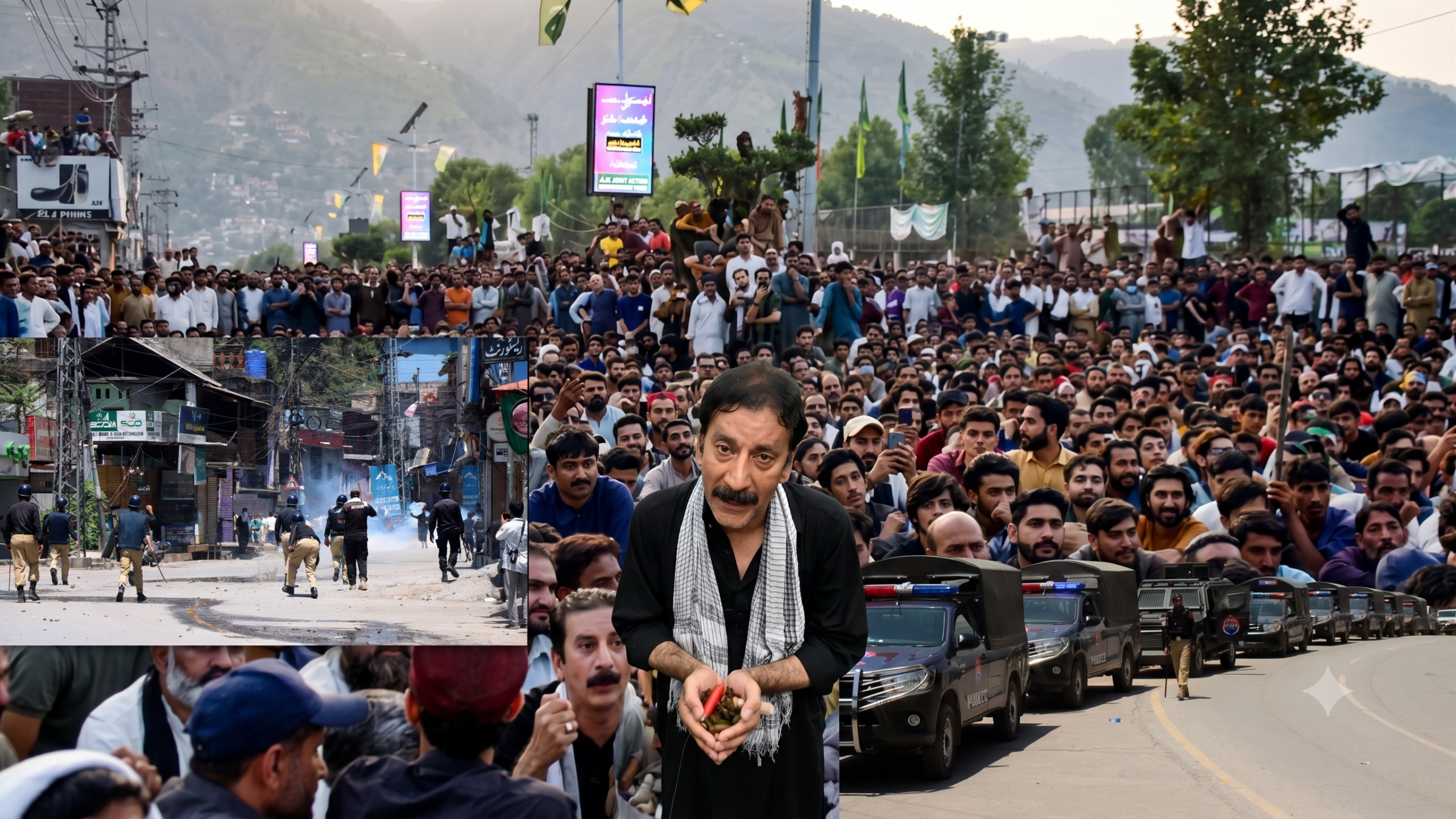
Over the past three weeks, Pakistan-administered Azad Jammu and Kashmir (AJK) has been consumed by a severe wave of civil unrest, resulting in a deadly state crackdown, internet blackouts, mass arbitrary arrests, and a highly controversial counter-terrorism designation aimed at a civilian rights movement.
What began over a year ago as a localized economic grievance regarding the soaring costs of flour and electricity has transformed into a profound political and human rights crisis.
The Trigger: Electoral Seats and Economic Strain
he underlying friction in the region dates back to mid-2023, when the Jammu and Kashmir Joint Awami Action Committee (JKJAAC) a broad-based, grassroots coalition of traders, lawyers, and civil society members began mobilizing mass demonstrations. The initial rallying cries were grounded in severe socioeconomic distress: demands for subsidized wheat flour, the elimination of lavish perks enjoyed by local bureaucrats, and electricity provision at the actual cost of production.
While the regional administration conceded to some economic demands following a massive “long march” toward Muzaffarabad in May 2024, deep-seated political tensions boiled over in early June 2026.
The immediate catalyst for the current phase of unrest is a fierce constitutional battle regarding the upcoming regional elections. The JKJAAC has demanded the abolition of 12 seats in the 45-member Azad Jammu and Kashmir Legislative Assembly that are strictly reserved for refugees who migrated from Indian-administered Kashmir decades ago and currently reside in other provinces of Pakistan.
The protest movement argues that these reserved seats allow non-residents to wield disproportionate influence over the political affairs and governance of AJK. However, on June 7, 2026, the Supreme Court of Azad Jammu and Kashmir ruled that these seats are constitutionally protected and cannot be altered without a formal constitutional amendment.
The judicial validation of the seat allocation immediately re-ignited mass public demonstrations.
The State Backlash: Human Rights Under Siege
In response to the resurgent, largely peaceful democratic demonstrations, the state apparatus deployed a severe security apparatus that human rights watchdogs warn has crossed dangerous red lines.
On June 5, 2026, the regional home department formally designated the JKJAAC as a “proscribed organization” under the Azad Jammu and Kashmir Anti-Terrorism Act. By branding a grassroots civil liberties coalition as a terrorist entity, authorities unlocked vast executive powers to suppress the dissent.
Amnesty International and local human rights groups have strongly condemned this designation, warning that utilizing anti-terror legislation against civil rights advocates marks a dangerous escalation intended to justify the use of lethal force and arbitrary detention.
Key Human Rights Concerns in AJK (June 2026)
- Abuse of Anti-Terror Laws (JKJAAC proscription)
- Mass Arbitrary Arrests & Sedition Charges
- Documented Fatalities (At least 11–20 deaths during recent clashes)
- Digital Clampdown (Complete mobile internet blackouts)
The human rights fallout over the past three weeks has been severe:
- Excessive and Lethal Use of Force: Clashes erupted in Rawalakot, Kotli, and Mirpur between demonstrators and heavily deployed federal paramilitary forces. Official estimates confirm that at least 11 individuals—including both civil protesters and security personnel—were killed in the first week of June alone, with some independent human rights trackers pushing the total casualty count closer to 20 dead and over 70 injured.
- Arbitrary Detentions and Sedition Charges: Dozens of activists and political coordinators have been swept into custody. The crackdown culminated in a high-profile raid resulting in the arrest of prominent JKJAAC leader Shaukat Nawaz Mir on sedition charges, following the state offering a 10 million rupee bounty for his capture.
- Information Blackouts: To prevent the coordination of rallies and to obstruct the documentation of state violence, authorities instituted severe regional internet and mobile data blackouts. This digital isolation has shielded law enforcement actions from international oversight and heavily disrupted independent local journalism.
The Underlying Crisis of Regional Autonomy
The violence of the past few weeks is a structural symptom of a much deeper, long-standing systemic crisis concerning governance, resource distribution, and regional autonomy.
A central point of local resentment centers around electricity. Residents argue that AJK produces substantial hydroelectric power for the national grid via major installations like the Mangla Dam, yet locals endure up to 10 hours of daily rolling blackouts while being forced to pay highly taxed, inflated electricity bills.
Furthermore, the overarching political structures—such as the Azad Jammu and Kashmir Council, which is chaired directly by the Prime Minister of Pakistan and populated heavily by unelected federal officials—leave local populations feeling fundamentally disenfranchised.
By treating local economic survival and demands for political accountability as security threats and acts of terrorism, the state has closed off the traditional avenues of democratic negotiation. As the region heads toward a highly contentious election cycle under the shadow of a militarized crackdown, the gulf between the local populace and the state apparatus continues to widen.
Mainly Two Issues:
- Dispute of 12 Refugees seats and
- Dispute of Hydroelectric between AJK and Pakistan
Read about these two issues in next article. And also watch two videos shared just before this article on main Stream









Get involved!
Comments