Trump’s Political Defeat: The Cost of Controversial Policies, Support for Netanyahu, and Relations with Pakistan’s Military Leadership
A Human Rights Perspective on the 2026 US Midterm Elections
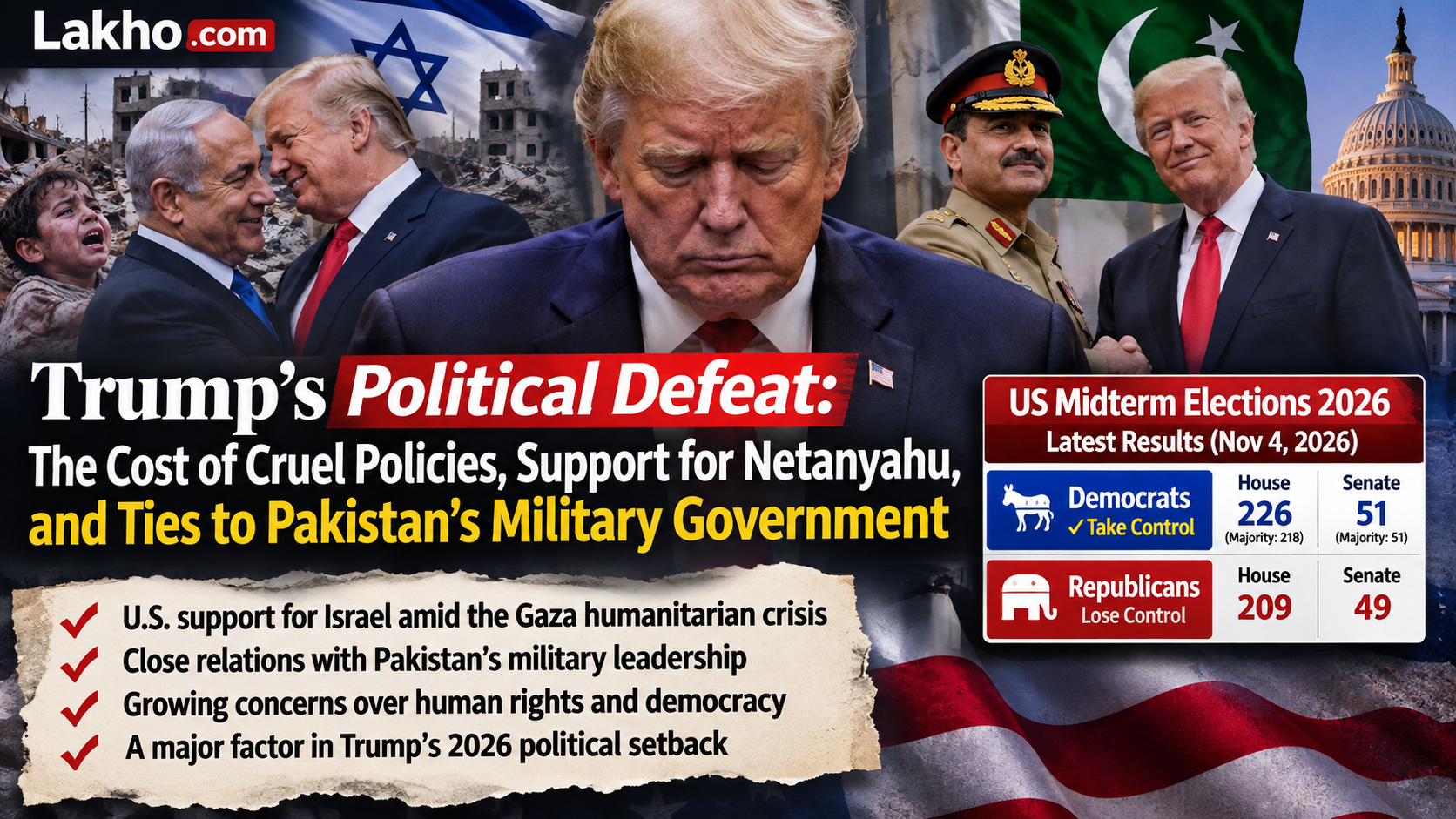
The November 3, 2026, United States midterm elections delivered a major political setback to President Donald Trump and the Republican Party. Democrats captured control of both chambers of Congress, reflecting widespread dissatisfaction with the administration’s domestic and foreign policies. The results raise an important question: Has Trump’s approach to international conflicts, controversial alliances, and human rights contributed to the erosion of public confidence in his leadership?
While economic hardship, rising living costs, and the war with Iran featured prominently in election reporting, Trump’s relationships with Israeli Prime Minister Benjamin Netanyahu and Pakistan’s powerful military leadership also deserve examination through the lens of democracy, justice, and international accountability.
1. Trump’s Support for Netanyahu and the Humanitarian Crisis in Gaza
One of the most controversial aspects of Trump’s foreign policy has been his relationship with Israeli Prime Minister Benjamin Netanyahu. Israel’s military operations in Gaza have generated profound international concern over civilian casualties, displacement, destruction of essential infrastructure, humanitarian access, and the protection of Palestinian civilians.
Human rights organizations and international legal institutions have raised serious questions about Israel’s conduct during the conflict. Critics of Washington’s support for Israel argue that continued military and diplomatic assistance, without sufficiently effective conditions protecting civilians, risks weakening America’s stated commitment to international humanitarian law.
Supporters of the US-Israel relationship, meanwhile, emphasize Israel’s security concerns, the October 7, 2023, Hamas attacks, hostage issues, and the strategic importance of the bilateral alliance. However, legitimate security concerns do not remove the obligations of any government to protect civilians and comply with international law. The fundamental human rights question is whether American policy has consistently applied the same standards of civilian protection and accountability to allies and adversaries. For many critics, Washington’s relationship with Netanyahu has become a symbol of that perceived inconsistency.
2. Human Rights Must Not Depend on Political Alliances
A central criticism of American foreign policy is that strategic interests sometimes receive greater priority than universal human rights principles. The right to life, protection from arbitrary detention, freedom of expression, and civilian protection during armed conflict should not depend on nationality, religion, political affiliation, or a government’s relationship with Washington.
In Gaza, the suffering of civilians demands independent investigation, humanitarian protection, and accountability wherever violations are established. The same standards must apply to abuses committed by Hamas, Israeli forces, and all other parties to armed conflicts.
For the United States, this presents a serious challenge: can a government credibly promote international human rights while maintaining close relationships with foreign leaders whose policies face substantial human rights criticism? That question extends far beyond the Middle East.
3. Trump’s Relations with Pakistan’s Military Leadership
Another important dimension of Trump’s international relationships is Pakistan. In June 2025, Trump hosted Pakistan’s army chief, Field Marshal Asim Munir, at the White House. The meeting attracted international attention because of Pakistan’s longstanding civil-military power imbalance. In September 2025, Prime Minister Shehbaz Sharif and Field Marshal Asim Munir also met Trump at the White House, with discussions covering regional security, economic cooperation, counterterrorism, and bilateral relations.
Such meetings are legitimate instruments of diplomacy. The United States and Pakistan have longstanding strategic and security interests. Nevertheless, they also raise questions about how Washington balances engagement with Pakistan’s military leadership against support for democratic institutions and civilian constitutional authority. Pakistan has experienced repeated periods of military rule, political instability, restrictions on civic freedoms, and allegations of political interference by security institutions.
Human rights advocates have also raised concerns about arbitrary detention, political prosecutions, restrictions on the media, enforced disappearances, and the treatment of peaceful protesters. These issues require scrutiny regardless of which political party governs Pakistan. When an American president publicly embraces influential military figures, critics may interpret that engagement as providing international legitimacy without demanding sufficient progress on democratic accountability. That interpretation should not be confused with proof that Washington endorses particular abuses. Diplomatic engagement and support for unlawful conduct are different matters. Still, the broader question remains: should strategic cooperation be accompanied by clearer and more consistent expectations concerning constitutional government and fundamental rights?
4. Democracy in Pakistan and the Responsibility of International Partners
Pakistan’s democratic future must ultimately be determined by its own citizens through constitutional institutions, free political participation, independent courts, and credible elections. No foreign government should determine who governs Pakistan. At the same time, international partners should recognize the importance of protecting democratic processes. Political stability cannot be achieved sustainably through repression, censorship, intimidation, or the exclusion of peaceful political voices.
A principled relationship between Washington and Islamabad would respect Pakistan’s sovereignty while encouraging institutional accountability, civilian governance, freedom of expression, and equal protection under the law. This is not an argument against cooperation with Pakistan’s armed forces. Military institutions have legitimate responsibilities for national defense and security. It is an argument that international partnerships should not come at the expense of democratic accountability.
5. Why Did Trump’s Republican Party Lose in the 2026 Midterm Elections?
The election results demonstrate a substantial shift in the American political landscape. According to November 4 reporting by Reuters and the Associated Press, Democrats gained control of the House of Representatives and the Senate, including victories in states that had previously favored Republicans.
Reports identified several important sources of voter dissatisfaction:
- Rising living costs and economic uncertainty.
- Concerns about tariffs, inflation, and household affordability.
- Opposition to the war with Iran and its economic consequences.
- Disapproval of Trump’s leadership and governing approach.
- Concerns about political accountability and the direction of American democracy.
These factors provide a stronger documented explanation of the election outcome than any claim that one foreign relationship alone caused the Republican defeat. Nevertheless, Trump’s wider foreign policy record remains relevant to evaluating his administration. His relationship with Netanyahu, the humanitarian consequences of the Gaza conflict, and his engagement with Pakistan’s military leadership illustrate the difficult questions surrounding American claims to defend democracy and human rights internationally.
Determining whether those specific issues changed American voting behavior would require more detailed exit polling and voter research.
6. The Contradiction Between Strategic Interests and Human Rights
The United States has long described democracy, freedom, and human dignity as important principles of its foreign policy. Yet successive American administrations, Republican and Democratic alike, have faced criticism for maintaining close relationships with governments accused of serious rights violations. Trump’s administration is not the first to confront this contradiction.
The broader problem is a recurring gap between declared principles and strategic practice. In the Middle East, critics question the consistency of American demands for accountability when Israel is involved. In South Asia, observers question whether military and security cooperation with Pakistan receives greater attention than constitutional democracy and civil liberties. Such criticism should be assessed against evidence rather than assumptions about the motives of individual leaders.
An effective human rights policy requires transparency, consistent standards, independent investigations, and meaningful protection for affected populations.
7. What the Election Means for International Accountability
The Democratic takeover of Congress creates a different balance of political power in Washington. Congressional committees may exercise greater oversight of executive decisions, examine foreign policy commitments, and demand explanations for controversial military and diplomatic policies. However, a change in congressional control does not automatically guarantee a different approach to Israel, Pakistan, or other international relationships.
Both major American parties contain differing views on foreign assistance, security partnerships, and human rights enforcement. The practical impact will depend on legislation, congressional investigations, budget decisions, diplomatic actions, and the willingness of elected officials to challenge established policy.
For human rights advocates, the important issue is not simply which party controls Congress. It is whether American institutions apply meaningful scrutiny to policies that affect civilian lives and democratic freedoms abroad.
8. A Lesson Beyond American Politics
The 2026 midterm elections are a reminder that political leaders operate within systems of public accountability. Voters may judge governments on economic conditions, national security, institutional integrity, and the consequences of policy decisions. International relationships also carry ethical responsibilities.
Support for Israel should not mean indifference to Palestinian civilian suffering. Cooperation with Pakistan should not mean overlooking concerns about constitutional democracy and civil liberties. Similarly, criticism of government policies must not become hostility toward entire nations, religions, or populations. The rights of Palestinians, Israelis, Pakistanis, Americans, and all other people deserve equal recognition.
Conclusion: Political Power Must Be Accompanied by Accountability
Donald Trump’s 2026 midterm setback has renewed scrutiny of his leadership, domestic policies, and international relationships. The evidence available immediately after the election points particularly to economic dissatisfaction, the Iran war, and concerns about the administration’s direction.
His support for Netanyahu and his diplomatic engagement with Pakistan’s military leadership raise additional questions about consistency in American human rights policy, although their direct electoral impact has not been established. The enduring issue is larger than Donald Trump or any single election. Governments that claim to defend freedom and human dignity must be willing to apply those principles consistently, including when doing so complicates relationships with powerful allies.
Human rights should never become negotiable privileges granted according to political convenience. They are universal obligations that deserve protection everywhere.
References
- Associated Press. (2026, November). Democrats Win the US House and Senate as Voters Deliver a Strong Rebuke to Trump and Republicans. https://apnews.com/article/f126e12e05b579a327b98481c0ae2226
- The Guardian. (2026, November 4). US Midterm Elections 2026: Live Results from Senate, House and Governor Races. https://www.theguardian.com/us-news/ng-interactive/2026/nov/03/midterm-elections-full-results-senate-house-governor-races
- United Nations Human Rights Office. (2026, February 19). Ethnic Cleansing Concerns in Gaza and West Bank Amid Intensified Violence and Forcible Transfers by Israel. https://palestine.un.org/en/310336-ethnic-cleansing-concerns-gaza-and-west-bank-amid-intensified-violence-and-forcible
- United Nations Special Coordinator for the Middle East Peace Process. (2026, September 24). UN Report Calls for Urgent Action to Scale Gaza Recovery, Stabilize the West Bank and Sustain Palestinian Institutions. https://unsco.unmissions.org/en/news/un-ahlc-report-un-report-calls-for-urgent-action-to-scale-gaza-recovery-stabilize-the
- Reuters. (2025, June 19). Trump Hosts Pakistani Army Chief, Discusses Israel-Iran Conflict. https://www.tbsnews.net/worldbiz/usa/trump-hosts-pakistani-army-chief-disagrees-india-over-india-pakistan-war-mediation
- Government of Pakistan, Press Information Department. (2025, September 26). Prime Minister and Field Marshal’s Meeting with US President Donald J. Trump at the Oval Office, White House. https://pid.gov.pk/site/press_detail/30468
- Human Rights Watch. (2026). World Report 2026: Pakistan — Events of 2025. https://www.hrw.org/world-report/2026/country-chapters/pakistan