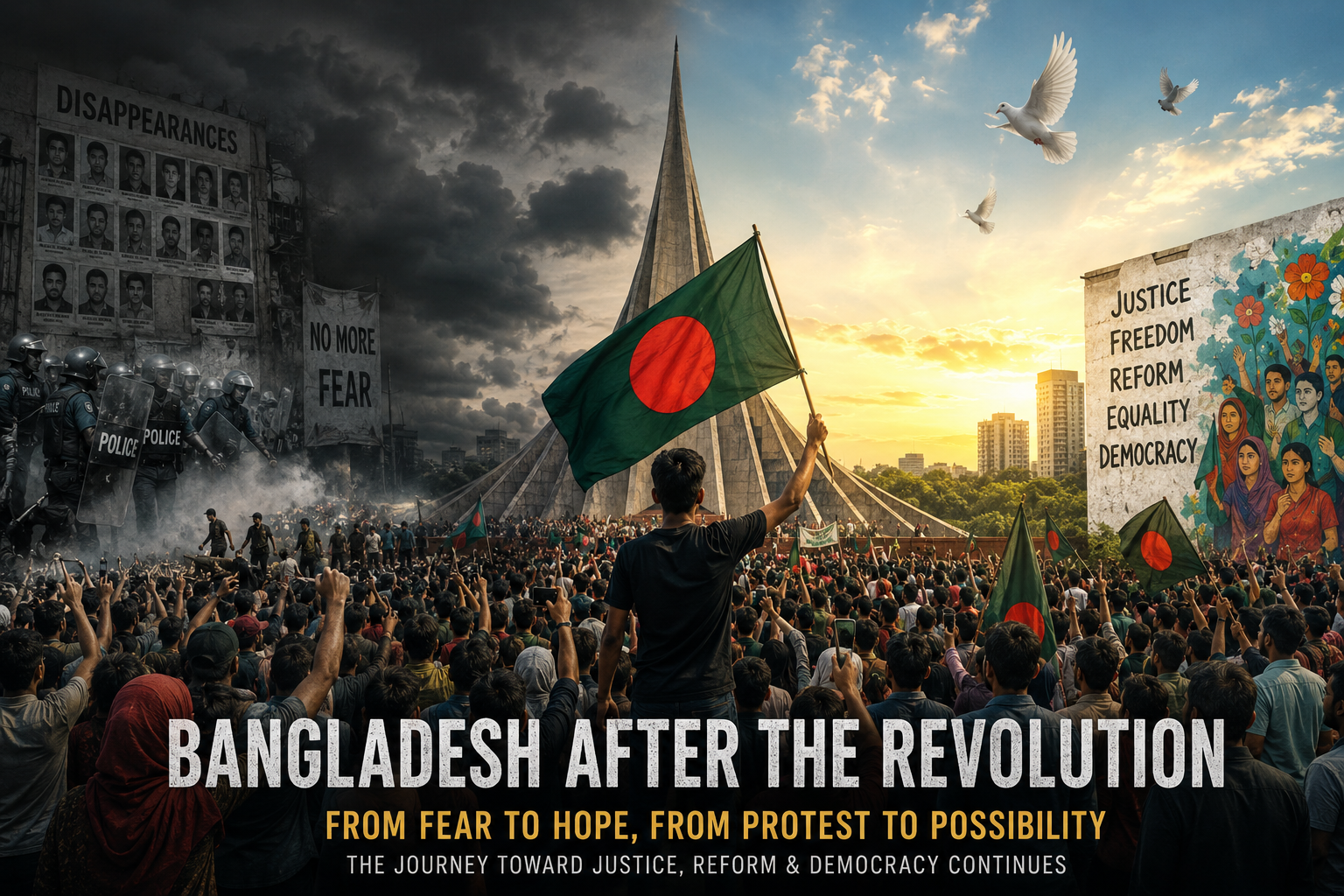
Bangladés Después de la Revolución de Julio: ¿Consiguió el Pueblo lo que Quería?
¡De la caída de Sheikh Hasina a la lucha por un nuevo orden político!
El levantamiento de Bangladés de julio-agosto de 2024 fue uno de los acontecimientos políticos más trascendentales de la historia del país. Lo que comenzó como un movimiento estudiantil contra las cuotas en el empleo público se convirtió en una revuelta a nivel nacional contra la Primera Ministra Sheikh Hasina y el sistema político que había evolucionado durante sus aproximadamente quince años en el poder.
Para el 5 de agosto de 2024, el gobierno de Hasina había colapsado y ella huyó a la India. Una administración interina encabezada por el premio Nobel Muhammad Yunus asumió posteriormente la responsabilidad de gobernar el país e iniciar reformas institucionales. La transición finalmente condujo a elecciones parlamentarias en febrero de 2026, ganadas de manera decisiva por el Partido Nacionalista de Bangladés (BNP), llevando a Tarique Rahman al poder. (YouTube)
Dos años después del levantamiento, sin embargo, la pregunta central ya no es simplemente si la revolución tuvo éxito en derrocar a Sheikh Hasina. Es si tuvo éxito en cambiar el sistema político que provocó el levantamiento en primer lugar.
La evidencia presenta un panorama complicado.
Bangladés ha cambiado incuestionablemente. Se rompió la extraordinaria concentración de poder político que caracterizó los últimos años del gobierno de Hasina. Fueron posibles investigaciones sobre desapariciones y otros abusos. Algunas restricciones a la actividad política y cívica se aliviaron, la reforma constitucional se convirtió en un tema nacional y Bangladés finalmente regresó a un gobierno electoral.
Al mismo tiempo, muchos de los mecanismos contra los que se rebelaron los bangladesíes —arrestos con motivaciones políticas, instituciones débiles, restricciones a la expresión, abusos policiales e intimidación política— no desaparecieron. Además, el período post-revolucionario produjo nuevos problemas, particularmente violencia de masas, ataques a minorías y periodistas, presión de los sectores religiosos de línea dura, venganza política y preocupaciones sobre la exclusión de la Liga Awami.
Por lo tanto, la revolución logró un cambio de régimen mucho más exitoso que un cambio sistémico.
1. ¿De qué se trató realmente la Revolución de Julio?
Comprender si los bangladesíes "obtuvieron lo que querían" requiere comprender lo que querían los manifestantes.
El problema inmediato era relativamente limitado: las cuotas de empleo público.
Una decisión judicial había reavivado un sistema de cuotas que reservaba una proporción sustancial de puestos en el sector público para categorías particulares, incluidos los descendientes de veteranos de la guerra de independencia de Bangladesh de 1971. Los estudiantes universitarios argumentaron que los empleos públicos debían asignarse principalmente según el mérito.
Pero la disputa por las cuotas fue solo el detonante.
La investigación de la ONU sobre el levantamiento concluyó que las protestas se basaban en quejas más amplias relacionadas con la política, la gobernanza y la desigualdad económica. (YouTube)
El movimiento evolucionó consecuentemente.
Primera fase: Reformar el sistema de cuotas
La demanda estudiantil original se refería a la reforma de la contratación en el empleo público.
Segunda fase: Justicia para los manifestantes
Cuando las fuerzas de seguridad y los partidarios del gobierno respondieron violentamente, la cuestión se convirtió en la rendición de cuentas.
Los estudiantes comenzaron a exigir justicia para los que habían sido asesinados, heridos o arrestados.
Tercera fase: Cambio político
A medida que aumentaban las muertes, el movimiento se convirtió en un rechazo más amplio del gobierno de Hasina.
La demanda ya no era simplemente:
“Reformar el sistema de cuotas.”
Efectivamente se convirtió en:
“Cambiar el sistema político.”
Esa distinción es esencial al juzgar el éxito de la revolución.
2. Bangladesh antes de la Revolución
Bangladesh bajo Sheikh Hasina no puede entenderse únicamente a través de los acontecimientos de julio de 2024.
Durante años antes del levantamiento, organizaciones internacionales de derechos humanos habían documentado graves problemas relacionados con elecciones, oposición política, agencias de seguridad, desapariciones, libertad de expresión e independencia de las instituciones.
La evaluación de Freedom House de 2024 otorgó a Bangladesh una puntuación de 40 sobre 100 y lo clasificó como “Parcialmente Libre”. Describió el acoso sostenido al BNP y otros opositores, la presión sobre los medios de comunicación independientes y la sociedad civil, la corrupción endémica, las débiles protecciones del debido proceso y las violaciones de derechos humanos por parte de las fuerzas de seguridad que operan con una impunidad sustancial. (Freedom House)
Estos problemas se desarrollaron a lo largo de muchos años.
3. Desapariciones Forzadas y Abusos Extrajudiciales
Uno de los aspectos más oscuros del período prerrevolucionario implicó desapariciones forzadas.
Human Rights Watch informó que los observadores de derechos humanos de Bangladesh habían documentado más de 600 desapariciones forzadas desde 2009.
Algunas víctimas finalmente regresaron a casa o comparecieron ante el tribunal. Otras fueron reportadas como muertas.
Casi 100 permanecieron desaparecidas en el momento de la evaluación de HRW de 2024. (Human Rights Watch)
Las instituciones de seguridad —particularmente la policía, las agencias de inteligencia y el Batallón de Acción Rápida— fueron acusadas repetidamente de graves abusos.
Las consecuencias políticas fueron significativas.
Cuando los activistas de la oposición creían que un arresto podía llevar no solo a un enjuiciamiento, sino potencialmente a la desaparición, la tortura o la detención prolongada, el miedo en sí mismo se convirtió en un instrumento de control político.
Eso creó un entorno político en el que las instituciones democráticas formales continuaron existiendo mientras que el espacio práctico para desafiar al gobierno se restringía cada vez más.
4. Elecciones sin competencia política efectiva
Otra queja importante se refería a las elecciones.
Bangladesh continuó celebrando elecciones durante el mandato de Hasina, pero los partidos de la oposición y los observadores internacionales cuestionaron cada vez más si seguía siendo posible una competencia política genuina.
Las elecciones de enero de 2024 fueron especialmente controvertidas. El BNP boicoteó la votación tras exigir una administración neutral interina.
En consecuencia, la Liga Awami retuvo un control abrumador.
El problema más profundo era, por tanto, institucional.
Una democracia requiere más que colegios electorales. Requiere:
- partidos políticos competitivos,
- una administración electoral independiente,
- libertad de organización política,
- medios de comunicación independientes,
- un poder judicial imparcial,
- y fuerzas de seguridad que no operen como instrumentos políticos.
Al final del mandato de Hasina, los críticos argumentaron que varias de estas salvaguardias se habían debilitado seriamente.
5. Libertad de expresión antes de la revolución
Las restricciones a la libertad de expresión fueron otra fuente importante de críticas.
La Ley de Seguridad Digital de Bangladesh, seguida por la Ley de Ciberseguridad de 2023, otorgó a las autoridades un poder considerable sobre la expresión en línea.
Los periodistas, activistas, escritores y críticos del gobierno podían enfrentarse a consecuencias legales por sus declaraciones.
Amnistía Internacional concluyó que la Ley de Ciberseguridad reenvasaba esencialmente muchas de las características represivas de la legislación anterior y se había utilizado contra periodistas, defensores de los derechos humanos y disidentes políticos. (Amnistía Internacional)
Esto produjo un importante efecto secundario:
la autocensura.
Las personas no necesitan ser arrestadas cada vez que critican a un gobierno para que funcione la represión política. Si los periodistas, académicos y ciudadanos comunes creen que las críticas podrían resultar en arresto, acoso o enjuiciamiento, muchos simplemente permanecerán en silencio.
6. La represión de 2024 lo cambió todo
El punto de inflexión decisivo llegó cuando el gobierno intentó reprimir las protestas estudiantiles.
La Oficina de Derechos Humanos de la ONU realizó posteriormente una investigación exhaustiva.
Sus hallazgos fueron devastadores.
La ONU estimó que hasta 1.400 personas pudieron haber muerto entre el 1 de julio y el 15 de agosto de 2024, con miles más heridas. La mayoría de los fallecidos, según informes, fueron tiroteados por las fuerzas de seguridad de Bangladesh.
El informe estimó que aproximadamente entre el 12 y el 13 por ciento de los fallecidos eran niños. (YouTube)
La investigación de la ONU concluyó que existían motivos razonables para creer que cientos de ejecuciones extrajudiciales, arrestos arbitrarios, torturas y otras violaciones graves ocurrieron como parte de una estrategia coordinada para reprimir las manifestaciones.
También encontró motivos razonables para una mayor investigación sobre si algunas violaciones constituían crímenes de lesa humanidad. (YouTube)
Esto cambió el carácter del movimiento.
La violencia del gobierno no destruyó el movimiento de protesta.
Lo expandió.
A los estudiantes que originalmente exigieron una reforma laboral se unieron familias, profesionales, trabajadores y ciudadanos comunes cada vez más indignados por las muídas.
El intento del gobierno de preservarse a sí mismo acabó acelerando su colapso.
7. 5 de agosto de 2024: ¿Victoria o Meramente el Comienzo?
Cuando Sheikh Hasina abandonó Bangladesh, millones de personas vieron comprensiblemente el momento como una liberación.
Pero destituir a un líder autoritario es más fácil que desmantelar las estructuras políticas autoritarias.
Ese se convirtió en el problema central del Bangladesh post-revolucionario.
El gobierno interino dirigido por Muhammad Yunus heredó:
- instituciones debilitadas,
- una burocracia politizada,
- fuerzas policiales profundamente desconfiadas,
- dificultades económicas,
- polarización política,
- demandas de justicia,
- demandas de elecciones,
- y demandas de transformación constitucional.
Esos objetivos a menudo entraban en conflicto.
Algunos bangladesíes querían elecciones inmediatamente.
Otros argumentaron que unas elecciones sin reforma institucional simplemente reproducirían el antiguo sistema político con un partido diferente controlándolo.
El debate fundamental post-revolucionario se convirtió, por lo tanto, en:
¿Reforma primero, o elecciones primero?
8. ¿Qué Mejoró Después de la Revolución?
A pesar de las frustraciones actuales, sería inexacto afirmar que nada cambió.
Ocurrieron varios desarrollos importantes.
La atmósfera de miedo estatal se debilitó
La evaluación de Human Rights Watch de 2025 concluyó que parte del miedo y la represión característicos del gobierno de Hasina —incluidas las desapariciones forzadas generalizadas— parecían haber terminado. (Human Rights Watch)
Eso es significativo.
Para las familias que pasaron años buscando a familiares presuntamente detenidos por agencias de seguridad, incluso la posibilidad de investigar lo sucedido representó un enorme cambio político.
9. Investigaciones Sobre Desapariciones Forzadas
El gobierno interino estableció una comisión que investigaba las desapariciones forzadas y las ejecuciones extrajudiciales cometidas durante el gobierno de la Liga Awami.
En agosto de 2025, la comisión había recibido supuestamente más de 1.850 denuncias.
Los investigadores dijeron a Human Rights Watch que habían recopilado pruebas significativas.
Sin embargo, también alegaron que los funcionarios de seguridad habían destruido pruebas, se habían negado a cooperar y se habían resistido a la rendición de cuentas. (Human Rights Watch)
Esto ilustra tanto el logro como la limitación de la revolución.
Antes de agosto de 2024, el estado rechazaba en gran medida las acusaciones de desapariciones sistemáticas.
Después de la revolución, el propio estado comenzó a investigarlas.
Eso representa un progreso genuino.
Pero una investigación no es lo mismo que una transformación institucional.
10. Aumentó la cooperación internacional en materia de derechos humanos
Otro desarrollo positivo fue una mayor cooperación con las instituciones internacionales de derechos humanos.
El gobierno interino invitó a la Oficina de Derechos Humanos de la ONU a investigar la violencia de 2024 y brindó una cooperación sustancial con la investigación. (YouTube)
Posteriormente, Bangladesh acordó establecer una presencia de derechos humanos de la ONU en el país y se adhirió en 2025 al Protocolo Facultativo de la Convención contra la Tortura, un mecanismo internacional destinado a fortalecer las salvaguardias contra la tortura y el maltrato en detención. (Amnesty International)
Estas fueron desviaciones significativas del enfoque defensivo que había caracterizado las respuestas anteriores a las críticas internacionales.
11. La reforma constitucional entró en la política principal
La revolución también abrió un espacio político para discusiones que anteriormente habrían sido extraordinariamente difíciles.
El gobierno interino estableció múltiples comisiones que abordaron áreas que incluyen:
- reforma constitucional,
- reforma electoral,
- reforma judicial,
- reforma policial,
- derechos de las mujeres,
- derechos laborales,
- y gobernanza.
Una Comisión de Consenso Nacional intentó convertir estas recomendaciones en un paquete de reformas acordado.
La Carta de Julio resultante se convirtió en uno de los legados políticos más importantes del levantamiento. (Human Rights Watch)
Las ideas discutidas incluyeron limitar el poder del primer ministro, fortalecer la independencia judicial, cambiar los nombramientos constitucionales, fortalecer los derechos fundamentales y reestructurar el Parlamento.
Este es, posiblemente, donde el legado a largo plazo más importante de la revolución podría residir finalmente.
12. Pero el proceso de reforma decepcionó a muchos
El problema fue la implementación.
Human Rights Watch concluyó que muchas de las reformas prometidas se estancaron porque los actores políticos no lograron alcanzar un acuerdo y se implementaron relativamente pocos cambios rápidamente. (Human Rights Watch)
Esto creó una frustración creciente entre las personas que creían que la revolución había creado una oportunidad única en una generación para rediseñar las instituciones políticas de Bangladesh.
El temor era directo:
Si la reforma institucional seguía incompleta y los partidos políticos convencionales simplemente volvían al poder, Bangladesh podría recrear el mismo sistema bajo un liderazgo diferente.
Esa preocupación sigue siendo relevante hoy.
13. Los arrestos políticos no desaparecieron
Quizás la contradicción más clara del Bangladesh post-revolucionario fue la continuación de la detención por motivos políticos.
Las víctimas cambiaron.
El método no desapareció por completo.
Human Rights Watch documentó miles de arrestos de personas percibidas como oponentes políticos durante el período interino.
Tras los enfrentamientos de febrero de 2025, la “Operación Caza de Demonios” del gobierno habría resultado en al menos 8.600 arrestos.
Cientos de figuras y simpatizantes de la Liga Awami fueron detenidos, a veces en casos que contenían un gran número de sospechosos anónimos. (Human Rights Watch)
Esto crea un paralelo incómodo.
Bajo Hasina:
Los simpatizantes de la oposición se quejaron de arrestos motivados políticamente.
Después de Hasina:
Los simpatizantes de la Liga Awami se quejaron de arrestos motivados políticamente.
La identidad política de los acusados cambió.
La debilidad del debido proceso no desapareció.
Ese es precisamente el tipo de continuidad institucional que los manifestantes esperaban que la revolución pusiera fin.
14. La prohibición de la Liga Awami creó una contradicción democrática
La decisión del gobierno interino en mayo de 2025 de prohibir las actividades de la Liga Awami se convirtió en uno de los desarrollos más controvertidos de la transición.
Las restricciones incluían reuniones, publicaciones y algunas formas de defensa política en línea.
Las organizaciones de derechos humanos cuestionaron si tales medidas eran compatibles con la libertad de asociación. (Amnesty International)
Hay un dilema obvio.
Los altos funcionarios responsables de delitos graves deberían ser procesados.
Las organizaciones políticas implicadas en violencia no pueden simplemente exigir inmunidad.
Pero la responsabilidad penal debería ser, por lo general, individualizada.
Castigar a un electorado político entero corre el riesgo de reproducir la lógica política excluyente que la revolución pretendía superar.
Esta es una de las razones por las que el historial de derechos humanos postrevolucionario no puede describirse simplemente como una liberación democrática.
15. Libertad de expresión: Mejor, pero aún vulnerable
La libertad de expresión ilustra el mismo patrón.
La revolución creó un debate político mucho más amplio y destruyó muchas de las barreras psicológicas que rodeaban la crítica al gobierno de Hasina.
Pero las restricciones legales no desaparecieron.
La Ley de Ciberseguridad continuó vigente durante el período intermedio antes de ser reemplazada en 2025 por una Ordenanza de Ciberseguridad.
Amnistía Internacional descubrió que, aunque el nuevo sistema representaba un cambio, persistían disposiciones amplias o definidas de forma vaga que podían ser objeto de abuso. (Amnistía Internacional)
Los periodistas y escritores continuaron enfrentando acoso, violencia y acciones legales.
Por lo tanto:
El espacio para la expresión se amplió políticamente, pero la protección institucional de la libertad de expresión siguió siendo incompleta.
16. El auge de la violencia de las turbas
Uno de los desarrollos más preocupantes tras la revolución fue el crecimiento de la violencia de las turbas.
Cuando un estado autoritario colapsa, la represión estatal puede disminuir sin que el estado de derecho mejore automáticamente.
Eso parece haber sucedido hasta cierto punto en Bangladesh.
Las fuerzas policiales, desacreditadas por su papel en la supresión del levantamiento, se volvieron menos efectivas en el mantenimiento del orden público.
Human Rights Watch informó de un alarmante aumento de la violencia por parte de grupos políticos, turbas e integristas religiosos.
Según cifras citadas por HRW de Ain O Salish Kendra, al menos 124 personas murieron en ataques de turbas solo entre junio y agosto de 2025. (Human Rights Watch)
Esto demuestra una distinción importante:
La libertad frente a un estado opresor no es necesariamente lo mismo que la seguridad bajo el estado de derecho.
Los ciudadanos requieren protección contra ambos.
17. Minorías y libertad religiosa
Otra gran preocupación involucra a las minorías religiosas y étnicas.
Bangladesh ha luchado durante mucho tiempo con ataques periódicos contra hindúes, budistas, comunidades indígenas y otras minorías.
La inestabilidad política tras la revolución creó vulnerabilidades adicionales.
Human Rights Watch documentó ataques contra minorías étnicas y religiosas durante la transición. (Human Rights Watch)
Algunos ataques fueron motivados políticamente, otros comunales y algunos involucraron identidades políticas y religiosas superpuestas.
Este tema también se ha politizado mucho a nivel internacional, particularmente en las relaciones entre Bangladesh y la India.
En consecuencia, las reclamaciones individuales requieren una verificación cuidadosa.
Sin embargo, la conclusión más amplia de las organizaciones de derechos humanos es clara:
El gobierno postrevolucionario no proporcionó consistentemente protección suficiente contra la violencia comunal y de masas.
18. Derechos de las mujeres: una prueba especialmente importante
Las mujeres desempeñaron un papel importante en el levantamiento de julio.
Sin embargo, la transición política no se tradujo necesariamente en una mayor protección de los derechos de las mujeres.
Una comisión de derechos de las mujeres designada por el gobierno propuso reformas, incluida una mayor representación, cambios en las leyes de familia y la penalización de la violación marital.
Las propuestas generaron una fuerte oposición de organizaciones islamistas.
Human Rights Watch informó que casi 20.000 partidarios de Hefazat-e-Islam se manifestaron en Dhaka contra las reformas propuestas y cuestiones relacionadas. (Human Rights Watch)
Esto revela otra contradicción de la revolución.
Un movimiento en el que las mujeres jóvenes participaron prominentemente ayudó a derrocar a un gobierno autoritario.
Sin embargo, la apertura política que siguió también creó un mayor espacio para los movimientos socialmente conservadores e islamistas.
Por lo tanto, la liberalización política no produce automáticamente liberalización social.
19. Rendición de cuentas de Sheikh Hasina
Una de las demandas más claras tras el levantamiento fue justicia para las personas asesinadas en 2024.
Las autoridades postrevolucionarias iniciaron procesos contra Hasina y otros exfuncionarios.
El Tribunal de Crímenes Internacionales de Bangladesh finalmente condenó a Hasina en rebeldía por crímenes de lesa humanidad relacionados con la supresión del levantamiento y la sentenció a muerte. (Human Rights Watch)
Para las familias de las víctimas, la rendición de cuentas representó una demanda central de la revolución.
Pero las organizaciones de derechos humanos plantearon serias preocupaciones sobre los procedimientos del tribunal.
Human Rights Watch argumentó que, a pesar de las reformas, persistían importantes problemas de debido proceso y criticó el uso continuado de la pena de muerte. (Human Rights Watch)
Eso crea otro principio importante.
La justicia después del autoritarismo no debe convertirse en venganza administrada a través de otro proceso judicial defectuoso.
Si la revolución se trató en parte de restaurar el estado de derecho, los juicios de los exgobernantes deben cumplir estándares especialmente altos.
20. El regreso al gobierno electoral
Bangladesh finalmente celebró elecciones parlamentarias en febrero de 2026.
El BNP ganó de forma decisiva, llevando a Tarique Rahman al poder y poniendo fin a la fase interina. Reuters describió el resultado como una victoria aplastante del BNP. (YouTube)
Esto representó un hito importante.
Por primera vez desde la revolución, Bangladesh volvió a tener un gobierno electo.
Pero las elecciones en sí mismas no resuelven la cuestión central de la revolución.
La pregunta ahora es si el gobierno del BNP institucionalizará las reformas prometidas después de julio de 2024, o si devolverá gradualmente a Bangladesh a la política del "el ganador se lo lleva todo" que caracterizó las décadas anteriores.
Análisis recientes también han destacado la continua influencia política y económica de los militares, sugiriendo que el fortalecimiento de las instituciones civiles sigue siendo esencial para la consolidación democrática de Bangladesh. (Financial Times)
¿21. Entonces, ¿consiguió la gente lo que quería?
No hay una respuesta única porque la revolución contuvo diferentes grupos con diferentes expectativas.
Pero podemos evaluar varias demandas importantes.
| Demanda | Resultado |
| Destitución de Sheikh Hasina | Conseguido |
| Fin del monopolio del poder de la Liga Awami | Conseguido |
| Rendición de cuentas por las muertes de julio | Conseguido parcialmente / en curso |
| Investigación de desapariciones | Progreso significativo |
| Fin de los arrestos por motivos políticos | No conseguido |
| Instituciones independientes | Conseguido parcialmente / inacabado |
| Mayor libertad de expresión | Mejorado pero incompleto |
| Reforma policial/del sector de seguridad | Incompleto |
| Reforma constitucional | Conseguido parcialmente / en curso |
| Fin de la cultura política autoritaria | Aún no conseguido |
| Protección de minorías | Insuficiente |
| Protección de mujeres y grupos vulnerables | Mixto |
| Restauración de elecciones competitivas | Sustancialmente logrado |
| Estado de derecho estable | No logrado suficientemente |
Por lo tanto, la conclusión más defendible es:
Los bangladesíes ganaron el derecho a intentar construir un sistema político diferente. No recibieron automáticamente ese sistema cuando cayó Sheikh Hasina.
22. Derechos humanos antes y después: la diferencia fundamental
El carácter de los problemas de derechos humanos ha cambiado.
Antes de la revolución
El mayor peligro provino de un estado cada vez más centralizado.
Los principales problemas incluían:
- desapariciones forzadas,
- impunidad de las fuerzas de seguridad,
- supresión de partidos de la oposición,
- detención con motivaciones políticas,
- restricciones al periodismo,
- leyes cibernéticas restrictivas,
- elecciones cuestionables,
- concentración del poder ejecutivo,
- y finalmente, violencia estatal masiva contra los manifestantes.
Después de la revolución
Algunos de esos peligros disminuyeron, en particular las desapariciones sistemáticas y la extrema concentración de poder político.
Pero otros problemas se volvieron más prominentes:
- violencia de turbas,
- venganza política,
- arrestos arbitrarios de antiguos partidarios del partido gobernante,
- restricciones a la actividad política de la Liga Awami,
- ataques a periodistas,
- intolerancia religiosa,
- amenazas contra mujeres y minorías,
- policía ineficaz,
- reforma institucional incompleta,
- y problemas continuos con el debido proceso.
En términos simplificados:
Antes de 2024, el principal problema de derechos humanos de Bangladesh era un estado cada vez más autoritario.
Después de 2024, el problema central se convirtió en la construcción de un estado democrático funcional capaz de proteger los derechos y, al mismo tiempo, prevenir la venganza política, el gobierno de la turba y otra concentración de poder.
¿Se ha vuelto Bangladesh más democrático?
En ciertos aspectos, sí.
El perfil de país actual de Freedom House otorga a Bangladesh 44/100, en comparación con 40/100 en su informe de 2024. Ambas evaluaciones clasifican al país como "Parcialmente Libre". (Freedom House)
Esa diferencia de cuatro puntos no debe exagerarse.
Pero ilustra el patrón más amplio.
Bangladesh no está simplemente donde estaba antes de agosto de 2024.
Tampoco se ha convertido en una democracia liberal consolidada.
Está en algún punto intermedio.
El país ha pasado de un orden político arraigado a una transición disputada.
24. El Mayor Riesgo: Reemplazar una Élite Gobernante por Otra
La historia de las revoluciones muestra que eliminar a un individuo es considerablemente más fácil que cambiar las instituciones.
El antiguo sistema político de Bangladesh concentraba un poder enorme en quien controlaba la rama ejecutiva.
Eso crea un peligro recurrente.
Si las instituciones siguen siendo débiles, cada partido de la oposición hace campaña por la democracia mientras está fuera del gobierno y descubre las ventajas de la autoridad centralizada después de ganar el poder.
Ese ciclo ha afectado la política de Bangladesh durante décadas.
Por lo tanto, el verdadero éxito de la Revolución de Julio no se determinará por si Sheikh Hasina regresa.
Se determinará por si los futuros gobiernos se vuelven institucionalmente incapaces de gobernar como lo hizo finalmente su gobierno.
Eso requiere:
tribunales independientes, policía profesional, servicios de inteligencia responsables, elecciones competitivas, medios de comunicación independientes, protección para los partidos de la oposición y limitaciones constitucionales a la autoridad ejecutiva.
Sin estas salvaguardias, Bangladesh podría eventualmente reproducir el autoritarismo bajo una bandera política diferente.
25. La Promesa Inacabada de la Revolución
Dos años después, describir la revolución de Bangladesh como un éxito total o un fracaso total es engañoso.
Tuvo éxito en su primera tarea histórica:
romper un gobierno arraigado que se había vuelto cada vez más autoritario.
Solo ha tenido un éxito parcial en su segunda tarea:
creando un sistema político en el que el autoritarismo no pueda regresar fácilmente.
Y ha luchado considerablemente con su tercera:
establecer un estado de derecho eficaz mientras se protege a las minorías, a los oponentes políticos, a los periodistas, a las mujeres y a los ciudadanos comunes de la violencia tanto estatal como no estatal.
La distinción entre estos logros es importante.
Destituir a un gobierno puede ocurrir en días.
Reformar las fuerzas policiales lleva años.
Construir tribunales independientes lleva años.
Cambiar la cultura política puede llevar generaciones.
Conclusión
El levantamiento de julio de 2024 alteró fundamentalmente la trayectoria política de Bangladesh.
Antes de la revolución, el país había experimentado años de creciente centralización política, acoso a los partidos de la oposición, restricciones a la expresión, denuncias de desapariciones y abusos por parte de las fuerzas de seguridad, culminando en una represión extraordinariamente violenta en la que las Naciones Unidas estiman que murieron hasta 1.400 personas. (YouTube)
La revolución acabó con ese orden político.
Pero no eliminó las instituciones y los hábitos políticos que lo sustentaban.
El Bangladesh post-revolucionario experimentó mejoras genuinas: mayor escrutinio de las agencias de seguridad, investigaciones sobre desapariciones, cooperación internacional en derechos humanos, esfuerzos de reforma constitucional y, en última instancia, un retorno al gobierno electoral.
Al mismo tiempo, la detención arbitraria continuó, la violencia de las turbas aumentó, los periodistas y las minorías se enfrentaron a amenazas, la presión islamista sobre cuestiones sociales se hizo más visible, se prohibió la actividad política a la Liga Awami durante la transición y las principales reformas institucionales quedaron incompletas. En consecuencia, Human Rights Watch concluyó que el gobierno interino luchó tanto para mantener el orden público como para llevar a cabo las reformas de derechos humanos prometidas. (Human Rights Watch)
La respuesta a “¿Obtuvo la gente lo que quería?” es, por lo tanto:
En parte.
Destituyeron al gobierno contra el que se rebelaron.
Abrieron la puerta a la rendición de cuentas.
Reabrieron cuestiones fundamentales sobre la constitución y las instituciones de Bangladesh.
Finalmente devolvieron el país a un gobierno electo.
Pero aún no han asegurado el objetivo más profundo detrás de la revolución: un sistema político en el que los ciudadanos no necesiten otra revolución para destituir a un gobierno abusivo.
Ese es el legado inacabado de julio de 2024.
Por lo tanto, la revolución de Bangladesh debe entenderse no como la finalización de una transformación democrática, sino como el comienzo de una.
Que esa transformación tenga éxito o no dependerá menos de quién ocupe la oficina del primer ministro y más de si Bangladesh puede construir instituciones lo suficientemente fuertes como para restringir a quienquiera que la ocupe.
Referencias y Fuentes
- Oficina del Alto Comisionado de las Naciones Unidas para los Derechos Humanos (ACNUDH) — Investigación de hechos sobre violaciones de derechos humanos durante las protestas de julio-agosto de 2024. La investigación de la ONU es la fuente principal para la estimación de hasta 1.400 muertes y las conclusiones relativas a ejecuciones extrajudiciales, detenciones arbitrarias y tortura. (YouTube)
- Human Rights Watch — Informe Mundial 2024: Bangladesh. Útil para establecer la situación de los derechos humanos inmediatamente antes de la revolución, particularmente las desapariciones, la represión política, los abusos de las fuerzas de seguridad y los arrestos de la oposición. (Human Rights Watch)
Human Rights Watch: Bangladesh 2024 - Human Rights Watch — Informe Mundial 2026: Bangladesh. Una de las principales fuentes para evaluar el período posrevolucionario, incluyendo arrestos, violencia de masas, esfuerzos de reforma, rendición de cuentas, derechos de las minorías y libertad de expresión. (Human Rights Watch)
Human Rights Watch: Bangladesh 2026 - Amnistía Internacional — Informes sobre derechos humanos en Bangladesh. Utilizado particularmente para la libertad de expresión, la asociación política y los desarrollos relacionados con la Ley de Ciberseguridad y la Ordenanza de Ciberseguridad. (Amnistía Internacional)
Amnistía Internacional: Bangladesh - Amnistía Internacional — “Reempaquetando la represión: La Ley de Ciberseguridad y la continua guerra legal contra la disidencia en Bangladesh”. Importante contexto sobre las restricciones a la expresión bajo el gobierno prerrevolucionario. (Amnistía Internacional)
Informe de Amnistía sobre la Ley de Ciberseguridad - Freedom House — Libertad en el Mundo 2024: Bangladesh. Utilizado para la evaluación prerrevolucionaria de los derechos políticos, las libertades civiles, el acoso a la oposición, la corrupción y la impunidad de las fuerzas de seguridad. (Freedom House)
Freedom House: Bangladesh 2024 - Freedom House — Perfil de Bangladesh / Libertad en el Mundo 2026. Útil para comparar la evaluación internacional de Bangladesh sobre democracia y libertades civiles antes y después del levantamiento. (Freedom House)
Freedom House: Perfil de Bangladesh - Reuters — Reportajes sobre las elecciones de febrero de 2026 en Bangladesh. Utilizado para confirmar la victoria del BNP y el regreso de Bangladesh a un gobierno electo. (YouTube)
- Associated Press — Reportajes de agosto de 2026 sobre Sheikh Hasina, el levantamiento y la situación política actual de Bangladesh. Útil para verificar los desarrollos en torno al segundo aniversario de la revolución. (AP News)
- Financial Times — Análisis de agosto de 2026 sobre la transición militar y política de Bangladesh. Utilizado particularmente para la cuestión continua de la influencia militar y la consolidación democrática institucional. (Financial Times)
Nota de investigación: El artículo evalúa la situación hasta el 8 de agosto de 2026. Las condiciones de los derechos humanos y la implementación de las reformas de julio siguen siendo fluidas, por lo que las conclusiones sobre el éxito final de la revolución deben tratarse como provisionales en lugar de definitivas.