
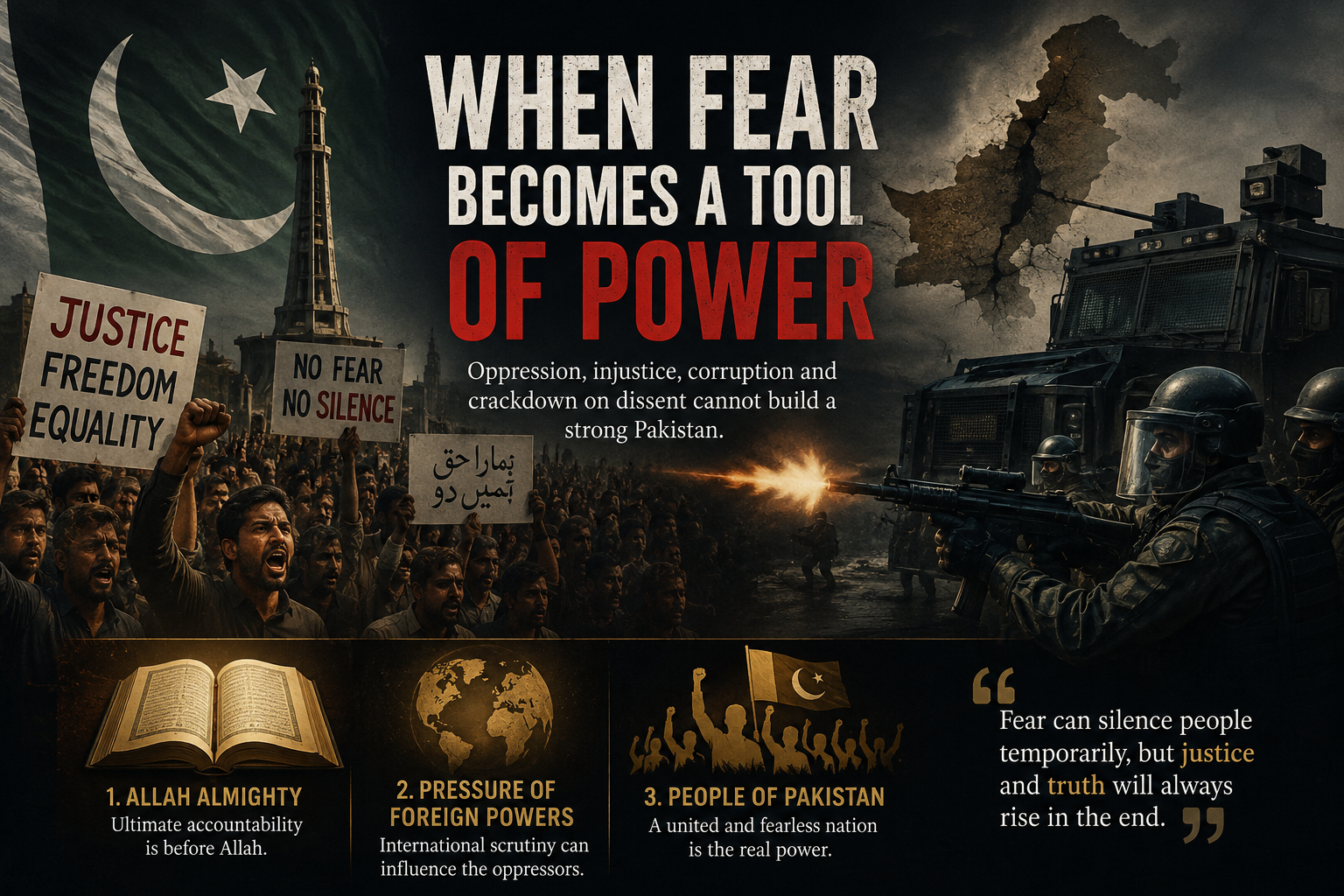
When Fear Becomes a Tool of Power
Pakistan is passing through a deeply troubling period. Many citizens see growing political oppression, injustice, corruption, restrictions on dissent, and increasingly harsh treatment of protesters. Reports and allegations concerning excessive force, and particularly any suggestion that authorities may use lethal force against demonstrators, raise serious questions about the protection of fundamental rights and the direction in which the country is heading.
When those holding power begin to believe that they are beyond accountability, institutions weaken and ordinary citizens lose confidence in the system. No government or institution should consider itself above the Constitution, the law, or basic principles of humanity.
Ultimately, unchecked power can be restrained by several forces. First is accountability before Allah Almighty. For a believer, worldly authority is temporary, while accountability before Allah is unavoidable. A person may escape courts, political consequences, or public criticism, but cannot escape divine justice.
Second is international pressure. Governments that disregard democratic principles or human rights can face diplomatic criticism and pressure from foreign governments, international institutions, and human-rights organizations. However, international politics is driven heavily by strategic interests, and Pakistan should never depend solely upon foreign powers to protect its democracy.
Third and perhaps the most important worldly force, is the people of Pakistan themselves. Yet public power becomes ineffective when fear dominates society. Arrests, intimidation, restrictions on demonstrations, and fear of violence can discourage ordinary citizens from raising their voices. When people begin believing that speaking out may cost them their freedom, livelihood, or even their lives, silence becomes a survival mechanism.
But fear cannot provide permanent political stability. A strong Pakistan requires institutions that citizens respect rather than fear: independent courts, accountable governments, professional law-enforcement agencies, a free press, peaceful political competition, and the right of citizens to protest without violence.
Pakistan does not need another cycle of revenge, hatred, or confrontation. It needs justice without discrimination, accountability without political engineering, and law that applies equally to the powerful and the powerless.
Power is temporary. Governments change, commanders retire, political leaders come and go, but the consequences of injustice can remain for generations.
Those who exercise authority today should therefore remember a simple principle: when earthly accountability fails, accountability before Allah remains.









Get involved!
Comments