
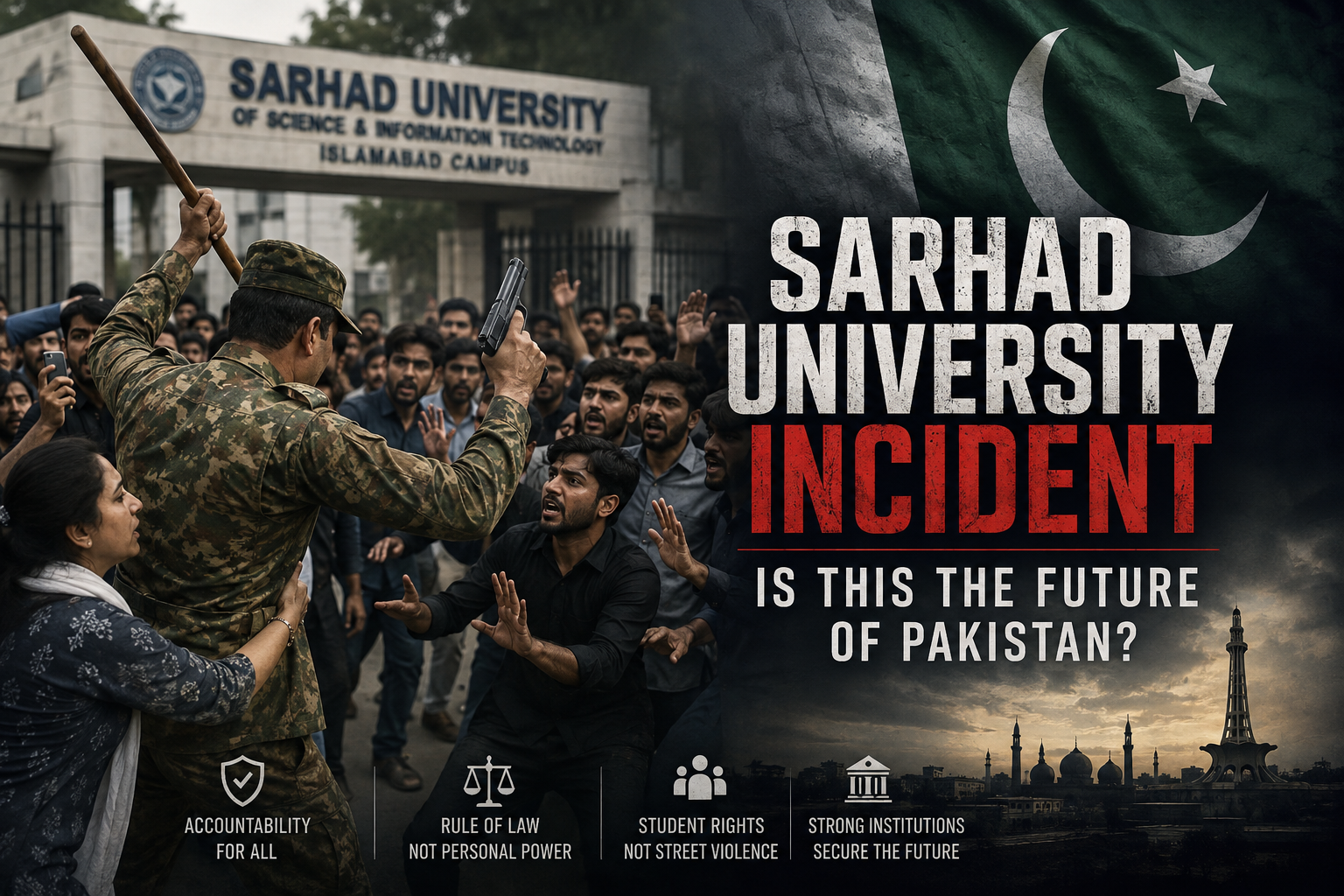
Sarhad University Incident: Is This the Future of Pakistan?
A University Protest, an Armed Confrontation, and a Warning Pakistan Should Not Ignore
On August 24, 2026, a student protest at the Islamabad campus of Sarhad University of Science and Information Technology (SUSIT) escalated into an extraordinary confrontation. Video footage circulating widely online showed a uniformed man striking a person with a stick, becoming involved in a physical clash with students, drawing a pistol, pointing it toward the crowd and then firing into the air. Police subsequently intervened. Pakistani media reported that the individual was a serving military officer and that he was later taken into custody for disciplinary proceedings.
The immediate incident is disturbing enough. But the more important question is larger:
What does it say about Pakistan when a dispute inside a university can escalate from disagreement and protest to sticks, physical violence and the display and discharge of a firearm?
And perhaps more importantly:
Is this an isolated breakdown of judgment, or a warning about the direction in which Pakistani society and its institutions are moving?
The answer requires caution. One incident cannot define an entire country or institution. Nor should allegations circulating on social media automatically be accepted as established facts. But the Sarhad University episode raises serious questions about institutional boundaries, civilian authority, student rights, accountability and Pakistan’s political culture.
What Happened at Sarhad University?
The incident occurred at SUSIT’s Chattha Bakhtawar campus in Islamabad on Monday, August 24.
According to Dawn and The Express Tribune, students had been protesting over the dismissal of a senior university official and other university-related grievances.
Business Recorder provided a more detailed account based largely on students’ claims. It reported that an earlier dispute had occurred between the Head of the Nursing Department, Dr Jadoon Khan, and HR manager Dr Aina Ilyas. Students subsequently protested against the HR manager’s behaviour and demanded her resignation.
However, important parts of this background remain disputed.
Another account reported that Dr Aina had made a harassment complaint against Dr Jadoon and that some protesting students later allegedly verbally abused or harassed her. Witnesses cited by Pakistan Connect said the situation was already deteriorating before the uniformed officer arrived.
This distinction matters.
A fair investigation must examine the behaviour of everyone involved—students, university officials, police and the military officer.
Whatever happened beforehand, however, the video evidence of the subsequent confrontation has created a separate and extremely serious issue.
The Arrival of the Uniformed Officer
Media reports identified the man as the husband of the university official and described him as a serving military officer.
According to Business Recorder, he arrived at the university in military uniform after being contacted by his wife. An argument followed and rapidly became physical.
Dawn reported that sources said he had gone to the university to assist his spouse after she had allegedly been harassed by protesters.
That context deserves consideration.
If a person genuinely believes that his spouse is in danger, the instinct to protect her is understandable.
But there is an enormous difference between protecting a family member and entering a civilian university dispute while in military uniform and armed.
If there was an immediate threat, the appropriate institutional response should have involved university security and civilian law enforcement.
That distinction is fundamental to a functioning state.
Then Came the Stick
The video footage described by multiple Pakistani news organisations shows the uniformed individual striking a person with a stick before the confrontation escalates.
The crowd then surrounds him, and some protesters appear to physically assault him.
This part should not be ignored simply because criticism has focused heavily on the officer.
Students do not acquire a right to beat someone merely because they are protesting.
If protesters assaulted the officer or threatened his wife, those actions should also be investigated and, where evidence supports prosecution, dealt with according to law.
Accountability cannot be selective.
But the crucial principle is that violence by one side does not automatically legalise or justify every response by the other.
The Moment That Changed the Meaning of the Incident
The confrontation reached its most dangerous point when the uniformed individual drew a pistol.
Footage described by Dawn and The Express Tribune shows him pointing the firearm toward the crowd. A woman accompanying him appears to attempt to restrain him. He then raises the weapon and fires into the air. Police officers subsequently move toward him.
This transformed a university dispute into something potentially deadly.
A bullet fired into the air does not simply disappear.
More importantly, introducing a firearm into a chaotic crowd creates the possibility of panic, accidental discharge, retaliatory violence or death.
Pakistan should therefore be thankful that the incident did not apparently become something much worse.
The Most Important Question: Why Was a Military Uniform Present in a Civilian University Dispute?
This is perhaps the central institutional question.
The Pakistan Army was not officially confronting Sarhad University students.
The reported dispute was not a military operation.
It was not a battlefield.
It was not a counterterrorism action.
It was an internal university dispute involving students and university officials.
Therefore, the appearance of a serving officer in uniform and armed with a firearm inevitably created an impression extending far beyond an ordinary dispute between individuals.
A military uniform represents the state and one of its most powerful institutions.
That is precisely why military discipline normally places extraordinary responsibility on the person wearing it.
When someone wearing that uniform becomes involved in a private confrontation, the distinction between personal authority and institutional authority can become dangerously blurred.
Pakistan’s Constitution Provides Another Standard
The Constitution of Pakistan provides important principles against which incidents such as this should be considered.
Article 14 declares the dignity of man inviolable.
Article 16 guarantees citizens the right to assemble peacefully and without arms, subject to reasonable restrictions imposed by law in the interest of public order.
Article 19 protects freedom of speech and expression, again subject to constitutionally recognised reasonable restrictions.
These rights are not licences for mob violence.
A peaceful protest can lose its protection when participants commit violence or other offences.
But neither can alleged misconduct by protesters erase the principle that state authority and coercive force must operate through lawful institutions and defined procedures.
That is the essence of rule of law.
The Positive Part of the Story Must Also Be Recognised
There is one development that should not be overlooked.
Reports indicate that the officer was taken into custody and that disciplinary proceedings or an inquiry were initiated.
Dawn reported sources as saying that the Pakistan Army’s priority was maintaining discipline and ensuring justice, with further action dependent on the findings of the inquiry.
Business Recorder similarly reported that military leadership had taken serious notice of the incident and that an inquiry had been initiated.
If that investigation is independent, credible and followed by appropriate action based on evidence, it would demonstrate something important:
An individual’s rank or uniform does not place him above accountability.
Pakistan desperately needs that principle to be visible in practice.
But Accountability Must Include Everyone
There is another lesson in the footage.
Pakistan cannot build the rule of law by replacing abuse of authority with mob justice.
If students surrounded and assaulted the officer, that too is unacceptable.
If a university employee was threatened or harassed, investigate it.
If students committed assault, investigate it.
If university management acted unlawfully, investigate it.
If police failed in their duties, investigate it.
And if an armed serving officer exceeded his authority, investigate and punish that conduct according to applicable law.
The formula should be remarkably simple:
One law, one process, one standard of justice.
Pakistan’s difficulty has often been achieving that equality in practice.
Is This the Future of Pakistan?
It does not have to be.
But the incident can reasonably be viewed as a warning.
Pakistan is a remarkably young country demographically. Its future depends heavily upon students who are currently sitting in universities, technical institutes and colleges.
Those young people are observing the institutions around them.
They are learning not merely from textbooks but from what society demonstrates to them.
If they repeatedly learn that connections are more powerful than procedures, that intimidation is more effective than dialogue, that violence produces faster results than institutions and that different people receive different treatment under the law, Pakistan risks creating a generation deeply distrustful of the state.
That would be extraordinarily dangerous.
Universities Should Produce Questions, Not Fear
A university should be among the safest places in society for disagreement.
Students will protest.
Administrations will make unpopular decisions.
Teachers and employees will have disputes.
Young people will sometimes behave irresponsibly.
Management will sometimes make mistakes.
These problems exist in universities throughout the world.
The solution is governance.
Universities need grievance mechanisms, disciplinary procedures, independent inquiry committees, student representation, campus security and—when criminal behaviour occurs—civilian police and courts.
The normal sequence should be:
Complaint → Investigation → Hearing → Decision → Appeal.
Not:
Argument → Threat → Stick → Crowd violence → Gunfire.
When the second sequence replaces the first, institutions have already failed.
The Danger Is Bigger Than One Officer
It would be easy to make the entire Sarhad University controversy about one individual.
That would miss the deeper issue.
The real question is whether Pakistan is developing institutions strong enough that individual power becomes unnecessary.
In a strong state, a university administrator should not need a powerful relative.
A student should not need a political organisation.
A citizen should not need connections in the police.
A businessman should not need a bureaucratic contact.
A victim should not need social-media pressure.
And an accused person should not need influence.
Everyone should need only one thing:
the law.
That is what separates institutional government from personalised power.
Pakistan’s Youth Are Watching
This may ultimately be the most consequential part of the Sarhad University episode.
Young Pakistanis can see everything.
Smartphones have radically changed the relationship between authority and citizens. An incident that twenty years ago might have remained inside a university compound can now be recorded from several angles and watched by millions within hours.
Authority therefore operates in a new environment.
Uniforms still command respect.
Government positions still carry authority.
But neither automatically controls the narrative anymore.
A mobile-phone camera can place the conduct of a powerful person before the entire country within minutes.
Institutions that understand this reality will become more transparent and disciplined.
Those that attempt to rely primarily upon fear may increasingly encounter public resistance.
The Dangerous Alternative
There is another possibility Pakistan should consider seriously.
If citizens lose confidence that institutions will deliver justice, they may increasingly try to obtain justice themselves.
That produces mob behaviour.
Then authorities respond with greater force.
Citizens become angrier.
Authorities become more defensive.
Protests become more confrontational.
The state responds more aggressively.
And each confrontation becomes justification for the next.
That cycle can destroy societies.
The answer is neither an all-powerful state nor an uncontrolled street.
It is credible institutions.
This Should Not Become an Anti-Army Story
There is also an important distinction that responsible reporting should maintain.
The alleged actions of one serving officer should not automatically be attributed to hundreds of thousands of members of Pakistan’s armed forces.
Individual responsibility matters.
Indeed, if the military investigates and appropriately disciplines an officer found to have violated its rules, that would demonstrate institutional accountability rather than institutional endorsement of his behaviour.
Criticism should therefore focus on conduct, authority and accountability, rather than hostility toward an entire institution.
The same standard applies to the students.
The misconduct of some protesters should not remove the rights of every student or delegitimise every grievance they raised.
What Should Happen Now?
First, the inquiry should establish a complete timeline: what started the original university dispute, what happened to the university officials involved, whether anyone was threatened or harassed, who called the police, when the officer arrived, who initiated physical violence, why a firearm was drawn, how many shots were fired and whether any criminal laws or military regulations were violated.
Second, relevant video evidence should be preserved rather than relying upon selectively edited social-media clips.
Third, students accused of assault or other offences should receive due process rather than collective punishment.
Fourth, any university officials accused of misconduct should also receive a fair investigation.
Fifth, the findings concerning the armed confrontation should eventually be communicated transparently enough that the public can understand whether accountability actually occurred.
Without transparency, rumours will fill the vacuum.
Is Fear Becoming Pakistan’s Method of Governance?
This incident also touches a wider national debate.
A state can maintain order through two fundamentally different forms of authority.
One is institutional legitimacy:
Citizens obey laws because they believe the system is broadly legitimate and that violations will be handled through predictable legal procedures.
The other is fear:
Citizens comply because they fear what powerful institutions or individuals might do to them.
Fear can produce obedience temporarily.
It cannot produce durable legitimacy.
A country of more than 240 million people cannot sustainably be governed through intimidation.
Eventually citizens ask a simple question:
Why should I respect institutions that do not respect me?
That question is dangerous for every state.
The Future Pakistan Should Choose
Sarhad University should therefore become more than another viral video that Pakistan discusses for several days before moving to the next controversy.
It should become a case study.
Not because it proves that Pakistan has no future.
Quite the opposite.
It demonstrates precisely what Pakistan must correct to protect its future.
Imagine the alternative Pakistan:
A student peacefully protests without fearing violence.
A university administrator handles grievances transparently.
A police officer enforces the law regardless of someone’s rank.
A military officer understands that the prestige of his uniform demands greater restraint, not greater privilege.
A protester understands that disagreement does not permit assault.
A judge examines evidence without considering status.
And a citizen knows that whether he is rich or poor, civilian or soldier, student or official, the same law applies to him.
That Pakistan is possible.
But it will not emerge automatically.
It has to be built through thousands of decisions in universities, police stations, government offices, military institutions and courts.
Conclusion: A Warning, Not a Prediction
Is the Sarhad University incident the future of Pakistan?
No—not inevitably.
But it offers Pakistan two possible futures.
In one, institutional boundaries continue to weaken. Personal influence substitutes for procedure. Citizens increasingly distrust authority. Protests become confrontational, officials respond with force, and each side sees the other as an enemy.
In the other, Pakistan treats incidents like this as opportunities to strengthen accountability. Officers are accountable for their conduct. Students are accountable for theirs. University administrators answer for theirs. Police operate according to law. Investigations establish facts instead of protecting status.
The difference between those futures comes down to one principle:
Nobody should be above the law—and nobody should be beneath its protection.
The most powerful image from Sarhad University should therefore not ultimately be the gun, the stick or the angry crowd.
It should be what happens afterward.
If the investigation is credible, evidence is made clear and everyone responsible is treated according to law, Pakistan’s institutions can emerge stronger.
If the controversy disappears without transparent accountability, the message received by millions of young Pakistanis will be very different.
And that message—not a few seconds of viral video—may determine whether Sarhad University was simply an ugly incident in Pakistan’s present or a glimpse of Pakistan’s future.
Sources
- Dawn — “Protest at Islamabad varsity turns ugly after clash between uniformed individual, students,” August 24, 2026. Reports the video evidence, custody of the security official and disciplinary proceedings.
- Dawn — “Varsity protest turns ugly after students clash with ‘man in uniform’,” August 25, 2026. Provides additional reporting concerning the protest, alleged harassment and subsequent confrontation.
- Business Recorder — “Protest at Sarhad University Islamabad: Inquiry against military officer launched,” August 25, 2026. Provides details concerning the preceding university dispute, protest, confrontation and reported military inquiry.
- The Express Tribune — “Student protest at Islamabad university turns tense after clash with uniformed official,” August 24, 2026. Reports the footage showing the stick, physical confrontation, firearm and police intervention.
- The Express Tribune — “Students protest after clash with varsity official,” August 25, 2026. Provides further reporting on the confrontation and video footage.
- National Assembly of Pakistan — Constitution of the Islamic Republic of Pakistan. Article 14 protects human dignity; Article 16 provides freedom of peaceful assembly; Article 19 provides freedom of speech and expression subject to constitutional restrictions.
Editorial Note
This report was prepared on August 25, 2026, while inquiries into the Sarhad University incident were still developing. Some details—particularly the events preceding the recorded confrontation—remain disputed. Allegations against students, university employees and the military officer should therefore not be treated as final findings of guilt until investigated by the competent authorities.









Get involved!
Comments