Nepal’s Gen Z Revolution: How a Social-Media Ban Became a Movement Against Corruption and Changed the Country’s Politics
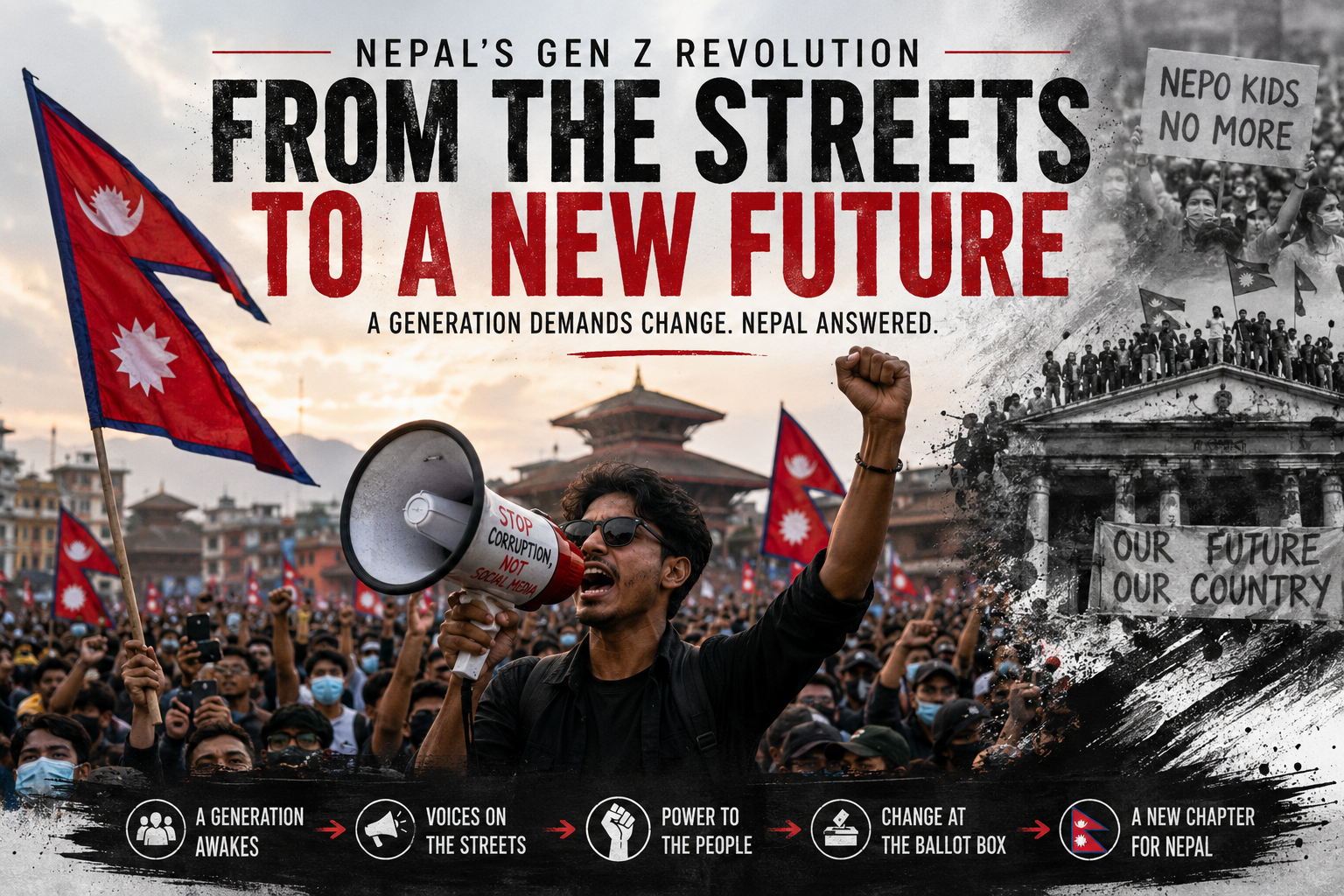
Nepal experienced one of the most dramatic political upheavals in its recent history in September 2025, when a largely youth-led protest movement—widely described as the “Gen Z Revolution” or “Gen Z uprising”—grew from demonstrations against restrictions on social media into a nationwide revolt against corruption, nepotism, political privilege and ineffective governance.
The movement was remarkably fast. Within days, Prime Minister K.P. Sharma Oli resigned, the controversial social-media restrictions were withdrawn, an interim government was established, parliament was dissolved and early elections were scheduled.
But the most important result came several months later.
On 5 March 2026, Nepal held parliamentary elections in which the Rastriya Swatantra Party (RSP) led by former Kathmandu mayor Balendra “Balen” Shah won a landslide victory. Shah subsequently became Nepal’s youngest prime minister.
The revolution therefore did something that many protest movements fail to accomplish: it moved from street demonstrations to a major change in electoral politics.
Yet its success came at an enormous human and institutional cost.
Nepal Before the Revolution
To understand why the uprising became so powerful, it is necessary to look beyond its immediate trigger.
Nepal had experienced years of political instability and public frustration following its transition from monarchy to a federal democratic republic. Governments changed frequently, while many familiar political leaders and parties continued to dominate national politics.
Among younger Nepalese, dissatisfaction was particularly strong.
Their grievances included:
- corruption;
- nepotism and political patronage;
- lack of accountability;
- unemployment and limited opportunities;
- economic inequality;
- repeated changes of government;
- frustration with established political parties;
- and the migration of large numbers of young Nepalese overseas in search of employment.
The Associated Press reported during the protests that youth unemployment was around 20 percent, while the government estimated that more than 2,000 young Nepalese were leaving the country each day seeking employment abroad.
For many young people, therefore, the problem was much larger than one government decision.
It was a growing belief that Nepal’s political system was working better for a connected elite than for ordinary citizens.
The “Nepo Kids” Campaign
Social media helped turn this frustration into a visible political movement.
In the weeks before the uprising, young Nepalese began circulating videos and posts highlighting the lifestyles of the children and relatives of politicians.
Hashtags such as #NepoKids, #NepoBabies and similar variations became popular.
Posts contrasted expensive clothes, luxury holidays and privileged lifestyles associated with political families against the economic difficulties faced by ordinary Nepalese families.
The contrast became particularly powerful because so many Nepalese depend upon family members working abroad.
Social media posts sometimes placed images of political privilege alongside images representing the sacrifices of migrant workers.
The message was simple:
How could families connected with political power live so comfortably while millions of ordinary Nepalese struggled for jobs and economic security?
The campaign transformed the abstract subject of corruption into something younger citizens could see, share and discuss.
By early September 2025, social media had therefore become an important political space.
Then the government restricted access to it.
The Immediate Trigger: Nepal Bans Major Social-Media Platforms
On 4 September 2025, Nepal blocked access to 26 major social-media and communications platforms, including Facebook, Instagram, WhatsApp, YouTube and X, after the companies failed to comply with government registration requirements.
The government argued that platforms needed to register and comply with Nepalese regulations concerning harmful content, misinformation and online offences.
The decision did not emerge entirely from nowhere; there had been regulatory and legal pressure on social-media companies to register.
Nevertheless, many young Nepalese interpreted the sweeping ban very differently.
For them, it looked like an attempt to restrict freedom of expression at precisely the moment when social media was being used to expose corruption and political privilege.
TIME reported that the shutdown coincided with the growing online campaign against political “nepo kids,” helping transform opposition to the ban into a much broader anti-corruption movement.
The government may have intended to regulate digital platforms.
Instead, it provided a common cause around which an already frustrated generation could mobilize.
8 September 2025: Gen Z Takes to the Streets
Large demonstrations began on 8 September 2025.
Young people gathered around Kathmandu’s New Baneshwar area, where Nepal’s parliament is located. Demonstrations also appeared elsewhere in the country.
Many participants were students and young citizens.
Their slogans demonstrated that the movement was already about much more than Facebook or Instagram.
One widely reported slogan captured the mood:
“Stop corruption, not social media.”
The protesters were demanding restoration of digital access, but increasingly they were also demanding:
- action against corruption;
- greater government transparency;
- political accountability;
- an end to nepotism;
- accountability for unexplained political wealth;
- political reform;
- and eventually the removal of the Oli government.
Some demonstrators also called for an independent institution capable of monitoring corruption and holding powerful officials accountable.
When the Protest Turned Deadly
The demonstrations rapidly became confrontational around parliament.
Security forces used tear gas, water cannon, rubber or kinetic-impact projectiles and eventually live ammunition.
The consequences were devastating.
According to Amnesty International’s later investigation, at least 19 people were killed and more than 300 injured during the September 8 protest in Kathmandu.
Across the broader period of demonstrations and subsequent unrest, Amnesty reported 76 deaths and more than 2,000 injuries.
Amnesty concluded that there had been widespread failures in the policing of the demonstrations and documented what it described as unlawful killings and unnecessary or excessive force, including the use of live ammunition against largely peaceful protesters.
The deaths transformed the political situation.
What had started partly as opposition to a social-media ban now became a struggle over government legitimacy and accountability for the killing of protesters.
The Government Retreats—but the Movement Continues
The government lifted the social-media ban.
Under normal circumstances, withdrawing the policy that triggered a protest might have ended the demonstrations.
It did not.
By this point, the deaths had dramatically increased public anger.
Protesters were no longer satisfied simply with getting social media restored.
They wanted political change.
Home Minister Ramesh Lekhak resigned, and pressure intensified on Prime Minister Oli.
On 9 September 2025, Prime Minister K.P. Sharma Oli resigned as the crisis escalated.
This was the decisive political victory of the street movement.
But it was also the moment when the uprising entered its most dangerous phase.
Violence, Arson and Destruction
The Nepal uprising should not be presented as entirely peaceful.
After the deadly crackdown, parts of the demonstrations descended into serious violence.
Government buildings, political offices and politicians’ residences were attacked or burned. Parliament and other important institutions were damaged during the unrest.
There were also attacks on individuals.
Amnesty International, while strongly criticizing unlawful state violence against protesters, also condemned mob violence against people and property and called for those responsible to be identified through proper investigations and fair trials.
This distinction is important.
The legitimate grievances of peaceful protesters—corruption, accountability, economic opportunity and freedom of expression—should not be confused with every act committed during the disorder.
Likewise, violence by some participants cannot justify unlawful lethal force against peaceful demonstrators.
Both issues require accountability.
From Revolution to Interim Government
With Oli’s government collapsing, Nepal faced the difficult question that confronts almost every successful protest movement:
Who governs next?
The Gen Z movement was decentralized and did not have a conventional political leadership structure.
Young activists increasingly used online platforms—including Discord—to debate Nepal’s political future and possible interim leaders.
One figure gained considerable support: Sushila Karki, the former chief justice of Nepal and the country’s first woman to hold that position.
Her anti-corruption reputation made her attractive to many protesters.
Karki became interim prime minister in September 2025.
President Ram Chandra Paudel dissolved the House of Representatives, and Nepal moved toward early parliamentary elections scheduled for 5 March 2026.
The uprising had therefore crossed an important threshold.
It was no longer merely removing a government.
It had created a path back toward democratic elections.
What Did Nepal’s Gen Z Actually Demand?
There was never a single centralized manifesto representing every protester.
That is one of the difficulties in describing the uprising as a traditional “revolution.”
Nevertheless, several broad demands consistently appeared.
1. End corruption
This was arguably the central demand.
Young Nepalese wanted political leaders and officials to be held accountable for corruption and misuse of public resources.
2. End nepotism and political privilege
The “Nepo Kids” campaign represented anger at a political culture in which connections appeared to provide wealth, influence and opportunity.
3. Protect freedom of expression
The social-media shutdown was viewed by many protesters as an attack on digital freedom and political expression.
4. Political accountability
Young people wanted leaders to face consequences for failures of government rather than simply rotating between political offices.
5. Accountability for the killings
After September 8, justice for those killed and injured became an important demand.
6. Better economic opportunities
Behind the political anger was a powerful economic issue: young Nepalese wanted opportunities to build their futures at home rather than feeling compelled to migrate abroad for employment.
7. A new political generation
Perhaps the deepest demand was not written on a single placard.
Young voters wanted to break the dominance of Nepal’s established political class.
The 2026 election would demonstrate just how powerful that demand had become.
March 2026: The Revolution Moves to the Ballot Box
Nepal held its early parliamentary election on 5 March 2026.
This became the most important test of whether the uprising represented temporary anger or a lasting political transformation.
The answer was dramatic.
The Rastriya Swatantra Party (RSP) led by Balendra “Balen” Shah won 182 of the 275 seats in the House of Representatives.
According to Nepal’s Election Commission, the RSP secured 57 proportional-representation seats alone.
The complete result gave the RSP:
125 constituency seats + 57 proportional seats = 182 seats.
The Nepali Congress finished far behind with 38 seats, while the CPN-UML won 25.
This was not merely an election victory.
It represented a massive rejection of Nepal’s traditional political establishment.
Balen Shah: From Rapper and Mayor to Prime Minister
The political symbol of the post-uprising era became Balendra Shah, widely known as Balen.
Shah had already built a reputation as an outsider.
He was trained as a structural engineer, became known publicly as a rapper and later entered politics, winning the Kathmandu mayoral election as an independent candidate.
He was particularly popular among younger Nepalese.
Although he was not a direct leader of the September street demonstrations, he publicly supported the Gen Z movement.
Following the RSP’s overwhelming election victory, President Ram Chandra Paudel appointed Shah prime minister.
On 27 March 2026, at only 35 years old, Balen Shah was sworn in as Nepal’s youngest prime minister.
A movement started largely by young people had therefore helped create a government led by the youngest prime minister in Nepalese history.
Was Nepal’s Revolution Successful?
The answer depends upon how success is defined.
If success means removing the government that protesters opposed, then yes.
Oli resigned.
If success means reversing the immediate policy that triggered the protests, then yes.
The social-media ban was lifted.
If success means forcing early elections, again the answer is yes.
Elections were held in March 2026.
If success means breaking the electoral dominance of established political parties, the evidence is even stronger.
The RSP’s 182-seat victory represented an extraordinary political realignment.
But if success means eliminating corruption, creating jobs, establishing completely accountable government and transforming Nepal’s political institutions, it is far too early to declare victory.
A revolution can remove leaders quickly.
Changing institutions is much harder.
The Human Cost of Victory
The political achievements should not obscure the tragedy.
According to Amnesty International, the wider uprising and unrest resulted in 76 deaths and more than 2,000 injuries.
Public and private property was destroyed.
Government institutions were damaged.
Security deteriorated.
Thousands of prisoners escaped during the unrest, creating additional challenges for the interim authorities.
Families lost children, relatives and loved ones.
For those families, political change cannot erase the human cost.
The revolution therefore carries two very different legacies:
democratic political transformation and profound human tragedy.
What Happened After the Revolution?
The immediate post-revolution period focused on stabilization, accountability and elections.
The interim government established mechanisms to investigate the September violence, introduced compensation for victims’ families and expanded voter registration ahead of the election.
The political consequences were enormous.
More than 800,000 new voters were registered, while younger candidates and newer political forces became increasingly prominent.
Traditional parties were forced to respond to issues that the Gen Z movement had pushed to the center of national politics:
corruption, jobs, governance and political accountability.
The March 2026 election then converted much of that public frustration into electoral power.
The Real Test Begins After the Revolution
Winning an election is easier than transforming a country.
Prime Minister Balen Shah inherited enormous expectations.
His government must demonstrate that a younger political generation can perform better than the establishment it criticized.
Among the biggest challenges are:
- reducing corruption;
- creating employment;
- strengthening public institutions;
- rebuilding trust in government;
- ensuring accountability for the protest deaths;
- maintaining democratic freedoms;
- restoring damaged infrastructure;
- improving economic opportunities;
- reducing dependence on overseas employment;
- and maintaining political stability.
There is another institutional challenge.
Although the RSP has an overwhelming majority in the House of Representatives, it does not control Nepal’s upper chamber, the National Assembly. That means the government must still cooperate with other political forces to pass parts of its legislative agenda.
The revolution gave Nepal’s younger generation political power.
Now that generation must demonstrate what it can do with it.
A Revolution of a Different Kind
Nepal’s Gen Z uprising is especially significant because it represents a modern form of political mobilization.
It did not begin with a traditional opposition party.
It did not initially have a single revolutionary leader.
It developed through:
social media → public anger → street demonstrations → government crackdown → political collapse → interim government → early elections → electoral realignment.
That sequence makes Nepal particularly interesting for other developing democracies.
Social media did not create Nepal’s underlying problems.
Corruption, unemployment, inequality and political frustration already existed.
What social media did was make those frustrations visible to millions of people simultaneously.
And when access to those platforms was restricted, the attempt to control the digital conversation helped push that conversation onto the streets.
From the Streets to Parliament
Perhaps the most important lesson from Nepal is that removing a government is not necessarily the final measure of a revolution’s success.
The crucial question is what happens afterward.
Countries can replace one ruling elite with another while leaving the underlying system unchanged.
Nepal took a different path by returning relatively quickly to elections.
The young generation that demonstrated in September 2025 was able to express its dissatisfaction again through the ballot box in March 2026.
The result was extraordinary.
A political establishment that had dominated Nepal for years suffered a major defeat, while a relatively new political force captured 182 of 275 seats.
The uprising therefore achieved something more substantial than the resignation of one prime minister.
It altered Nepal’s political landscape.
Conclusion: Revolution Won—Reform Still Unfinished
Nepal’s 2025 Gen Z Revolution began with a social-media ban, but it was never really only about social media.
Behind the demonstrations were deeper questions:
Why does corruption continue?
Why do politically connected families appear to enjoy privileges unavailable to ordinary citizens?
Why must so many young Nepalese leave their country to find opportunity?
Why are political leaders not sufficiently accountable?
And ultimately:
Can a younger generation govern differently?
The protesters achieved remarkable results.
The social-media restrictions were reversed.
The Oli government fell.
An interim administration took power.
Early elections were held.
Traditional parties suffered a historic electoral defeat.
And 35-year-old Balen Shah became Nepal’s youngest prime minister.
By those measures, Nepal’s Gen Z uprising was extraordinarily successful.
But revolutions should ultimately be judged not simply by who they remove, but by what they build afterward.
Nepal’s real test therefore begins now.
If the new political generation creates stronger institutions, reduces corruption, expands employment, protects civil liberties and delivers accountable government, September 2025 may eventually be remembered as a genuine democratic turning point.
If the same practices return under younger faces, the uprising will instead become another chapter in Nepal’s long search for political stability.
The revolution changed the government.
The election changed the political establishment.
Whether it changes the system will be the story of the years ahead.
Sources and References
- Election Commission of Nepal — Official results and seat allocation for the 2026 House of Representatives election. The commission confirmed proportional-representation seat allocations including 57 seats for the Rastriya Swatantra Party.
- UK Parliament – House of Commons Library, Nepal: 2026 legislative election and future prospects, 2 June 2026. Provides an overview of the uprising, interim political transition and final 2026 election results, including the RSP’s 182-seat majority.
- Amnesty International, Nepal: Government must ensure accountability for unlawful killings and use of force during Gen-Z protests, 8 December 2025. Investigation of police actions, protest deaths, injuries and subsequent violence.
- Associated Press, coverage of the September 2025 demonstrations and the resignation of Prime Minister K.P. Sharma Oli. Includes reporting on corruption, unemployment, political privilege and the escalation of the demonstrations.
- Associated Press, Nepal’s youngest prime minister takes the oath of office, 27 March 2026. Coverage of Balen Shah’s appointment following the RSP’s landslide election victory.
- TIME, What to Know About the Deadly ‘Gen Z’ Protests Over a Social-Media Ban and ‘Nepo Kids’ in Nepal, September 2025. Background on the social-media restrictions, “Nepo Kids” campaign and protesters’ demands.
- The Guardian, At least 19 killed in ‘Gen Z’ protests against Nepal’s social media ban, 8 September 2025. Contemporary reporting on the first day’s demonstrations, casualties and security-force response.
- Heinrich Böll Stiftung, Nepal’s Gen Z Revolution and the Politics of Visibility, 19 April 2026. Analysis of the underlying corruption and nepotism grievances, digital mobilization, women’s participation and the political consequences of the uprising.
- Inter Press Service, Nepal’s Gen Z Electoral Revolution, March 2026. Analysis of the uprising’s electoral impact, including more than 800,000 newly registered voters and increased youth participation.
- Bloomsbury Intelligence and Security Institute, After September 2025: Nepal’s Political Landscape, 3 February 2026. Analysis of the interim government, investigation of the protest violence, changing political parties and preparations for the early election.