The Lakho Human Freedom & Rights Index (LHFRI)
Published Exclusively for Lakho.com
Comprehensive Country-by-Country Assessment of Global Human Rights, Civil Liberties, and Institutional Protections.
Executive Summary & Methodology
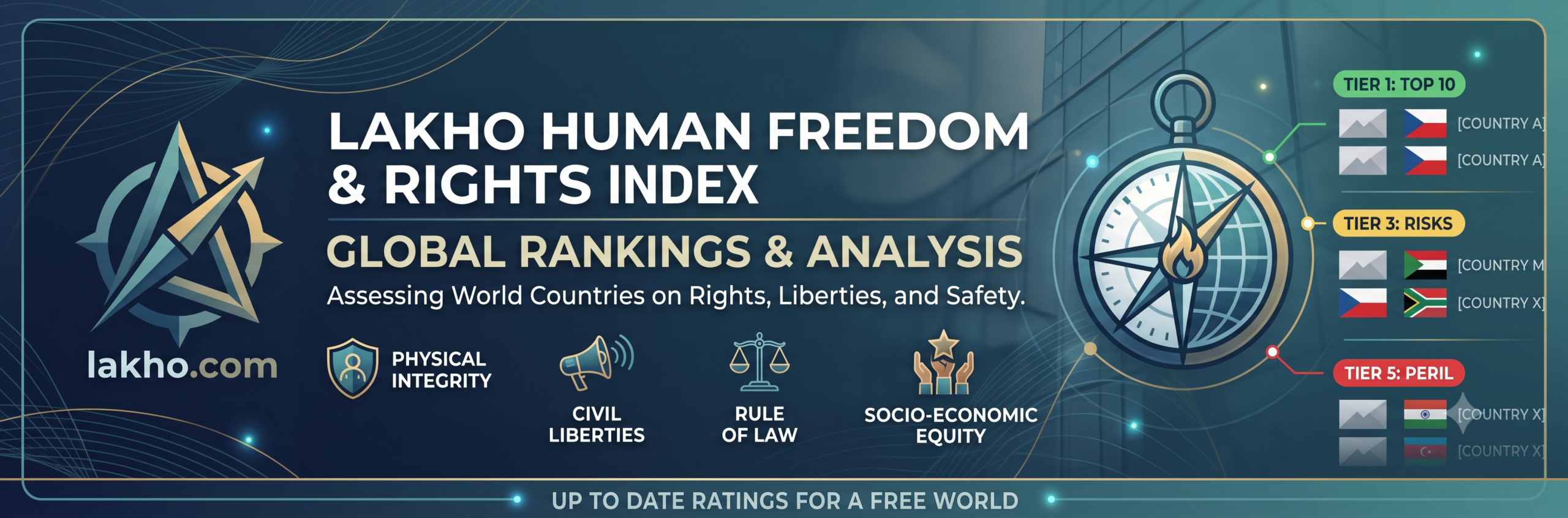
Evaluating human rights requires moving beyond superficial political labels. The Lakho Human Freedom & Rights Index (LHFRI) assesses 130 countries using a composite evaluation model. The index synthesizes data from global civil society trackers, judicial monitors, press freedom groups, and international legal repositories.
Each country receives an overall score on a 0 to 100 scale, calculated across four core, equally weighted pillars (25% each):
- Physical Integrity & Safety (25%): Freedom from extrajudicial killing, state torture, arbitrary detention, political violence, and forced disappearance.
- Civil & Political Liberties (25%): Freedom of speech, press independence, freedom of assembly, electoral integrity, and religious liberty.
- Rule of Law & Institutional Integrity (25%): Judicial independence, anti-corruption safeguards, equal protection under the law, and limits on state power.
- Socio-Economic Equity & Individual Autonomy (25%): Gender equality, worker rights, non-discrimination protections, property rights, and personal autonomy (movement, marriage, bodily autonomy).
Global Human Rights Rankings
Tier 1: Exceptional Protections (Score: 90.0–100.0)
Nations in Tier 1 feature robust judicial checks, strong protections for political and civil liberties, independent media, and minimal state repression.
| Rank | Country | Region | LHFRI Score | Key Evaluation Summary |
| 1 | Finland | Europe | 98.8 | Unmatched press freedom, judicial independence, and low corruption. |
| 2 | Norway | Europe | 98.5 | High individual safety, worker protections, and prison rehabilitation standards. |
| 3 | New Zealand | Oceania | 98.1 | Global lead in public transparency, civic participation, and indigenous rights frameworks. |
| 4 | Sweden | Europe | 97.7 | Comprehensive gender equality, social protections, and civil liberties safeguards. |
| 5 | Denmark | Europe | 97.4 | Highest rule-of-law metrics, institutional trust, and strong press protections. |
| 6 | Ireland | Europe | 96.2 | Rapid expansion of individual rights, press protections, and judicial autonomy. |
| 7 | Switzerland | Europe | 95.8 | Direct democratic checks, strong personal freedoms, and economic autonomy. |
| 8 | Iceland | Europe | 95.5 | Top global rankings for gender equality, safety, and press freedom. |
| 9 | Luxembourg | Europe | 95.1 | Strong institutional safeguards, civic freedoms, and anti-discrimination laws. |
| 10 | Netherlands | Europe | 94.7 | Pioneer in LGBTQ+ legal equality, bodily autonomy, and anti-discrimination protections. |
| 11 | Canada | Americas | 94.2 | Strong civil liberties, minority protections, and independent judiciary. |
| 12 | Estonia | Europe | 93.8 | Global leader in digital rights, information access, and transparent governance. |
| 13 | Uruguay | Americas | 92.5 | Top Latin American country in democratic stability, political rights, and secular law. |
| 14 | Australia | Oceania | 92.1 | Strong democratic mechanisms, free press, and personal safety guarantees. |
| 15 | Taiwan | Asia | 91.6 | East Asia’s most progressive nation for LGBTQ+ rights, press freedom, and open elections. |
| 16 | Belgium | Europe | 91.2 | Robust judicial protections, labor rights, and vibrant civic participation. |
| 17 | Austria | Europe | 90.9 | Solid rule-of-law baseline, strong privacy protections, and political stability. |
| 18 | Portugal | Europe | 90.5 | Progressive drug-decriminalization model, low violent crime, and strong civil rights. |
| 19 | Slovenia | Europe | 90.2 | Strong social equality metrics, press freedoms, and environmental justice protections. |
| 20 | San Marino | Europe | 90.0 | High civic participation, low state overreach, and strong civil liberties. |
Tier 2: Strong Protections with Minor Vulnerabilities (Score: 75.0–89.9)
Countries in this tier maintain overall democratic integrity and protection of rights, but face specific challenges like institutional friction, legislative overreach, or systemic inequalities.
| Rank | Country | Region | LHFRI Score | Key Evaluation Summary |
| 21 | Germany | Europe | 89.6 | Excellent rights protections; minor concerns over domestic surveillance expansion. |
| 22 | Japan | Asia | 88.7 | High personal safety; areas for improvement in LGBTQ+ equality and criminal defense rights. |
| 23 | Spain | Europe | 88.1 | Broad social liberties; occasional friction over regional political expression. |
| 24 | Lithuania | Europe | 87.5 | High civic rights; strong media protections and anti-corruption efforts. |
| 25 | Latvia | Europe | 86.9 | Strong democratic institutions; ongoing work regarding non-citizen integration. |
| 26 | Czechia | Europe | 86.4 | Strong civil liberties; minor concerns around political polarization. |
| 27 | Costa Rica | Americas | 85.8 | Central America’s model for political stability, human rights, and environmental protections. |
| 28 | Chile | Americas | 85.0 | Strong democratic baseline; ongoing reforms in indigenous representation and policing. |
| 29 | United Kingdom | Europe | 84.2 | Longstanding rights tradition; penalized for protest restrictions and public surveillance laws. |
| 30 | Italy | Europe | 83.6 | Free press and democratic elections; challenged by judicial backlogs and migrant rights policy. |
| 31 | Slovakia | Europe | 83.0 | Robust basic freedoms; recent pressures on public broadcasting and judicial reforms. |
| 32 | France | Europe | 82.5 | Strong legal protections; points deducted for police conduct during protests and secularism laws affecting religious expression. |
| 33 | South Korea | Asia | 81.8 | Vibrant democratic culture; limitations remain on national security laws and labor union actions. |
| 34 | United States | Americas | 81.0 | Broad free speech protections; reduced score due to criminal justice disparities, voting access restrictions, and political polarization. |
| 35 | Barbados | Americas | 80.5 | Strong Caribbean leader in republican governance, personal liberties, and safety. |
| 36 | Malta | Europe | 80.1 | High personal liberties; ongoing international oversight regarding media safety and judicial delays. |
| 37 | Croatia | Europe | 79.6 | Stable democratic baseline; room for growth in whistle-blower protections. |
| 38 | Panama | Americas | 79.2 | Free elections and trade freedoms; challenges in judicial corruption and social equity. |
| 39 | Cyprus | Europe | 78.7 | Solid institutional rights; complicated by island partition and migrant processing facilities. |
| 40 | Greece | Europe | 78.1 | High constitutional safeguards; docked for press monitoring incidents and border management policies. |
| 41 | Cabo Verde | Africa | 77.6 | Africa’s top tier performer in electoral integrity, civil rights, and free expression. |
| 42 | Mauritius | Africa | 77.0 | Stable democratic institution, multi-ethnic civil protections, and strong rule of law. |
| 43 | Bahamas | Americas | 76.5 | Strong civic freedoms; minor challenges regarding prison conditions and judicial backlogs. |
| 44 | Trinidad & Tobago | Americas | 75.8 | Free press and vibrant political debate; impacted by high violent crime rates. |
| 45 | Jamaica | Americas | 75.1 | Strong free expression; penalized for systemic violent crime and police accountability gaps. |
Tier 3: Moderate Risk / Hybrid Systems (Score: 50.0–74.9)
Countries where basic rights exist legally, but execution is inconsistent due to corruption, government pressure, security threats, or social tensions.
| Rank | Country | Region | LHFRI Score | Key Evaluation Summary |
| 46 | Poland | Europe | 74.5 | Active civil society; rebounding judicial independence following political transitions. |
| 47 | Romania | Europe | 73.8 | Strong EU rights baseline; ongoing struggle against institutional corruption. |
| 48 | Mongolia | Asia | 73.2 | Vibrant democratic island in Central Asia; impacted by resource governance issues. |
| 49 | Argentina | Americas | 72.5 | Strong social movements and free press; economic instability risks social rights delivery. |
| 50 | Suriname | Americas | 71.8 | Independent judiciary; modest infrastructure for protecting economic rights. |
| 51 | Ghana | Africa | 71.0 | Strong democratic transitions in West Africa; recent legislative friction on minority rights. |
| 52 | Bulgaria | Europe | 70.2 | Open political competition; media ownership concentration remains a key vulnerability. |
| 53 | Namibia | Africa | 69.5 | Press freedom beacon in Africa; inequality and land rights remain key challenges. |
| 54 | Botswana | Africa | 68.8 | Longstanding political stability; penalized for criminal justice death penalty retention. |
| 55 | Montenegro | Europe | 68.1 | NATO/EU candidate status; ongoing anti-corruption efforts and media independence struggles. |
| 56 | Brazil | Americas | 67.4 | Strong voting infrastructure; severe risks from police violence, land conflicts, and impunity. |
| 57 | South Africa | Africa | 66.8 | Progressive constitution and independent courts; undermined by high crime, corruption, and inequality. |
| 58 | Moldova | Europe | 65.9 | Active civil society; vulnerable to foreign political interference and security pressures. |
| 59 | Dominican Rep. | Americas | 65.2 | Open elections; systemic issues regarding Haitian migrant status and labor protections. |
| 60 | Colombia | Americas | 64.5 | Vibrant democracy; severe ongoing violence against human rights defenders and social leaders. |
| 61 | Georgia | Europe/Asia | 63.8 | Active public participation; sharp decline due to foreign-agent style legislation and opposition friction. |
| 62 | North Macedonia | Europe | 63.0 | Electoral competition intact; weak judicial execution and public trust issues. |
| 63 | Albania | Europe | 62.3 | Electoral democracy; persistent concerns regarding organized crime influence and press pressures. |
| 64 | Guyana | Americas | 61.5 | Rapid economic transformation; institutional safeguards trying to keep pace with growth. |
| 65 | Malaysia | Asia | 60.8 | Stable electoral system; legal restrictions on free speech, assembly, and religious converts. |
| 66 | Armenia | Asia | 60.0 | Democratic reforms since 2018; external security threats strain domestic stability. |
| 67 | Peru | Americas | 59.2 | Continuous political instability, executive-legislative deadlocks, and protest suppression. |
| 68 | Fiji | Oceania | 58.5 | Recent democratic normalization; historical legacy of military political intervention. |
| 69 | Paraguay | Americas | 57.9 | Electoral democracy; deep structural corruption and weak land rights enforcement. |
| 70 | Senegal | Africa | 57.1 | Rebounded democratic institution after election disputes; civil space remains under watch. |
| 71 | Hungary | Europe | 56.3 | EU member state with severe democratic backsliding, judicial capture, and media centralized control. |
| 72 | Indonesia | Asia | 55.5 | Large electoral democracy; penalized for criminal code updates restricting personal autonomy. |
| 73 | Philippines | Asia | 54.8 | Active press and civil society; legacy of drug-war violence and extrajudicial pressure. |
| 74 | Ecuador | Americas | 54.0 | Institutional baseline threatened by gang violence, emergency states, and security crises. |
| 75 | Bosnia & Herz. | Europe | 53.2 | Complex Dayton governance model; ethnic polarization and administrative gridlock. |
| 76 | India | Asia | 52.5 | Mass democratic participation; sharp score cuts for press freedom curbs and minority tensions. |
| 77 | Sri Lanka | Asia | 51.8 | Democratic transitions post-economic crisis; lingering military accountability issues. |
| 78 | Tunisia | Africa | 51.0 | Post-Arab Spring leader severely degraded by executive centralisation and opposition arrests. |
| 79 | Serbia | Europe | 50.4 | Candidate EU nation suffering from media dominance, electoral irregularities, and executive control. |
| 80 | Nepal | Asia | 50.0 | Federal republic transition; slow judicial resolution for civil-war era human rights claims. |
Tier 4: Severe Risks & Systemic Violations (Score: 25.0–49.9)
Nations where state oversight, restricted political competition, weak judicial systems, or active conflict severely compress basic human liberties.
| Rank | Country | Region | LHFRI Score | Key Evaluation Summary |
| 81 | Singapore | Asia | 49.2 | High physical safety and rule of law in commerce; severe restrictions on political speech, press, and assembly. |
| 82 | Kenya | Africa | 48.5 | Vibrant press and judiciary; offset by excessive police force during public protests. |
| 83 | Mexico | Americas | 47.8 | High mortality rates for journalists, systemic impunity, and cartel violence. |
| 84 | Ukraine | Europe | 47.0 | Resilience under Russian martial invasion; domestic rights impacted by martial law state of emergency. |
| 85 | Guatemala | Americas | 46.2 | Democratic survival post-elections; ongoing judicial targeting of anti-corruption prosecutors. |
| 86 | Morocco | Africa | 45.5 | Monarchy-led governance; strict limits on critical reporting regarding sensitive sovereign topics. |
| 87 | Zambia | Africa | 44.8 | Democratic transition underway; persistent economic pressures on social rights. |
| 88 | Ivory Coast | Africa | 44.0 | Post-conflict economic stability; opposition political participation remains restricted. |
| 89 | El Salvador | Americas | 43.1 | Massive reduction in violent crime; significant trade-off in mass detentions without due process. |
| 90 | Thailand | Asia | 42.4 | Active parliamentary politics; strict lese-majeste laws restrict political expression. |
| 91 | Jordan | Middle East | 41.5 | Relative regional security; restricted freedom of assembly and political party activities. |
| 92 | Nigeria | Africa | 40.8 | Vibrant media scene; plagued by security force abuses, religious conflict, and kidnapping risks. |
| 93 | Kuwait | Middle East | 39.8 | Active parliament historically; recent suspension of assembly and press limitations. |
| 94 | Angola | Africa | 39.0 | Anti-corruption reform rhetoric; tight state control on political gatherings and media. |
| 95 | Lebanon | Middle East | 38.2 | Political freedom tradition crippled by systemic state breakdown and external conflict. |
| 96 | Pakistan | Asia | 37.0 | Dynamic media and judiciary; heavy political interference, military authority, and blasphemy law misuse. |
| 97 | Algeria | Africa | 36.2 | Civic space heavily restricted following Hirak protest bans; opposition journalists detained. |
| 98 | Turkey | Europe/Asia | 35.5 | Major NATO country with centralized executive power, opposition jailing, and media controls. |
| 99 | Kazakhstan | Asia | 34.8 | Economic modernization efforts; tight limits on political opposition and unauthorized protests. |
| 100 | Iraq | Middle East | 33.9 | Competitive local elections; militia impunity, corruption, and safety threats for activists. |
| 101 | Bangladesh | Asia | 33.0 | Political volatility post-regime changes; judicial independence and police reform in flux. |
| 102 | Tanzania | Africa | 32.2 | Partial opening of political space; historical restrictions on political opposition remain. |
| 103 | Vietnam | Asia | 31.5 | Single-party state; strict economic growth paired with total suppression of political dissent. |
| 104 | Uganda | Africa | 30.2 | Longstanding executive control; severe legal crackdowns on opposition figures and minority groups. |
| 105 | Zimbabwe | Africa | 29.5 | Contested elections; harassment of civil society leaders and severe economic human rights degradation. |
| 106 | Cambodia | Asia | 28.8 | De-facto single-party state; exile or imprisonment of major political opposition leaders. |
| 107 | Rwanda | Africa | 28.0 | High public order and gender equity in parliament; tight control over political opponents and free speech. |
| 108 | Uzbekistan | Asia | 27.2 | Incremental administrative reforms; key political and media activities remain under state supervision. |
| 109 | Azerbaijan | Europe/Asia | 26.0 | Dynamic energy state; absolute suppression of domestic political opposition and independent media. |
| 110 | Egypt | Africa/M.East | 25.2 | Extensive security apparatus, tens of thousands of political prisoners, and banned opposition parties. |
Tier 5: Extreme Rights Peril (Score: 0.0–24.9)
Countries exhibiting severe state autocracy, total suppression of civil liberties, systemic torture, state-led violence, or collapse into war.
| Rank | Country | Region | LHFRI Score | Key Evaluation Summary |
| 111 | Ethiopia | Africa | 24.5 | Internal conflict, regional civil war abuses, and severe press restrictions. |
| 112 | Chad | Africa | 23.8 | Military-led dynastic transition; lethal suppression of political demonstrations. |
| 113 | Cameroon | Africa | 23.0 | Decades of single-executive rule; ongoing violence in Anglophone regions and anti-opposition crackdowns. |
| 114 | **** | Middle East | 22.2 | Modern infrastructure; zero legal political parties, strict digital surveillance, and banned labor unions. |
| 115 | Democratic Rep. Congo | Africa | 21.5 | Mass humanitarian crises in eastern regions, rebel violent displacement, and weak state protection. |
| 116 | Saudi Arabia | Middle East | 20.0 | Social reforms underway; non-existent political rights, severe anti-dissent laws, and capital punishment. |
| 117 | Venezuela | Americas | 18.5 | Total judicial capture, disqualified political opposition, arbitrary detentions, and economic collapse. |
| 118 | Mali | Africa | 17.2 | Military junta governance; suspended elections, foreign mercenary presence, and security breakdown. |
| 119 | Libya | Africa/M.East | 16.0 | Dual rival governments; human trafficking hubs, militia violence, and absence of unified rule of law. |
| 120 | Somalia | Africa | 14.8 | Federal state struggles against insurgent terror networks; severe physical integrity threats. |
| 121 | Iran | Middle East | 13.5 | Severe suppression of women’s bodily autonomy, lethal protest crackdowns, and high execution rates. |
| 122 | Nicaragua | Americas | 12.0 | Total police-state transition; stripping citizenship from political dissidents and banning civil NGOs. |
| 123 | Russia | Europe/Asia | 10.5 | Near-total elimination of independent reporting, political imprisonment, and wartime domestic censorship. |
| 124 | China | Asia | 9.2 | One-party state with pervasive surveillance, repression in Xinjiang/Tibet, and total media censorship. |
| 125 | Cuba | Americas | 8.5 | Single-party socialist republic; prohibition of political opposition, press control, and jailing of protesters. |
| 126 | Belarus | Europe | 7.0 | Autocracy dependent on political arrests, torture of opposition members, and total media censorship. |
| 127 | Eritrea | Africa | 5.5 | Totalitarian control, indefinite military conscription, no independent press, and no elections. |
| 128 | Syria | Middle East | 4.2 | Massive post-war structural destruction, displacement, political repression, and lawlessness. |
| 129 | North Korea | Asia | 2.5 | Total state control over all aspects of life, complete censorship, and state labor camps. |
| 130 | South Sudan | Africa | 0.8 | Complete collapse of institutional protections, endemic conflict, and total absence of civil rights. |
Regional Analysis & Key Takeaways
Key Insights from the Lakho Index
- The Nordic Standard: Western Europe and the Nordic region continue to define the global benchmark for human freedom, maintaining strong institutions alongside broad personal liberties.
- Democracies Under Pressure: Established powers like the United States (81.0) and the United Kingdom (84.2) maintain strong legal rights, but suffer score drops due to public assembly restrictions, criminal justice inequities, and institutional polarization.
- The Autocratic Bottom: The bottom 10 countries suffer from near-complete institutional failure or total state control, where basic individual autonomy is systematically denied.