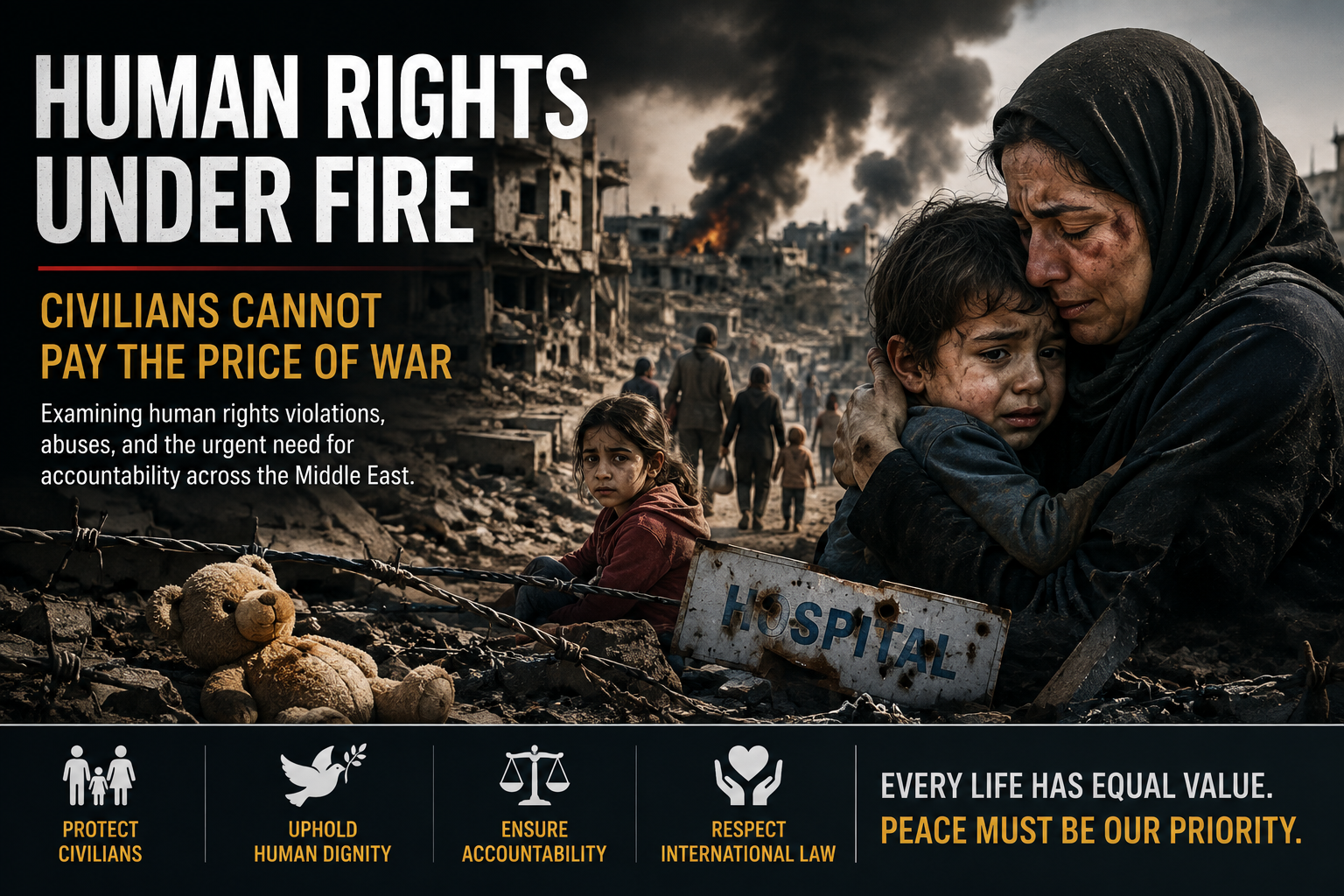
Human Rights Under Fire: Civilians Continue to Pay the Highest Price in the Middle East Conflict
For decades, the Middle East has endured cycles of armed conflict, political instability, and humanitarian crises. Yet the recent escalation across Gaza, Israel, Lebanon, the West Bank, Iran, Syria, Yemen, and neighboring regions has once again demonstrated a painful reality: civilians, not governments or armed groups, bear the greatest burden of war.
Beyond military operations and geopolitical rivalries lies a growing human rights emergency. Families have been displaced, hospitals have been damaged, schools have been destroyed, journalists and humanitarian workers have been killed, and millions of civilians continue to face insecurity, hunger, and uncertainty. International organizations have repeatedly warned that respect for international humanitarian law is deteriorating across multiple conflicts.
Civilians Must Never Be Targets
International humanitarian law, including the Geneva Conventions, requires all parties to armed conflict to distinguish between military objectives and civilians.
Reports from the United Nations, the Office of the High Commissioner for Human Rights (OHCHR), Amnesty International, and Human Rights Watch have documented allegations of unlawful attacks on civilian areas, disproportionate use of force, attacks on civilian infrastructure, and failures to adequately protect non-combatants in several conflicts across the region. Many of these incidents have prompted calls for independent investigations into possible war crimes. (United Nations)
Regardless of who commits these violations, attacks intentionally directed at civilians or carried out without sufficient precautions are prohibited under international law.
Gaza and Israel: Civilians Trapped Between War
The conflict between Israel and Hamas has produced one of the region’s gravest humanitarian crises.
United Nations investigators have reported that Palestinian civilians are caught between military operations by Israeli forces and abuses by Hamas and other Palestinian armed groups. The Commission concluded that civilians have suffered severe violations committed by multiple parties to the conflict. (United Nations)
Human rights organizations have also documented allegations involving indiscriminate attacks, hostage-taking, arbitrary detention, attacks affecting medical facilities, and restrictions on humanitarian assistance. These allegations concern different actors and require independent investigation and accountability where violations are established. (United Nations)
Lebanon: Civilian Communities Continue to Suffer
Recent fighting in southern Lebanon has left thousands displaced and caused extensive destruction to civilian infrastructure.
Amnesty International has stated that several Israeli air strikes that killed civilians, including children, should be investigated as possible war crimes. The organization has also criticized provisions in a recent political framework agreement that it argues could undermine victims’ access to justice. (Amnesty International)
At the same time, Hezbollah’s rocket attacks directed toward Israeli communities have also drawn condemnation for endangering civilians and violating the laws of armed conflict. (Le Monde.fr)
Iran and the Wider Region
The regional conflict has increasingly extended beyond traditional front lines.
Amnesty International has reported that Iranian drone strikes on civilian infrastructure in Gulf states may constitute war crimes if confirmed through independent investigations. The organization has also documented concerns about domestic repression, restrictions on freedom of expression, and arrests linked to the conflict. (Amnesty International)
Meanwhile, civilians inside Iran have experienced air strikes, infrastructure damage, water shortages, internet disruptions, and growing humanitarian hardship alongside increased internal repression, according to recent reporting and human rights observers. (The Guardian)
The Human Cost Beyond the Battlefield
Human rights violations during armed conflict extend far beyond direct violence.
Across the region, humanitarian organizations have reported concerns including:
- Forced displacement of civilian populations
- Destruction of homes and civilian infrastructure
- Damage to hospitals, schools, and places of worship
- Restrictions on humanitarian aid
- Arbitrary detention
- Abuse of detainees
- Attacks affecting journalists and medical personnel
- Psychological trauma among children
- Family separation and prolonged displacement
These consequences often persist for generations, leaving societies struggling with trauma, poverty, interrupted education, and weakened public institutions.
Accountability Cannot Be Selective
One of the most important principles of international human rights law is that accountability must apply equally to everyone.
Whether violations are committed by state armed forces, non-state armed groups, militias, or foreign actors, the law requires impartial investigations and, where appropriate, prosecution of those responsible.
Justice cannot depend on nationality, religion, ethnicity, or political alliances. Selective accountability weakens international law and undermines the rights of victims everywhere.
The Role of the International Community
Governments and international institutions face increasing pressure to move beyond statements of concern.
Human rights organizations continue to call for:
- Immediate protection of civilians
- Compliance with international humanitarian law
- Safe and unhindered humanitarian access
- Independent investigations into alleged war crimes
- Protection of journalists and medical personnel
- Release of unlawfully detained civilians
- Accountability for serious violations regardless of the perpetrator
- Renewed diplomatic efforts toward sustainable peace
Human Rights Must Never Become Casualties of War
Wars eventually end. The suffering of civilians often does not.
Every civilian life has equal value regardless of nationality, religion, or political identity. Human rights are universal—not conditional. Protecting those rights during conflict is not simply a legal obligation but a moral one.
As violence continues across parts of the Middle East, lasting peace will require more than ceasefires and political agreements. It will require justice for victims, accountability for perpetrators, and a renewed commitment by all parties to uphold the fundamental dignity and rights of every human being.
Lakho.com believes that human rights are universal. We condemn unlawful attacks on civilians, hostage-taking, torture, arbitrary detention, indiscriminate attacks, and other violations of international humanitarian law by any party to a conflict. Protecting human dignity must remain the foundation of every effort toward peace.